Bitcoin mining is one of the most misunderstood parts of the network. It's not just "making bitcoins" — it's the mechanism that keeps every transaction final and every historical record safe from tampering. This guide covers what miners actually do computationally, the economics of mining in 2026, whether individuals can still profit from home mining, and how the whole system will eventually transition to a fee-only model after 2140.
What miners actually do
A miner's job is to find a hash that meets a specific difficulty target. The process:
- The miner collects pending transactions from the mempool and assembles them into a candidate block.
- They combine the block data with a random number (a "nonce").
- They hash the whole thing with SHA-256.
- They check whether the resulting hash starts with the required number of zeros.
- If not, they change the nonce and try again. Millions of times per second.
When a miner finds a valid hash, they broadcast the block. Other nodes verify it in milliseconds and add it to their copies of the blockchain. The successful miner receives newly-minted BTC (3.125 BTC in 2026) plus all transaction fees.
For the underlying blockchain mechanics: How Does Bitcoin Work?.
Why the puzzle is hard by design
The difficulty target adjusts automatically every 2,016 blocks (~2 weeks) to keep block times averaging 10 minutes regardless of how much total mining power is running.
In 2026, the network computes ~700 exahashes per second globally — 700,000,000,000,000,000,000 hashes per second. Finding a valid hash requires that much combined effort spread across ~10 minutes.
The consequence: to rewrite Bitcoin's history, an attacker would need to redo all that work faster than the honest network can advance. The energy cost of that would be tens of billions of dollars per year. This is what makes Bitcoin secure.
ASICs and the mining hardware race
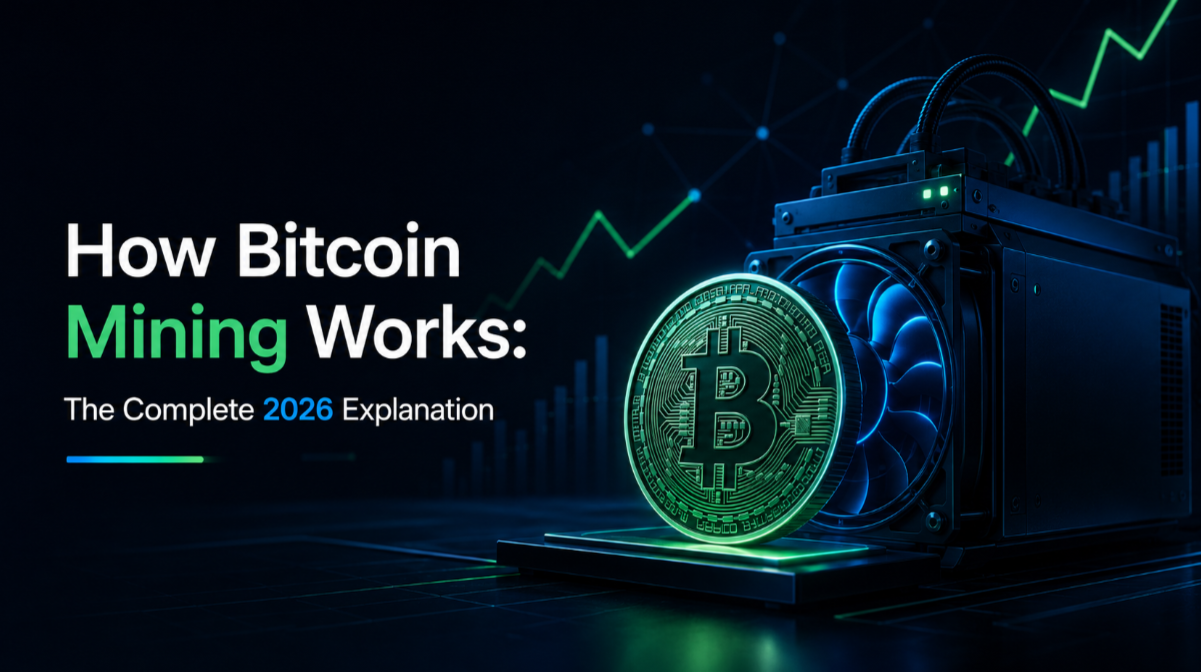
Modern Bitcoin mining is done exclusively on ASICs (Application-Specific Integrated Circuits) — chips designed specifically for SHA-256 hashing.
Rough evolution:
- 2009-2010: CPUs. Anyone could mine on a laptop.
- 2011: GPUs. 10-100x more efficient than CPUs.
- 2012-2013: FPGAs. Custom-programmed chips.
- 2013-present: ASICs. Purpose-built silicon.
Modern miners (Antminer S21 XP, Whatsminer M60S) achieve 200-400 TH/s while consuming 3-5 kW of power. Cost: $5,000-10,000 per unit. Efficiency: 15-25 joules per terahash.
The result: home mining with anything other than a modern ASIC is unprofitable. Even with an ASIC, profitability depends heavily on electricity costs.
The economics of mining in 2026
Revenue side (per miner):
- Block subsidy: 3.125 BTC per block, halves every 4 years.
- Transaction fees: varies wildly, currently ~1-5% of subsidy on average.
- Total network revenue: ~$25-50M per day depending on price.
Cost side:
- Hardware capex: $5-10k per ASIC, amortized over 2-3 year useful life.
- Electricity: 3-5 kW per ASIC, running 24/7 = 26-44 MWh per year.
- Facility costs: cooling, security, rent.
- Pool fees: 1-3% of block rewards.
Break-even electricity cost:
For a home miner running a Whatsminer M60S at Bitcoin around $65k, break-even is approximately $0.06/kWh. Above that, mining loses money to electricity alone before covering hardware costs. Average US residential rate: $0.15/kWh.
This is why modern Bitcoin mining happens in facilities near cheap power: Texas (wind, gas), Iceland (geothermal), Kazakhstan (coal), Paraguay (hydro), and increasingly at stranded-energy sites (flared gas, curtailed renewables).
Mining pools
A single home miner might solo-mine for years without ever finding a block. To smooth income, miners join pools — groups that combine hash power and split rewards proportionally.
Major pools in 2026:
- Foundry USA: largest.
- AntPool.
- F2Pool.
- ViaBTC.
- MARA Pool.
Pool concentration is a real concern for Bitcoin decentralization. The top 3-5 pools produce most blocks. Efforts like Stratum V2 aim to give individual miners more control over which transactions they include, reducing pool operators' influence.
Home mining: possible but rarely profitable
If you want to home-mine anyway:
- Buy a modern ASIC from a reputable vendor (Bitmain, MicroBT, Canaan).
- Ensure adequate electrical supply (3-5 kW per unit).
- Handle heat and noise — ASICs are loud (75+ dB) and hot.
- Join a mining pool. Solo mining a single ASIC could take decades to find a block.
- Calculate profitability at your electricity rate before committing.
Alternative uses that make home mining more viable:
- Heat recycling. Some hobbyists use miner heat to warm homes or greenhouses in winter, effectively "free" electricity.
- Solar overproduction. Households with solar excess can mine when panels overproduce.
- Hobby. Treat it as an educational cost. Do not expect profit.
The halving cycle
Bitcoin's block subsidy halves every 210,000 blocks (~4 years). Historical:
- 2009-2012: 50 BTC per block.
- 2012-2016: 25 BTC.
- 2016-2020: 12.5 BTC.
- 2020-2024: 6.25 BTC.
- 2024-2028: 3.125 BTC.
- 2028-2032: 1.5625 BTC.
- ... and so on.
Each halving cuts miner revenue in half (before price effects) and forces less-efficient miners to shut down. In practice, halvings have historically preceded major bull runs, though correlation is not causation.
What happens after 2140
When the last fraction of Bitcoin is mined (~2140), miners will be paid entirely from transaction fees. Whether fees will be enough to sustain security is Bitcoin's single largest open question.
Two possible futures:
- Optimistic: Bitcoin becomes valuable enough that even modest fees ($5-20 per transaction) provide sufficient miner revenue. The Lightning Network and other L2s reduce fee pressure on mainnet.
- Pessimistic: Fee revenue is insufficient, hash power declines, network security degrades. A soft fork adjusting monetary policy might become necessary — highly controversial in the Bitcoin community.
This transition is decades away. It matters more as a design consideration than an immediate concern.
Bitcoin mining is the exact activity that turns electricity into truth. Every unforgeable block, every irreversible transaction, every guarantee that history cannot be secretly rewritten — all backed by real work in the physical world. Understanding mining is understanding why Bitcoin works.
Related: How Does Bitcoin Work? · Proof of Stake vs Proof of Work · What Is Bitcoin?.