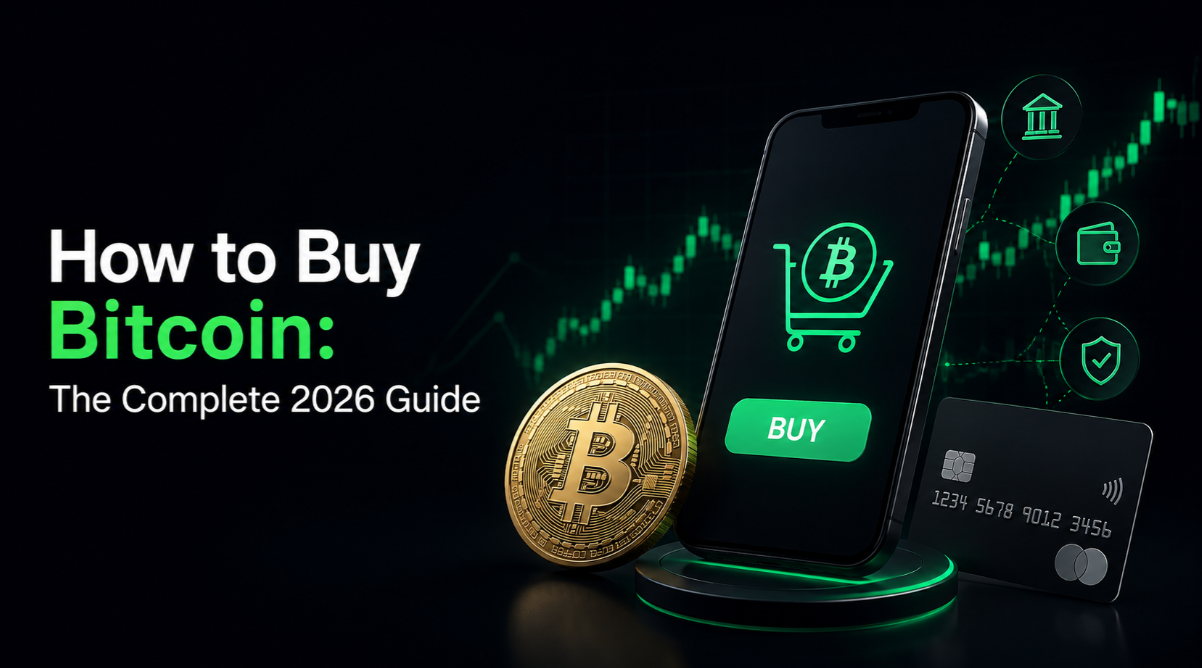
Buying Bitcoin in 2026 is straightforward: pick a regulated exchange, verify identity, fund via bank transfer, place a market order, then withdraw to a hardware wallet. This guide walks through each step in detail, with specific recommendations by region, exact payment method trade-offs, and the withdrawal process that separates real Bitcoin ownership from an IOU on an exchange balance sheet.
Before you buy: three decisions
1. How much to spend. Start with an amount you can afford to lose entirely. For a first buy, $50-500 is enough to learn the process. Treat this as educational cost, not investment.
2. What you're actually buying. Bitcoin (BTC) is one specific asset. Beware "Bitcoin Cash" (BCH), "Bitcoin SV" (BSV), "Bitcoin Gold" (BTG), "Wrapped Bitcoin" (WBTC) — these are different assets. If you want Bitcoin, buy BTC.
3. That mistakes are irreversible. On-chain transactions cannot be reversed. This is why the withdrawal step later matters so much — a single mistyped address means permanent loss.
Step 1: Pick a regulated exchange
Best options by region in 2026:
- US: Coinbase (best UX), Kraken (best security reputation), Gemini (institutional-grade).
- EU: Bitstamp (oldest EU exchange), Kraken (MiCA-compliant), Coinbase (also MiCA-compliant).
- UK: Kraken or Bitstamp — both FCA-registered.
- Canada: Kraken (regulated internationally), Bitbuy (Canadian-focused).
- Australia: Kraken, Independent Reserve, CoinJar.
For a full comparison see the best crypto exchanges 2026 guide and exchange ratings hub.
Step 2: Sign up and complete KYC
The account setup workflow:
- Register with a real email address and a strong unique password (16+ characters, generated by a password manager).
- Enable authenticator-app 2FA (Google Authenticator, Authy, or 1Password). Never SMS.
- Complete KYC: upload government ID, take a live selfie, sometimes provide proof of address.
- Wait for verification (5-30 min usually, occasionally up to 72 hours).
Do not use a VPN during KYC — flagged verifications take weeks to resolve. Do not use a fake name — you cannot withdraw funds if your account name doesn't match your bank details.
Step 3: Fund with a bank transfer
Bank transfer (ACH in the US, SEPA in the EU, Faster Payments in the UK) is the recommended funding method:
- Fees: usually free or under $1.
- Best exchange rate.
- Timing: 1-3 business days.
Debit cards are faster (instant) but cost 2-4%. Never use a credit card — banks often treat crypto purchases as cash advances with additional interest and higher fees.
Step 4: Place your buy order
Once fiat lands in your exchange account, click Buy and select BTC. Two order types:
- Market order: buys immediately at the current best price. Simplest for beginners.
- Limit order: buys only if the price reaches a level you set. Useful if you want to wait for a better price, at the risk of never filling.
For a first buy, market order is fine. Enter the fiat amount, review the estimated BTC and fee, confirm. Execution takes seconds. Congratulations — you now own Bitcoin.
Step 5: Withdraw to a hardware wallet (critical)
Coins on an exchange are IOUs. If the exchange fails, your balance vanishes. The historical record is unambiguous: even large exchanges collapse (Mt.Gox 2014, FTX 2022). See Hardware Wallets Buyers Guide for how to choose one. Withdraw with this process:
- Set up your hardware wallet. Write down the seed phrase. Store it on paper (or metal) somewhere secure.
- Copy the wallet's receive address for Bitcoin (starts with "bc1..." typically).
- On the exchange, initiate a withdrawal. Paste the address. Confirm the first 4 and last 4 characters match your wallet's display.
- Send a SMALL test transaction first ($10-20). Wait for it to confirm (10-60 minutes).
- Once the test arrives, send the rest.
Never skip the test transaction for a first withdrawal to a new wallet. A wrong character in the destination means permanent loss.
Common mistakes to avoid
- Buying "Bitcoin Cash" thinking it's Bitcoin. Two different assets. Verify the ticker is BTC.
- Using SMS 2FA. SIM-swap attacks are cheap and devastating. Authenticator apps only.
- Leaving large balances on the exchange. Exchanges fail. Get it into self-custody.
- Sending to the wrong address. Always test with a small amount first.
- Using unregulated exchanges. Higher fraud risk, no legal recourse.
- Buying via a "friend" or Telegram DM. Peer-to-peer trades to strangers are how many first-time buyers get scammed.
Alternatives to consider (mostly worse)
Bitcoin ATMs: convenient but charge 5-15% fees. Only worth it for cash-based buyers with no bank access.
Peer-to-peer platforms (Bisq, LocalBitcoins successors): no KYC, but higher fraud risk and complexity. Only for advanced privacy-focused users.
Bitcoin ETFs (US spot ETFs): convenient for retirement account exposure but you don't actually own the underlying BTC. Good for tax-advantaged accounts; suboptimal for self-custody purposes.
Payment apps (Cash App, PayPal): often can't withdraw the BTC to a self-custody wallet, or charge high fees to do so. Skip.
The 30 minutes it takes to buy Bitcoin through the regulated-exchange + self-custody workflow is one of the highest-return uses of time in personal finance. Every alternative shortcut either costs more or adds risk. Do it the boring way.
Next steps: How to Secure Your Crypto Wallet · Dollar Cost Averaging in Crypto · Building Your First Crypto Portfolio.