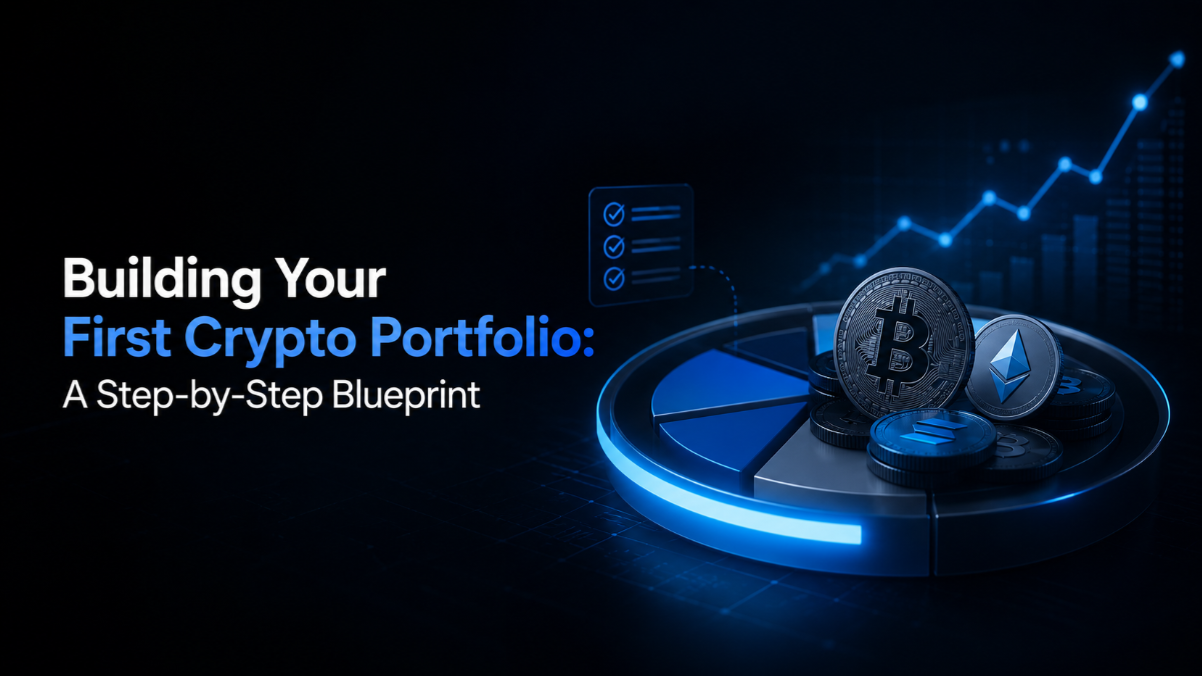
Your first crypto portfolio should be simple, small, well-secured, and boring. This guide is the exact blueprint for building it in 2026 — how to size it, what assets to hold, how to execute the purchases, how to secure everything, and how to monitor it during the first year without letting daily volatility drive bad decisions. Follow this and you will avoid the mistakes that cost most new crypto investors their capital.
The core principle for first portfolios
A first portfolio has one job: teach you the workflow while limiting downside. Everything else is optimization that can come later.
This means: simple asset selection, tiny total exposure relative to net worth, mechanical dollar-cost averaging, and strict security practices. It does not mean chasing maximum returns, exploring altcoins, or engaging in complex strategies. Those come after year one.
Step 1: Size your total crypto allocation
Before you buy anything, decide how much of your net worth belongs in crypto. For a first portfolio: 3-5% of your investable assets.
The math for a first-time investor with $50,000 in investable assets:
- Conservative: $1,500 total crypto exposure.
- Moderate: $2,500 total.
- Aggressive (for a first portfolio): $5,000 total.
Prerequisites before this step (do NOT skip):
- Emergency fund fully funded (3-6 months of expenses in cash).
- High-interest debt (credit cards) paid off.
- Retirement contributions at least matching employer.
- Health insurance in place.
Step 2: Choose your first assets
For a first portfolio, only two positions:
- Bitcoin (BTC): 80% of your crypto allocation.
- Ethereum (ETH): 20% of your crypto allocation.
Reasoning: BTC has the longest track record, deepest liquidity, strongest institutional adoption. ETH adds exposure to programmable-blockchain infrastructure. Together they represent about 60-70% of the entire crypto market cap. See Ethereum vs Bitcoin for deeper reasoning.
What NOT to include in a first portfolio:
- Any altcoin — statistically most lose 90%+ of value over 5 years.
- Meme coins — pure speculation, near-zero expected value.
- Stablecoins — you already have cash exposure through your bank account.
- DeFi tokens — high complexity, high risk. Not for beginners.
- NFTs — not a first portfolio purchase, ever.
Step 3: Choose your exchange
Region-specific recommendations for a first purchase:
- US: Coinbase or Kraken.
- EU: Bitstamp or Kraken.
- UK: Kraken or Bitstamp (both FCA-registered).
- Canada: Kraken or Bitbuy.
- Australia: Kraken or Independent Reserve.
Full walkthrough of first-time exchange setup: Your First Crypto Purchase Step-by-Step.
Step 4: Execute the purchases
The execution order:
- Sign up at chosen exchange.
- Complete KYC verification.
- Enable authenticator-app 2FA (NEVER SMS 2FA).
- Fund via bank transfer (lower fees than card).
- Once funds arrive, buy BTC and ETH in your chosen ratio using market orders.
- Wait for orders to confirm.
Two purchasing approaches:
Lump sum: invest the full amount at once. Simple. Historically produces slightly better returns because markets trend up over long horizons.
DCA: invest 1/12th of the total over 12 monthly buys. Smoother psychologically. Better if you're nervous about buying at a peak.
Both work. See Dollar Cost Averaging in Crypto.
Step 5: Set up cold storage
Within a few days of purchase, move both BTC and ETH to a hardware wallet. Do not leave meaningful amounts on the exchange.
- Buy a hardware wallet from the manufacturer's official website ONLY. Ledger Nano S Plus or Trezor Safe 3 are good starter choices.
- Set up the device following its official instructions. Generate a new seed phrase; write it down on the provided card.
- Transcribe the seed phrase to metal (Cryptosteel, Blockplate) or engraved stainless steel plate.
- Store the metal backup somewhere fire-safe and secure.
- Send a small test transaction ($5-10) from the exchange to the hardware wallet address. Confirm arrival.
- Once test confirms, send the remaining balance.
Full walkthrough: Hardware Wallets Buyers Guide and How to Secure Your Crypto Wallet.
Step 6: Set up ongoing dollar-cost averaging
If you plan to add capital over time, automate it. On your exchange, set up a recurring buy — weekly or bi-weekly — for a fixed amount. Automation prevents emotional timing decisions.
Example: $100 per week going 80/20 into BTC/ETH. Set it once, let it run for 12+ months.
Withdraw accumulated coins to your hardware wallet every 3-6 months. Do not let a large balance accumulate on the exchange.
Step 7: The first-year monitoring routine
The behavioral discipline is more important than the initial setup. Rules:
- Check portfolio weekly. Not daily. Not hourly. Weekly is enough.
- Do NOT react to daily volatility. 5-15% daily moves are normal in crypto. Ignore them.
- Rebalance quarterly. If your ratio has drifted from 80/20 by more than 25% relative (i.e., BTC now over 88% or under 65%), rebalance back to target.
- Do NOT add altcoins during bull euphoria. The urge will be strongest exactly when it's worst timed.
- Do NOT panic-sell during drawdowns. Crypto has -50% drawdowns as normal events. Selling at the bottom locks in losses.
- Read one educational article per week. Slow, steady building of understanding.
What "success" looks like in year one
The right measurement for a first year is NOT dollar returns. Success looks like:
- You made your first purchase and withdrew to self-custody.
- You held through at least one 30%+ drawdown without selling.
- You did not add any speculative positions you cannot defend.
- Your security setup is solid (hardware wallet + metal seed backup + off-site copy for larger amounts).
- You understand what you own and why.
Users who accomplish these in year one are set up for decades of successful crypto investing. Users who "win" by picking a speculative altcoin that pumped 5x are set up for eventual disaster.
Year 2+: when to add complexity
After 12+ successful months of the simple BTC/ETH portfolio, appropriate next steps:
- Consider adding a small SOL or XRP position (5-10% of crypto allocation).
- Start earning yield on stablecoins via Aave on Base or Arbitrum (small amount to learn).
- Consider ETH liquid staking via Lido or Rocket Pool (turns idle ETH into 3-5% yield).
- Explore Layer 2s with small experimental amounts.
None of these are required. Many sophisticated crypto investors hold nothing but BTC and ETH forever and do fine. Complexity is optional.
The best first crypto portfolio is one you'll still hold, unchanged, five years from now. Simple, secure, sized correctly, and boring by design. Excitement is the enemy of long-term returns.
Continue learning
Related: Crypto Portfolio Diversification · Dollar Cost Averaging in Crypto · Crypto Risk Management · Long-Term Holding vs Day Trading.