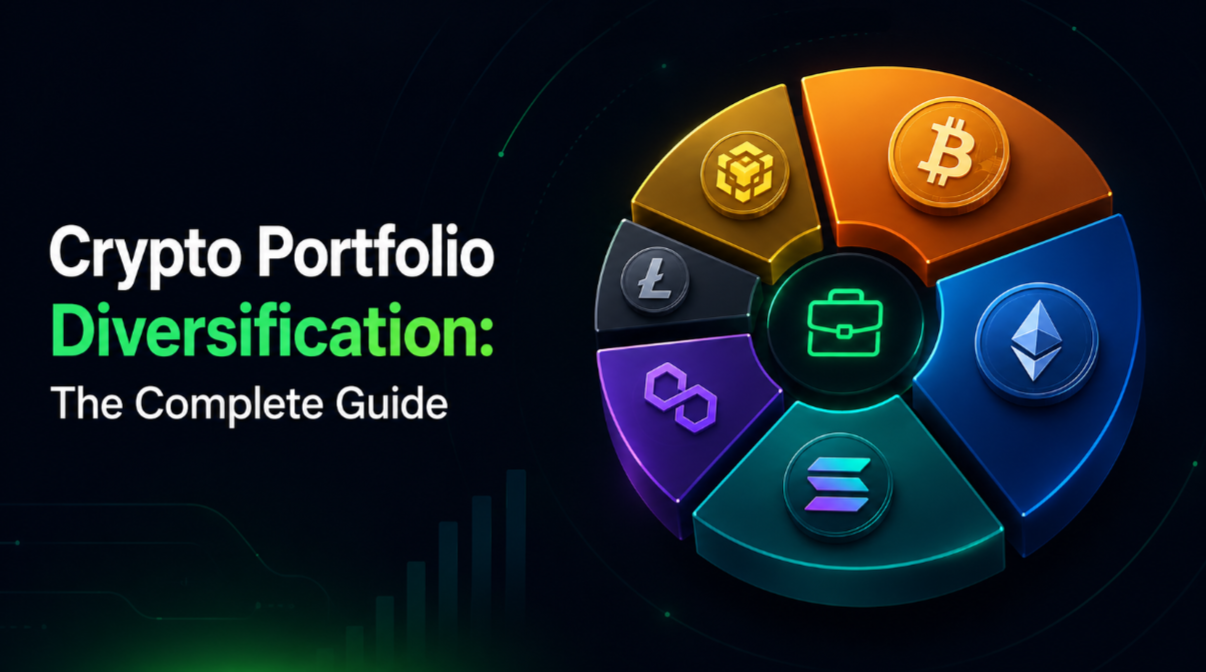
A well-diversified crypto portfolio is not just "own more coins" — it's a specific set of decisions about how much crypto to hold, how to split among assets, how to handle sector exposure, and how to rebalance across cycles. This guide walks through the frameworks used by real institutional investors and sophisticated retail traders in 2026 — with specific numbers, not vague principles. By the end you'll have a defensible allocation strategy that survives both bull euphoria and bear despair.
Step 1: How much of your net worth belongs in crypto
This is the single most important decision and the one most beginners get wrong. Sizing determines whether crypto helps or hurts your overall financial outcomes.
Rules of thumb by profile:
- Conservative (retirees, near-retirement, tight budgets): 2-5% of investable assets.
- Moderate (working professionals with stable income): 5-10% of investable assets.
- Aggressive (younger, higher income, high risk tolerance): 10-20% of investable assets.
- All-in (rarely appropriate): 25%+ — makes sense only if crypto is your career and you truly understand the risks.
Prerequisites before any crypto allocation:
- Fully funded emergency fund (3-6 months of expenses in cash).
- High-interest debt (credit cards) paid off.
- Retirement contributions maxed to at least the employer match.
- Health insurance and adequate life insurance in place.
Only after these are handled should meaningful crypto exposure be considered. Crypto is a volatile long-duration asset — it does not substitute for cash reserves or debt reduction.
Step 2: The BTC / ETH / altcoin split
Within crypto, the second decision is how to split among assets. The most defensible frameworks:
Beginner allocation:
- 80% Bitcoin
- 20% Ethereum
- Simple, high-conviction, historically strong risk-adjusted returns
Moderate allocation:
- 60% Bitcoin
- 30% Ethereum
- 10% Solana / stablecoins / opportunistic large-cap alt
- Adds some non-BTC/ETH exposure without dilution
Advanced allocation:
- 50% Bitcoin
- 25% Ethereum
- 15% Large-cap alts (SOL, XRP, or thesis-driven picks)
- 10% DeFi tokens / stablecoins for yield
For deeper reasoning on BTC vs ETH weighting, see Ethereum vs Bitcoin.
Step 3: The stablecoin reserve
Sophisticated crypto portfolios keep 10-30% of the crypto allocation in stablecoins. This is not underinvestment — it's strategic reserve.
Why stablecoins matter:
- They preserve purchasing power during bear markets when everything else drops 60-80%.
- They earn 3-8% APR on lending protocols even in flat markets.
- They provide dry powder to buy during bottoming phases.
- They reduce portfolio volatility, keeping you psychologically capable of holding through drawdowns.
See What Are Stablecoins? for the mechanics.
Step 4: The altcoin sizing problem
Beginners over-allocate to altcoins because their upside stories are more dramatic. The math punishes this approach.
Reality of altcoin returns:
- Of the top 100 altcoins from any 2020 snapshot, 60-70% are down 90%+ five years later.
- The winners often 10x+, but you almost never pick them ex ante.
- The correlation to BTC during downturns is nearly 1.0 — altcoin diversification doesn't work when it matters most.
Practical rules:
- No single altcoin position should exceed 5% of your total crypto allocation.
- Total altcoin exposure should not exceed 20-25% of your total crypto allocation.
- Every altcoin position needs a defensible thesis in writing. If you can't explain in three sentences why it will succeed, don't hold it.
- Review altcoin theses quarterly. If the thesis has broken, sell — do not "wait for it to come back."
Step 5: Sector diversification within crypto
A more sophisticated view: crypto isn't one asset class — it's several. A well-diversified portfolio has exposure to different themes:
- Store of value: BTC (dominant), some hold ETH here too.
- Smart contract platforms: ETH, SOL, and others.
- DeFi infrastructure: AAVE, UNI, MKR, LDO.
- Stablecoins: USDC, DAI, USDT — the "cash equivalent" position.
- Restaking / new primitives: thesis-driven, small position sizes.
A portfolio exposed only to store-of-value assets misses upside from DeFi growth. A portfolio only in DeFi tokens takes on much higher risk without base-layer stability. Mix.
Step 6: Rebalancing — the mechanical contrarianism
Rebalancing forces you to sell what has run up and buy what has lagged. This is uncomfortable in the moment and enormously effective over cycles.
Two approaches:
Calendar rebalancing
Every quarter (or every 6 months), return the portfolio to target weights. If BTC went from 60% to 72% during a rally, sell some BTC and buy the underweight positions. If it dropped from 60% to 48%, buy more.
Threshold rebalancing
Set drift thresholds (typically 25% relative). If a position drifts more than that from target, rebalance. Otherwise leave it alone.
Either approach works. Both share the essential property: they force you to sell high and buy low mechanically, without emotion. This is the single largest source of long-term outperformance for retail investors who use it consistently.
Step 7: Handling gains and losses tax-efficiently
Rebalancing creates taxable events. Two ways to reduce the tax drag:
- Tax-loss harvesting. When rebalancing, prioritize selling positions at a loss to offset gains elsewhere. Reduces the year's tax bill without changing your target allocation.
- New capital first. When adding new money, direct it to underweight positions rather than selling overweight ones. This rebalances toward target without creating any taxable events.
For the underlying tax framework, see Crypto Taxes: Beginner Guide.
What "not diversifying" actually looks like
Common failure modes:
- 80% of net worth in crypto because of a bull market.
- 90% of crypto portfolio in a single altcoin because "it's about to moon."
- 100% in altcoins with zero BTC exposure.
- Zero stablecoin reserves — nothing to deploy during drawdowns.
- Trying to time entries and exits instead of holding target weights.
- Ignoring position sizing rules whenever conviction is high.
Each of these is common. Each has produced life-changing losses for real people. The frameworks above are boring by design — they trade some upside for far better downside management.
The best crypto portfolio you can build in 2026 is not the one that will 100x if everything goes right. It is the one you can hold, unaltered, through both a 300% bull rally and an 80% bear crash — because it is sized correctly and diversified correctly. The all-star portfolio is worthless if you can't hold it.
Continue learning
Related: Building Your First Crypto Portfolio · Dollar Cost Averaging in Crypto · Crypto Risk Management · Long-Term Holding vs Day Trading.