
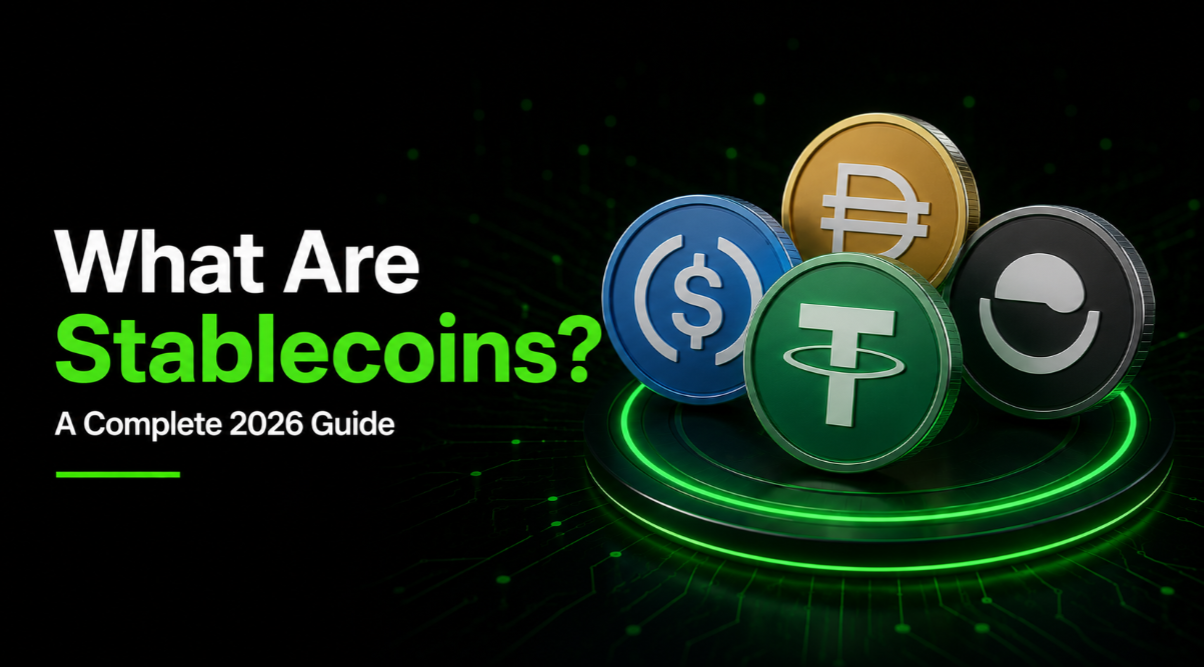
A stablecoin is a cryptocurrency designed to hold a stable value, almost always pegged to the US dollar at $1. As of 2026, over $200 billion in stablecoins circulate globally, moving hundreds of billions of dollars per day. They are the plumbing of the crypto economy — the medium of exchange most traders use, the settlement asset most DeFi protocols run on, and the on-ramp/off-ramp between traditional banking and crypto. This guide explains how they actually work, the differences between the big three (USDC, USDT, DAI), the risks you should understand, and how to earn safe yield on them.
The one-sentence definition of stablecoins
A stablecoin is a crypto token that promises to be redeemable for $1, backed by reserves that make that promise credible.
The word "backed" is doing a lot of work. Different stablecoins are backed differently — some by cash and US Treasuries, some by other crypto, some by algorithms alone. The quality of the backing determines whether the peg actually holds during stress. This is the single most important thing to understand.
The three main categories
There are three broad approaches to keeping a stablecoin at $1:
1. Fiat-backed (the majority of the market).
For every stablecoin token in circulation, the issuer holds one dollar of real assets in a bank or in short-term US Treasuries. When users redeem, they burn the token and receive real dollars. This is how USDC and USDT work. It requires trusting the issuer to maintain the reserves and to honor redemptions.
2. Crypto-backed.
The stablecoin is backed by overcollateralized crypto — for example, users deposit $150 of ETH to mint $100 of DAI. If the ETH price drops, the position is liquidated. This is more decentralized (no single company controls it) but less capital-efficient.
3. Algorithmic (mostly failed).
The stablecoin relies on smart contracts and market dynamics rather than hard reserves. This model has a bad track record. Terra's UST — once the third-largest stablecoin — collapsed from $1 to essentially zero in May 2022, wiping out $40+ billion. In 2026, the algorithmic-stablecoin category is essentially dead.
For a full comparison with an emphasis on 2026 issuers and adoption, see What Is a Stablecoin.
USDC: the institutional standard
USDC is issued by Circle, a US-regulated financial services company that filed for a public listing. Its reserves are almost entirely US Treasuries with maturities under 3 months, plus cash held at insured banks.
What matters about USDC:
- Circle publishes monthly attestation reports by major auditing firms (Deloitte).
- It is available on every major blockchain: Ethereum, Solana, Base, Arbitrum, Polygon, and more.
- It has the strongest regulatory posture of any large stablecoin — supported natively by BlackRock, MoneyGram, and dozens of banks.
- It has historically maintained the peg within 0.1% under normal conditions.
USDC did briefly depeg to $0.87 during the March 2023 Silicon Valley Bank collapse — Circle held $3.3 billion at SVB when it failed. Once the FDIC guaranteed the deposits, USDC restored the peg within days. This is the model risk: even with clean reserves, banking failures can create short-term depeg events.
USDT: the global standard
USDT (Tether) is the largest stablecoin by circulation and volume, and by a wide margin. It is issued by Tether, incorporated in the British Virgin Islands.
What matters about USDT:
- Its reserves are backed by US Treasuries, cash, and other assets, per quarterly attestations by BDO.
- It has the deepest liquidity of any stablecoin — it is the default settlement asset on almost every exchange globally.
- It has less regulatory clarity than USDC, particularly in Western jurisdictions.
- It has historically held the peg with occasional 1-2% deviations during stress events.
The practical view: USDT is functional and works. Institutional players tend to prefer USDC. Traders outside the US and Europe often prefer USDT because of broader exchange support and easier off-ramps to local currency. For long-term holdings, USDC is the more transparent choice.
DAI: the decentralized alternative
DAI is issued by MakerDAO, a decentralized protocol on Ethereum. Instead of relying on a single company holding reserves at a bank, DAI is minted when users deposit crypto (or, increasingly, tokenized real-world assets) as overcollateral.
What matters about DAI:
- The protocol has been operational since 2017 and has held peg through multiple crises.
- It is governed by MKR token holders, not a company.
- A significant portion of its backing is now real-world assets (tokenized US Treasuries), making it a hybrid model.
- It offers a native savings rate (DSR) that lets holders earn yield without lending to a third party.
DAI is the go-to for users who want stablecoin exposure without single-company custody risk. It carries different risks — smart contract vulnerabilities and governance attacks — but eliminates the "the issuer freezes your funds" risk that fiat-backed stablecoins have.
The real risks: what actually goes wrong
Stablecoins have real risks that beginners often overlook. Five categories:
1. Issuer insolvency. If the issuer's reserves are insufficient (or if audits reveal misrepresentation), the stablecoin can lose peg permanently. This is why fiat-backed stablecoin transparency matters.
2. Bank failure risk. Fiat-backed stablecoins hold reserves at banks. If those banks fail (as with SVB in 2023), the stablecoin can temporarily depeg.
3. Regulatory action. Governments can freeze stablecoin addresses. USDC has frozen thousands of addresses over the years — many for legitimate compliance reasons (OFAC sanctions), but the fact that it can happen is a risk if your address ends up on a list wrongly.
4. Smart contract risk (for DeFi-native stablecoins). DAI depends on the MakerDAO smart contracts working correctly. A protocol bug could theoretically drain reserves.
5. Algorithmic failure. For non-fiat-backed stablecoins, the peg can fail catastrophically (Terra/UST). Avoid these entirely.
For deeper risk analysis of specific stablecoins, see Are Stablecoins Safe?.
How to earn yield on stablecoins safely
One of the most attractive things about stablecoins is that you can earn yield on them — often 3-8% APR — while holding what is functionally a dollar. In 2026, the safer options:
- Aave lending on a Layer 2. Deposit USDC into Aave on Base or Arbitrum. Current yields around 3-6%. Small gas costs. Multi-year track record. See Lending Protocols Explained.
- DAI Savings Rate (DSR). The MakerDAO protocol offers a native savings rate on DAI, currently 4-8%. No third-party lending; the rate is paid from protocol revenue.
- Curve stablecoin pools. Provide liquidity to stablecoin-only pools (USDC/DAI/USDT). Yields 2-5% from swap fees, plus CRV rewards. Low impermanent loss since all pool tokens are pegged to $1.
- Money market products from regulated crypto firms. Coinbase, Kraken, and others offer USDC-earn products in supported jurisdictions. Rates are lower than DeFi (typically 2-5%) but come with regulated custody.
What to avoid: unregulated offshore platforms offering 10%+ yields, "delta-neutral" strategies you don't understand, or anything that requires locking your funds for months. History has too many examples (Celsius, BlockFi, Genesis) of platforms offering unsustainable yields that ended in insolvency.
Practical uses beyond just holding
Stablecoins solve real problems that beginners often don't realize until they encounter them:
- International remittance. Sending USDC on a Layer 2 costs cents and settles in seconds. Compare to Western Union at 5-10% fees over hours.
- Escaping local currency inflation. In countries with high inflation, holding stablecoins is functionally holding dollars — and often the only way to access dollar-denominated savings.
- DeFi settlement. Almost every DeFi transaction uses stablecoins somewhere — as the quote asset, the borrowed asset, the yield-earning asset. See What Is DeFi.
- Business payments. B2B invoices settled in USDC clear in minutes instead of days, with lower fees than SWIFT.
Stablecoins are the first crypto product that non-crypto people actually use every day. They solve real problems — cheap international transfers, savings in inflating economies, always-on payments — without asking users to speculate on token prices.
What to read next
To deepen your knowledge on the stablecoin corner of crypto: Best Stablecoins Ranked · USDC vs USDT vs DAI · How to Earn Yield on Stablecoins.
For platform reviews with an emphasis on stablecoin support: best crypto exchanges 2026 and the DeFi ratings hub.