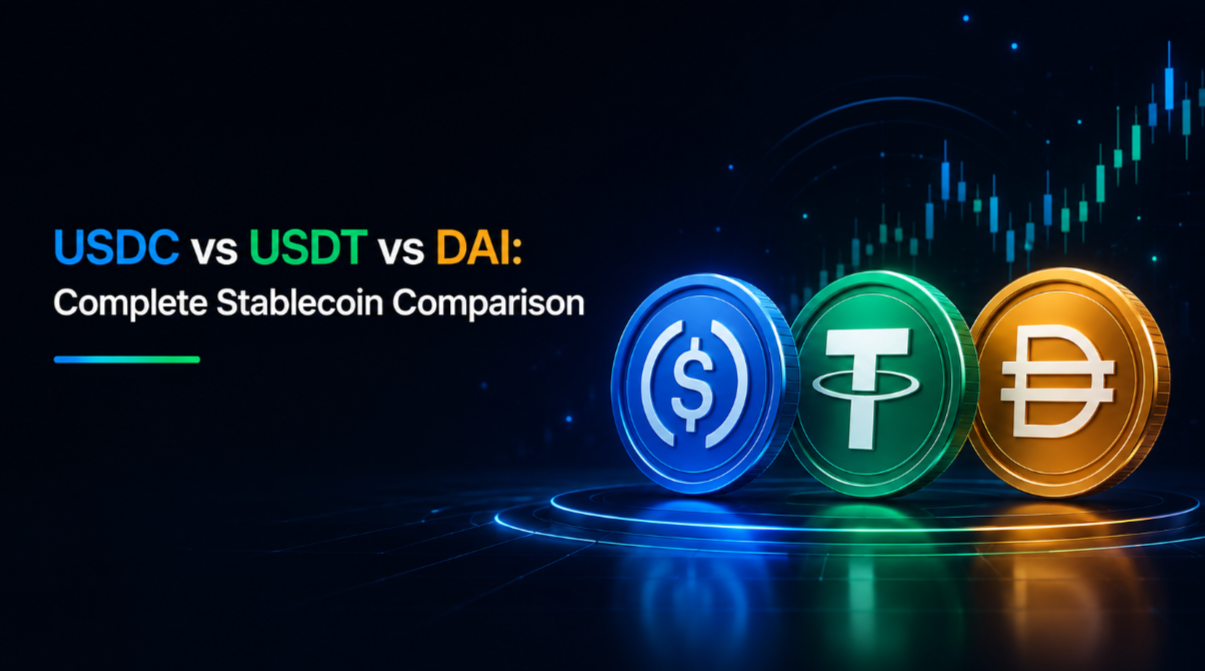
Stablecoins are the "cash" of crypto. USDC, USDT, and DAI together account for over 90% of stablecoin circulation. Understanding the differences between them matters both for personal holdings and for choosing which to accept or send. This guide gives a head-to-head comparison across peg mechanisms, regulatory status, transparency, use cases, and specific recommendations.
The three at a glance
- USDC: Issued by Circle. US-regulated. Backed by short-term US Treasuries and cash. Best transparency.
- USDT: Issued by Tether. BVI-incorporated. Backed by mix of Treasuries, cash, and other assets. Largest by market cap.
- DAI: Issued by MakerDAO smart contracts. Overcollateralized by crypto + tokenized real-world assets. Decentralized.
For the underlying category context: What Are Stablecoins?.
USDC in detail
Issuer:
- Circle, a US-regulated financial services company.
- Circle filed for a US public listing in 2024-25.
- Regulated under multiple US state money transmission licenses plus federal MSB registration.
Reserves:
- Almost entirely US Treasury securities with maturities <3 months.
- Cash at insured banks.
- Monthly attestation reports from Deloitte.
Availability:
- Native on Ethereum, Solana, Base, Arbitrum, Polygon, Optimism, and 20+ other chains.
- Preferred stablecoin for BlackRock and increasingly for institutional DeFi.
Risks:
- Bank failure risk (SVB in March 2023 caused brief depeg to $0.87).
- Regulatory action (Circle has frozen thousands of addresses per OFAC).
- Concentrated issuer risk.
USDT in detail
Issuer:
- Tether Limited, incorporated in the British Virgin Islands.
- Has faced regulatory scrutiny in multiple jurisdictions but no cessation.
- Has settled with NYAG (2021) and CFTC (2021) over past reserve representations.
Reserves:
- Primarily US Treasury bills.
- Some bitcoin holdings (~5% of reserves as of 2024).
- Some corporate bonds, secured loans, and other assets.
- Quarterly attestations by BDO.
Availability:
- Largest issuance on Tron (>50% of supply).
- Also on Ethereum, Solana, Arbitrum, Avalanche.
- Dominant stablecoin on Asian exchanges.
Risks:
- Less transparency than USDC.
- Regulatory action risk (particularly from US authorities).
- Reserve composition includes assets less liquid than pure Treasuries.
DAI in detail
Issuer:
- MakerDAO — a decentralized protocol governed by MKR token holders.
- No single company issues DAI. Users mint it by depositing collateral.
- Rebranded to Sky Protocol with USDS as the successor stablecoin (2024-25).
Backing:
- Crypto collateral (ETH, wBTC, stETH) deposited into vaults.
- Increasingly, tokenized real-world assets (US Treasuries via BlockTower, Monetalis, others).
- Overcollateralized: typically 130-170% of DAI value backs each DAI.
Availability:
- Deep integration across all major DeFi protocols.
- Widely accepted as collateral in lending platforms.
- DSR (DAI Savings Rate) offers native yield of 4-8% APR.
Risks:
- Smart contract bugs in MakerDAO.
- Governance capture (though timelock protections exist).
- Correlation risk if collateral (mostly ETH) drops sharply.
Head-to-head feature comparison
Regulatory clarity:
- USDC: strongest (US-regulated public company path).
- USDT: weaker (offshore, past disputes).
- DAI: N/A (decentralized).
Transparency:
- USDC: monthly attestations, real-time reserve dashboard.
- USDT: quarterly attestations, less detail.
- DAI: fully on-chain — anyone can inspect collateral in real time.
DeFi integration:
- USDC: deepest support on Ethereum and L2s.
- USDT: dominant on Tron; strong on Ethereum.
- DAI: universally integrated in DeFi.
CEX support:
- USDT: universal, most trading pairs.
- USDC: universal, favored by US-regulated exchanges.
- DAI: supported but usually smaller pairs.
Yield options:
- USDC: Aave, Compound, Morpho — typically 3-6% APR.
- USDT: same protocols, similar rates.
- DAI: DSR (native, 4-8%), plus Aave/Compound.
When to hold which
Hold USDC for:
- Long-term stablecoin savings (transparency matters).
- US-based accounts and regulated products.
- DeFi on Ethereum L2s.
- Business/institutional use cases.
Hold USDT for:
- Trading on Asian exchanges (where it dominates).
- Tron-based transfers (cheapest gas).
- Broad exchange compatibility.
Hold DAI for:
- Decentralized backing preference.
- DAI Savings Rate exposure.
- Reducing issuer-freeze risk.
Practical stablecoin allocation
For someone holding $10,000 in stablecoins:
- Conservative: 100% USDC (simplest, most transparent).
- Diversified: 60% USDC, 30% DAI, 10% USDT (hedges issuer risk).
- Yield-optimized: 40% USDC in Aave, 40% DAI in DSR, 20% USDT for trading needs.
Stablecoins seem interchangeable but aren't. USDC, USDT, and DAI represent three different bets: on Circle, on Tether, and on MakerDAO governance. Understanding what you're actually holding matters more than optimization for a few extra bps of yield.
Related: What Are Stablecoins? · Are Stablecoins Safe? · Earn Yield on Stablecoins.