A DAO — Decentralized Autonomous Organization — is one of the most-marketed concepts in crypto and one of the most-misunderstood. This guide gives the honest 2026 picture: what DAOs actually are, how their governance works in practice (versus in theory), why most fail, and the specific ones that have actually built durable value.
The one-sentence definition
A DAO is an organization coordinated by rules encoded in smart contracts, whose decisions are made collectively by token holders or members rather than by a traditional executive team.
The vision: transparent, democratic, censorship-resistant organizations that operate without traditional corporate structure. The reality: most DAOs are a mix of on-chain rules and off-chain human coordination, with all the messiness real organizations have.
How DAO governance actually works
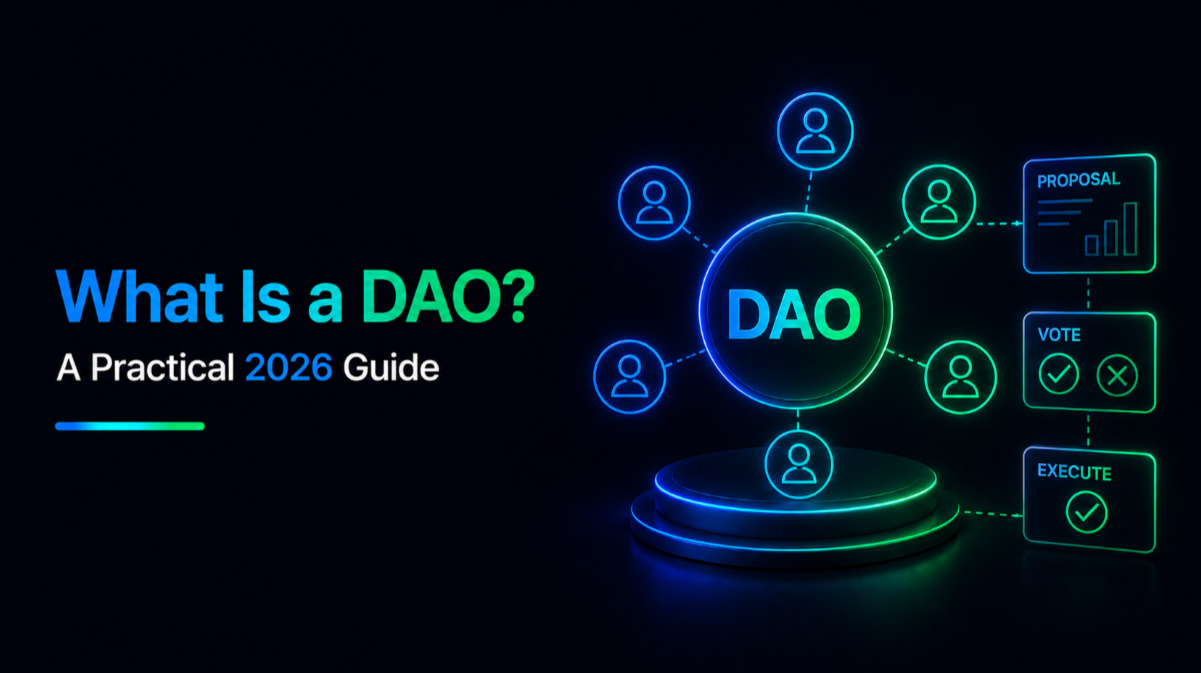
The typical lifecycle of a DAO proposal:
- Discussion. Someone raises an idea in the DAO's forum (Discourse, Commonwealth) or Discord.
- Formal draft. The idea gets written up as a formal proposal with specific details.
- Off-chain vote. A Snapshot vote gauges support without gas costs. If it fails here, the idea usually dies.
- On-chain vote. If Snapshot passed, an on-chain vote is initiated via governance contract (like Governor Bravo). Voters spend gas to vote.
- Timelock. If passed, most DAOs have a 2-7 day timelock before the proposal executes — safety window for detecting malicious proposals.
- Execution. The proposal automatically executes on-chain. Treasury spend, contract upgrade, parameter change — whatever was voted on.
The token voting model
How it works:
Token holders vote with tokens; more tokens = more votes. Typical governance parameters:
- Quorum: 5-15% of total tokens must participate for the vote to count.
- Threshold: 50-66% approval typically required.
- Proposal deposit: small amount of tokens to prevent spam.
- Voting period: 3-7 days.
Problems with token voting:
- Whales dominate (top 10 holders often control majority).
- Voter apathy (typical participation: 5-20% of holders).
- Vote buying and bribes.
- Governance attacks via flash loans (though timelock protections help).
Alternative governance models
Quadratic voting:
Voters get influence proportional to the square root of their tokens, reducing whale power. Used by Optimism's Citizens' House. Complex to implement well.
Delegated voting:
Token holders delegate their voting power to representatives who actively vote. Used by Optimism, Compound, Uniswap. Improves participation but concentrates power in professional delegates.
Multisig with community input:
A trusted group of signers executes decisions after community consultation. Less "decentralized" but more operationally efficient. Used by many DAOs' operational subcommittees.
Reputation-based voting:
Voting power based on contribution history rather than token holdings. Difficult to implement without gameable metrics. Some experiments (Colony) exist.
The DAOs that actually work in 2026
Protocol treasury DAOs (most successful category):
- Uniswap DAO: Manages billions in UNI treasury. Slow but functional governance.
- Sky Protocol (formerly Maker): Governs USDS/DAI stablecoin issuance. Longest track record.
- Aave: Governs lending protocol parameters. Active delegation ecosystem.
- Optimism Collective: Novel bicameral system with token holders + Citizens' House.
Ecosystem DAOs:
- ENS DAO: Governs Ethereum Name Service. Strong participation.
- Gitcoin: Funds public goods via quadratic funding.
Most other DAO categories have struggled:
- Venture DAOs: Attempts to make investment decisions collectively. Mostly slow and poor at picking winners.
- Social DAOs: Communities organized as DAOs. Often become paid membership groups.
- Media DAOs: Content publications governed by holders. Difficult to align with editorial quality.
Why most DAOs fail
1. Governance apathy
Most token holders don't vote. In many DAOs, 90% of holders never participate. This leaves decisions to a small active minority, undermining the democratic legitimacy the DAO was designed for.
2. Coordination costs
A DAO decision that takes weeks — proposal, discussion, voting, timelock — would take hours in a traditional company. This makes DAOs terrible at operational execution and responding to fast-moving situations.
3. Whale dominance
Token distribution rarely stays evenly spread. Founders, VCs, and early buyers accumulate large holdings. Their votes often determine outcomes despite "one token, one vote" rhetoric.
4. Lack of executive function
Even after a proposal passes, someone has to actually execute it — write the code, engage with counterparties, handle unexpected issues. DAOs often lack accountable execution.
5. Legal ambiguity
DAOs's legal status is unclear in most jurisdictions. This creates risk for contributors (personal liability), for token holders (regulatory action), and for counterparties (unclear who can sign contracts).
What makes the successful ones work
- Clear scope. They govern specific things (protocol parameters) rather than trying to run everything.
- Delegation infrastructure. Active delegates who vote regularly and are accountable to voters.
- Off-chain coordination. Working groups, elected councils, and paid contributor teams handle execution.
- Timelocks and safety mechanisms. Prevent flash-loan governance attacks.
- Real skin in the game. Contributors who genuinely benefit from protocol success.
DAOs are neither the future of all organizations (as evangelists claim) nor a failed experiment (as critics claim). They work for a specific domain — governing crypto protocols and their treasuries — and they struggle everywhere else. Understanding the difference matters for both participants and observers.
Related: What Is DeFi? · What Is a Smart Contract? · What Is Web3?.