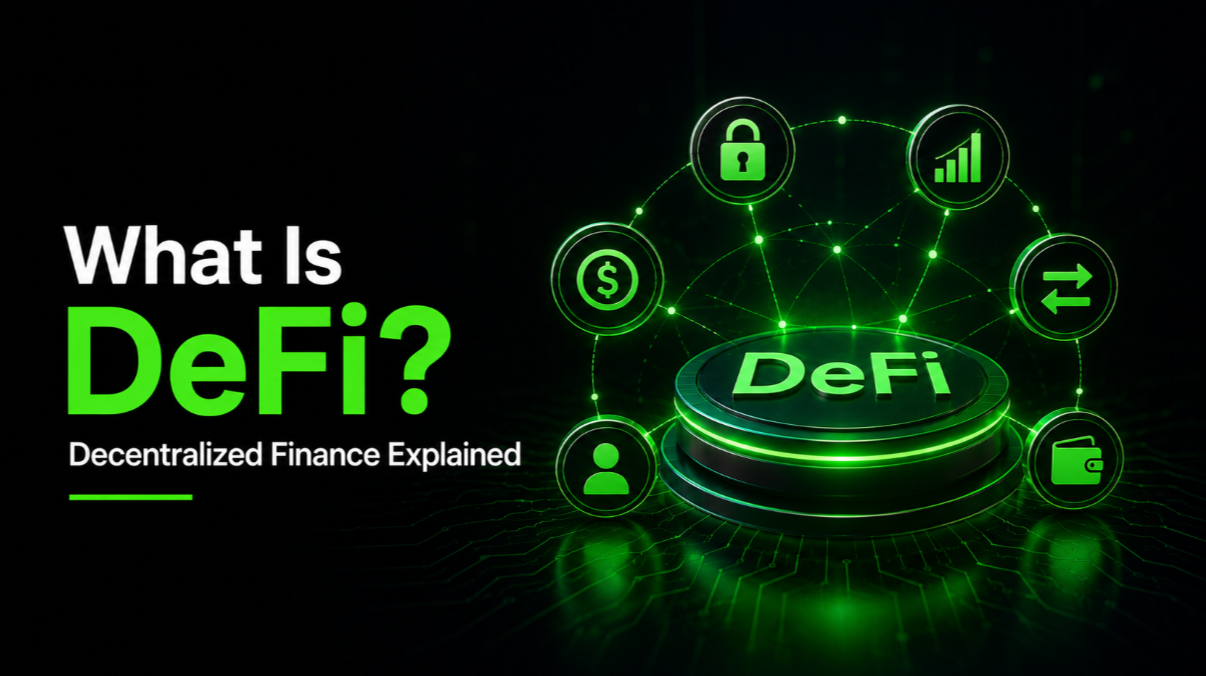
DeFi — short for Decentralized Finance — is a set of financial services that run on public blockchains without banks, brokers, or any intermediary. Lending, borrowing, trading, earning yield: all executed by smart contracts that anyone with a wallet can access 24/7. As of 2026, over $100 billion sits in DeFi protocols. This guide explains what DeFi actually is, how the major categories work, the real risks you should understand before touching it, and how to start with $50 without losing money.
The one-sentence definition of DeFi
DeFi replaces banks and brokers with smart contracts. That is the whole idea. Everything else — yields, tokens, ecosystems — is built on that foundation.
In traditional finance, if you want to borrow, you go to a bank. The bank decides whether you qualify. In DeFi, if you want to borrow, you interact with a smart contract like Aave. You post collateral, the contract lends you assets algorithmically. There is no employee. No approval process. No branch. Just code that runs on Ethereum or a Layer 2.
The four core DeFi categories
Almost every DeFi protocol falls into one of four buckets:
- Decentralized Exchanges (DEXs) — trade tokens directly from your wallet. Examples: Uniswap, Curve, Jupiter (Solana). No sign-up, no KYC. Prices set by automated formulas.
- Lending protocols — deposit crypto, earn interest. Borrow against your crypto without selling. Examples: Aave, Compound, Morpho.
- Yield / staking protocols — earn returns on your crypto in various ways. Examples: Lido (liquid staking), Pendle (yield tokenization), Ethena (delta-neutral yield).
- Derivatives protocols — trade perpetual futures, options, or synthetic assets on-chain. Examples: dYdX, Hyperliquid, GMX.
Beginners should stick to the first two categories for at least six months. DEXs and lending are the most battle-tested and lowest-risk parts of DeFi.
DEXs: swap tokens without an exchange
A decentralised exchange lets you swap one token for another directly from your wallet. There is no account, no order book, no trading firm. Instead, a smart contract holds a pool of two tokens and quotes prices via a mathematical formula (an automated market maker).
The workflow, using Uniswap as an example:
- Connect your wallet (MetaMask, Rabby, or a hardware wallet) to the Uniswap website.
- Select the token you have and the token you want.
- Enter the amount. The contract shows you exactly what you'll receive at current pool ratios, minus a small fee (usually 0.3%).
- Approve the swap. Your wallet asks you to sign the transaction and pay gas.
- Once confirmed on-chain, the new tokens appear in your wallet.
For a deeper look at how DEX pricing works, see Automated Market Makers Explained and Liquidity Pools Explained.
Lending: earn interest, borrow without selling
DeFi lending protocols like Aave and Compound work through overcollateralized loans. You deposit crypto worth $1,000, and can borrow up to about $700 worth of other assets against it. If the value of your collateral drops, the contract automatically liquidates it to repay the debt.
Why this matters:
- You can earn 2-8% yield by depositing stablecoins or major assets — often higher than a savings account.
- You can borrow against your crypto without selling it — useful for tax reasons or if you're bullish long-term but need cash short-term.
- Interest rates adjust algorithmically based on supply and demand — no negotiation, no application, no credit check.
For deep coverage of lending protocol mechanics and risks, see Lending Protocols Explained.
The real risks: what actually goes wrong in DeFi
DeFi is not risk-free. History has plenty of protocols that lost users hundreds of millions of dollars. The five main risk categories every user should understand:
1. Smart contract bugs.
The code has a flaw. An attacker finds it and drains the protocol. This has happened dozens of times, from Poly Network ($611M in 2021) to Ronin Bridge ($625M in 2022). Mitigation: use protocols with multi-year track records and multiple independent audits.
2. Oracle failures.
Protocols read prices from external sources called oracles (Chainlink is the standard). If an oracle is manipulated, positions can be wrongly liquidated or borrows can be wrongly enabled. Mitigation: prefer protocols using Chainlink or multiple oracle sources.
3. Governance attacks.
Many protocols have a governance token that lets holders vote on changes. If an attacker acquires enough tokens (through market buying or a flash loan), they can pass a malicious proposal. Mitigation: prefer protocols with vote delay periods and diverse token distribution.
4. Impermanent loss.
When you provide liquidity to a DEX pool, price divergence between the two tokens can leave you with less value than if you had just held. See Impermanent Loss Explained for the math.
5. Rug pulls.
An anonymous team launches a shiny new protocol, users deposit funds, the team drains everything and disappears. This is common in low-quality DeFi (usually new AMM pools or "yield farms" advertising 10,000% APY). Mitigation: never touch a protocol that has been live for less than a year and has no reputable investors or audits.
For a full risk playbook, see DeFi Risks Explained.
How to actually start with $50 in DeFi
Practical first steps for a beginner. Skip Ethereum mainnet — the gas fees will eat your $50. Use Base or Arbitrum instead.
- Set up a MetaMask or Rabby wallet. Add the Base or Arbitrum network to it. Both have public RPC configurations available at chainlist.org.
- Bridge $50 of ETH to your chosen Layer 2. Use the official bridge (bridge.base.org or bridge.arbitrum.io) or a service like Across or Hop. Takes 5-15 minutes.
- Swap a portion into USDC via Uniswap. Now you have some ETH for gas and some stablecoin balance to work with.
- Deposit USDC into Aave on your Layer 2. You start earning yield immediately. The gas cost is under $0.50 on L2.
- Watch what happens for a month. See your balance grow. Check the interface daily. This is the "feel" of DeFi — you now understand the mechanic in a way no article can teach.
After a month of watching, you have earned about $0.30 of interest on $50. Not exciting. But you have learned the workflow with real money at scale you can afford. Now you can scale up.
What to avoid as a DeFi beginner
These are the traps that consume most first-year DeFi users:
- "Yield farms" advertising 500%+ APY. These are almost always Ponzi mechanics. The yield exists only until new deposits stop.
- Anonymous team + < 6 months old. If you cannot find a real name behind the project, do not deposit funds.
- Unaudited protocols. Every reputable DeFi protocol has multiple independent audits published publicly. If they are not on the website, walk away.
- Cross-chain bridges you have never heard of. Bridges are the most-hacked category in crypto. Use only the biggest ones (LayerZero, Wormhole, Across, official rollup bridges).
- "Approve unlimited spend" popups. Approving unlimited token spend for an unknown contract gives it permission to drain that token from your wallet forever. Approve exact amounts only when possible.
DeFi is not about beating traditional finance yields. It is about permissionless access — anyone in the world can use the same tools as sophisticated investors. That access is the innovation. The yield is downstream.
Where to go from here
The next articles in your DeFi learning path: Yield Farming Explained · Liquidity Pools Explained · DEX vs CEX · Best DeFi Wallets.
For editor-tested reviews of specific DeFi platforms, see the DeFi ratings hub.