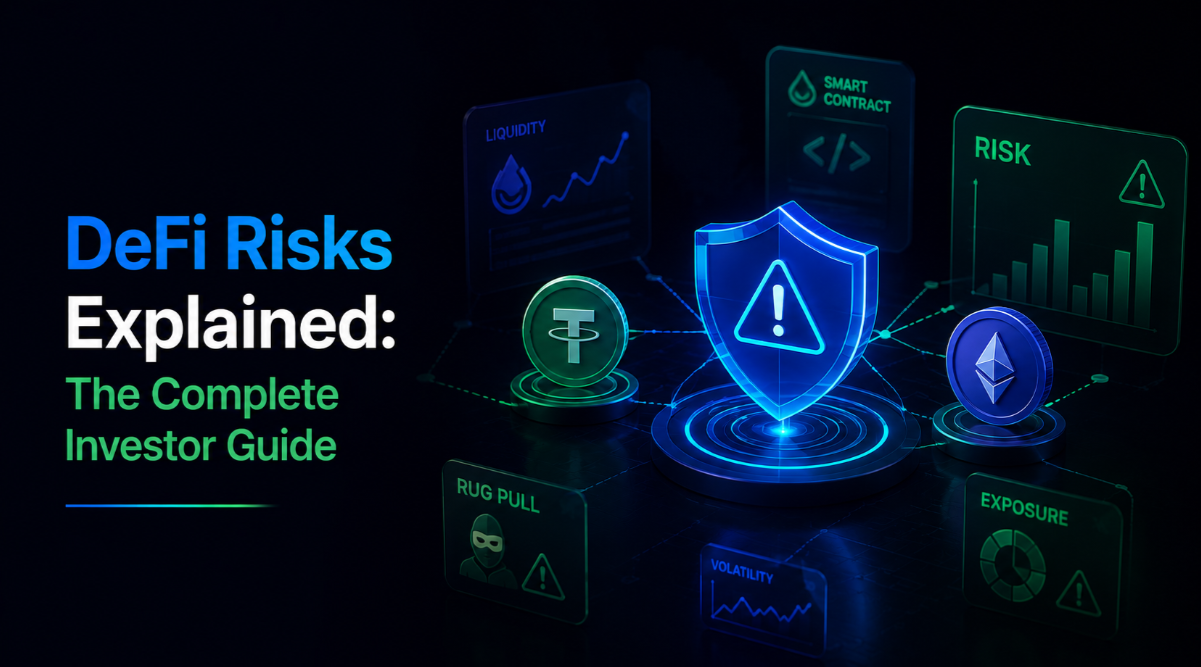
DeFi has generated real yield for millions of users and lost billions to exploits. Understanding the actual risks is what separates users who compound returns over years from those who blow up in a single incident. This guide covers every major DeFi risk category with specific examples, the due-diligence framework professional DeFi users apply before deploying capital, and the protocols currently considered blue-chip in 2026.
The five risk categories
1. Smart contract exploits
Bugs in protocol code that let attackers drain funds. The most common failure mode.
Notable losses:
- Ronin Bridge (2022): $625M via compromised validator keys.
- Poly Network (2021): $611M via signature verification flaw.
- Wormhole Bridge (2022): $325M via signature verification exploit.
- Euler Finance (2023): $200M via donation-attack pattern.
- Curve pools (2023): $70M via Vyper compiler bug.
Mitigation: use protocols with multi-year track records, multiple audits (Trail of Bits, OpenZeppelin, Consensys Diligence, Certora), active bug bounties, and transparent post-mortems on past incidents.
2. Oracle failures
Many protocols read prices from external oracles (Chainlink is the standard). If an oracle reports a wrong price, positions can be liquidated wrongly or borrows can be enabled at unrealistic collateralization.
Mango Markets (2022) lost $110M via oracle manipulation. Multiple smaller protocols have had similar failures.
Mitigation: prefer protocols using Chainlink or multiple oracle sources. Avoid protocols using single low-liquidity DEX pools as their oracle.
3. Governance attacks
Many protocols have governance tokens that vote on protocol changes. If an attacker acquires enough tokens (through market buys or flash loans), they can pass malicious proposals — including proposals that drain the treasury.
Beanstalk (2022) lost $182M via governance flash loan attack in a single transaction.
Mitigation: prefer protocols with vote delay periods (timelocks) on treasury actions and diverse token distribution. Avoid protocols where a few whales dominate governance.
4. Bridge risk
Cross-chain bridges have been the single most-hacked category in crypto history. When you bridge assets, you deposit them into a smart contract on chain A and receive a synthetic asset on chain B. The security depends on the bridge's specific model.
Bridge hacks total over $2.5B since 2020. Poly Network, Ronin, Wormhole, Nomad, Harmony — all major bridges have been drained.
Mitigation: for large amounts, use only the biggest, most-audited bridges (LayerZero, Across, official rollup bridges). For smaller transfers, canonical bridges (bridge.arbitrum.io, bridge.base.org) are safest.
5. Rug pulls
Anonymous teams launch a new protocol, users deposit funds, the team drains everything and disappears. Common in "yield farm" launches promising 500%+ APY.
Estimated cumulative losses to rug pulls: $10B+ since 2020, spread across thousands of small protocols.
Mitigation: avoid protocols younger than 12 months. Avoid protocols with anonymous teams. Verify audits actually exist and were from reputable firms.
Second-order risks
Composability risk
DeFi's biggest feature — protocols can integrate with each other — is also a risk. If protocol A has a bug that affects protocol B that affects protocol C, a single exploit can cascade.
Liquidation risk
Borrowing against collateral means the position can be liquidated if collateral value drops below the loan threshold. Sudden price crashes have liquidated even conservatively-sized positions during flash crashes.
Regulatory risk
DeFi regulation is evolving. Protocols may be forced to add KYC, block certain addresses, or shut down entirely. This creates ongoing uncertainty for user positions.
Slashing / stake risk (for staking derivatives)
If you hold stETH via Lido, and Lido validators get slashed, your stETH loses value. Not zero, but not negligible either.
The due-diligence framework
Before depositing to any DeFi protocol, verify:
- Age. How old is the protocol? Anything under 12 months is high-risk. 3+ years is meaningfully safer.
- Track record. Has it survived a major crypto cycle without incidents? Has it recovered gracefully from any past bugs?
- Audits. Multiple audits from reputable firms (Trail of Bits, OpenZeppelin, Consensys Diligence). Read the audit reports.
- Team. Public team members with real identities, LinkedIn profiles, and track records.
- TVL and adoption. $100M+ TVL suggests real usage. Beware TVL concentrated in a few wallets.
- Governance. Timelocks on treasury actions. Diverse token distribution. Transparent proposals process.
- Bug bounties. Active bounty on Immunefi or similar, ideally with meaningful payouts ($1M+ for critical bugs).
- Insurance. Optional coverage available via Nexus Mutual, Unslashed, or InsurAce.
The blue-chip DeFi protocols in 2026
The protocols institutional investors consider safest:
- Aave: Lending. Founded 2017. Multiple V1→V2→V3→V4 upgrades. Multi-billion TVL across chains.
- Uniswap: DEX. Founded 2018. V1→V2→V3→V4. Largest by trading volume in most months.
- Curve: Stablecoin DEX. Founded 2020. Battle-tested. Central to stablecoin liquidity.
- Lido: Liquid staking. Founded 2020. Largest ETH staking pool.
- MakerDAO / Sky: DAI/USDS issuance. Founded 2017. Longest-running DeFi protocol.
- Compound: Lending. Founded 2018. Original DeFi lending protocol.
None of these are risk-free. All have had incidents at some point. But they represent the highest-conviction DeFi holdings.
Portfolio-level risk management
At the portfolio level:
- Never concentrate all DeFi exposure in one protocol.
- Diversify across chains (Ethereum mainnet, L2s, Solana) so single-chain failures don't wipe everything.
- Keep the DeFi allocation as a percentage of your crypto allocation, and your crypto allocation as a percentage of net worth. See
- Crypto Portfolio Diversification
- .
- Consider protocol insurance for large positions.
- Regularly revoke stale approvals via revoke.cash.
DeFi risk is not "should I use it or not?" — it's "how much, and in what?" Understanding the risk categories, applying the due-diligence framework, and sizing appropriately turns DeFi from a lottery ticket into a reasonable component of a diversified crypto portfolio.
Related: What Is DeFi? · Yield Farming Explained · Common Crypto Scams · Crypto Risk Management.