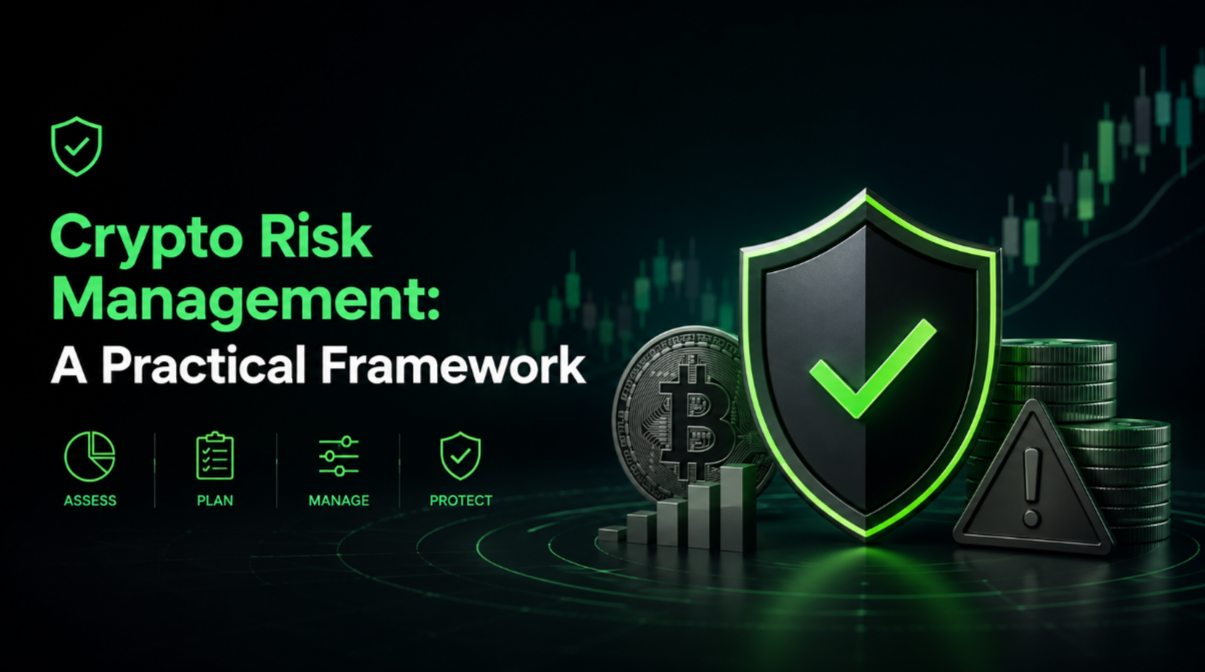
Risk management is what separates crypto investors who survive multiple cycles from those who blow up in one. This guide covers the practical framework: position sizing, stop-loss discipline, security posture, protocol risk, and the specific behavioral rules that make the difference between reaching your 10-year crypto goals and losing it all in a single bad quarter. None of this is exciting. All of it works.
The core principle
The goal of risk management is not to maximize returns. It is to ensure you are still investing 10 years from now.
Every retail investor who blows up in crypto ignored this. They chased maximum returns without any tail-risk buffer, took on leverage they couldn't afford, or over-concentrated in a single asset. When something inevitably went wrong, they were forced out permanently. The investor with modest returns but no ruinous drawdown compounds. The investor with spectacular returns punctuated by 90% losses does not.
Rule 1: Never risk what you can't afford to lose
The single most important rule. Define a percentage of net worth you're willing to see go to zero, and treat that as your ceiling.
- Cash reserves (3-6 months of expenses): sacred. Do not touch for crypto.
- Retirement contributions to at least employer match: sacred.
- High-interest debt (credit cards): pay off first.
- Everything above that: crypto-eligible, sized appropriately.
The forbidden inputs:
- Borrowed money (credit cards, personal loans, home equity).
- Rent, groceries, medical, or education funds.
- Money for a specific short-term goal (down payment in 2 years).
- Money you'd need to sell during a bear market to cover expenses.
The reason: crypto can drop 60-80% over a 12-24 month bear market. If you're forced to sell during that drawdown, you lock in life-changing losses. If your holdings are truly discretionary, you can wait out the recovery.
Rule 2: Position sizing before every trade
Every position size should be pre-decided by policy, not emotion. Blank framework:
- Core holdings (BTC, ETH): up to 60% and 30% of crypto allocation respectively.
- Large-cap alts (SOL, XRP): 3-10% per position, 20% max in aggregate.
- Mid-cap thesis-driven (DeFi tokens, sector picks): 1-3% per position, 10% max in aggregate.
- Small caps and speculative bets: 0.5-1% per position, 5% max in aggregate. Treat as expected zero.
- Stablecoin reserve: 10-30% of crypto allocation.
For the full portfolio framework, see Crypto Portfolio Diversification.
Rule 3: Define your exit before entry
Before opening any active trading position, know:
- Target price where you take profit (or partial profit).
- Stop-loss price where you cut the position.
- Time horizon after which you review.
- Position size (as % of portfolio).
Writing this down in advance prevents the emotional trap of "just holding a bit longer" during losses or "letting the winners run" past your original target. Both feel logical in the moment; both destroy long-term returns for most traders.
For long-term holders
The "exit plan" is different — usually no stop-loss (30-50% drawdowns are normal), but a systematic rebalancing rule that trims positions when they exceed target weights.
Rule 4: Security posture as risk management
Security failures are the #1 uncompensated risk in crypto. Your investment thesis being correct doesn't help if you get phished or your exchange collapses.
The security minimum for any meaningful crypto position:
- Hardware wallet for cold storage. See
- Hardware Wallets Buyers Guide
- .
- Seed phrase on metal, geographically distributed, tested annually.
- Authenticator-app 2FA on every exchange (never SMS).
- Separate email for crypto accounts.
- Whitelisted withdrawal addresses on exchanges.
- Awareness of the
- common crypto scam playbooks
- .
The cost is a few hours and $100 in devices. The prevention value is your entire holdings.
Rule 5: Protocol and counterparty risk
Every place your crypto sits is a risk:
- On a centralized exchange. Exchange insolvency risk. Mitigation: only use top 5-10 regulated exchanges, keep active balances small.
- In a DeFi protocol. Smart contract risk. Mitigation: use protocols with multi-year track records, multiple audits, active bug bounties. See DeFi Risks Explained.
- In a "crypto interest account". Counterparty credit risk. Celsius, BlockFi, and Genesis all offered similar products and all failed. Extreme skepticism warranted.
- In a hardware wallet. Physical loss risk. Mitigation: seed phrase backup as covered above.
The rule: no single risk exposure should be so large that its failure ruins you. A user with $100k split across 3 protocols and a hardware wallet survives a single protocol failure. A user with $100k in one hot yield farm does not.
Rule 6: Never use leverage until you've been through a full cycle
Leverage — margin trading, perpetual futures, liquidation-risk borrowing — magnifies both gains and losses. In crypto's 30-70% weekly volatility, leverage is fatal for most retail participants.
- 10x leverage means a 10% adverse move liquidates you.
- Crypto has 10% moves multiple times per week.
- You will be liquidated. It is a question of when, not if.
- The exchanges know this — leverage products are a fee-extraction mechanism.
Serious traders sometimes use modest leverage (2-3x) with strict rules. Retail traders should not. If you must experiment, start with 0.5% of net worth and firm mental commitment to zero it out.
Rule 7: Behavioral rules matter more than analytical ones
The single largest source of retail investor losses is not bad analysis — it is emotional decisions during market extremes.
Rules that address behavioral failures:
- Reduce checking frequency. Check portfolio weekly, not hourly. Constant checking triggers action; action is usually wrong.
- Rebalance mechanically. Calendar or threshold rules, not "when it feels right."
- Wait 24 hours before big decisions. "I'm going to buy $10k more" or "I'm going to sell everything" — force a 24-hour wait. Most emotional decisions look silly after 24 hours.
- Document your thesis. Written positions are harder to abandon than mental ones. Rewriting your thesis when it changes forces you to acknowledge what happened.
- Talk to someone. A trusted friend or partner familiar with your setup provides sanity checks that solo decision-making does not.
The specific traps that catch experienced investors
- "This time is different." It never is. Cycles repeat in different-looking clothes.
- "I need to catch up." Chasing missed moves is the source of most tops-bought.
- "I'm going to double down here." Averaging down on losing thesis-driven bets is how convictions become ruinous.
- "I know this project." Insider information is often wrong or already priced in. Familiarity is not analysis.
- "Just this once." One exception becomes ten. Discipline requires zero exceptions.
Risk management is not about avoiding all risk. It is about ensuring the risks you take are ones you can survive, in sizes that let compounding do its work. The most successful crypto investors are not those with the highest peak returns — they are those whose losses never crossed the ruin threshold.
Continue learning
Related: Crypto Portfolio Diversification · Building Your First Crypto Portfolio · Common Crypto Scams · DeFi Risks Explained.