Crypto markets have moved through remarkably consistent 3-4 year cycles since Bitcoin's early days. Understanding these cycles — what phase we're currently in and what typically happens next — is one of the highest-value skills a crypto investor can develop. This guide covers the four phases in detail, historical performance across cycles, what drives each phase, and how sophisticated investors position without falling into the emotional traps that catch most retail participants.
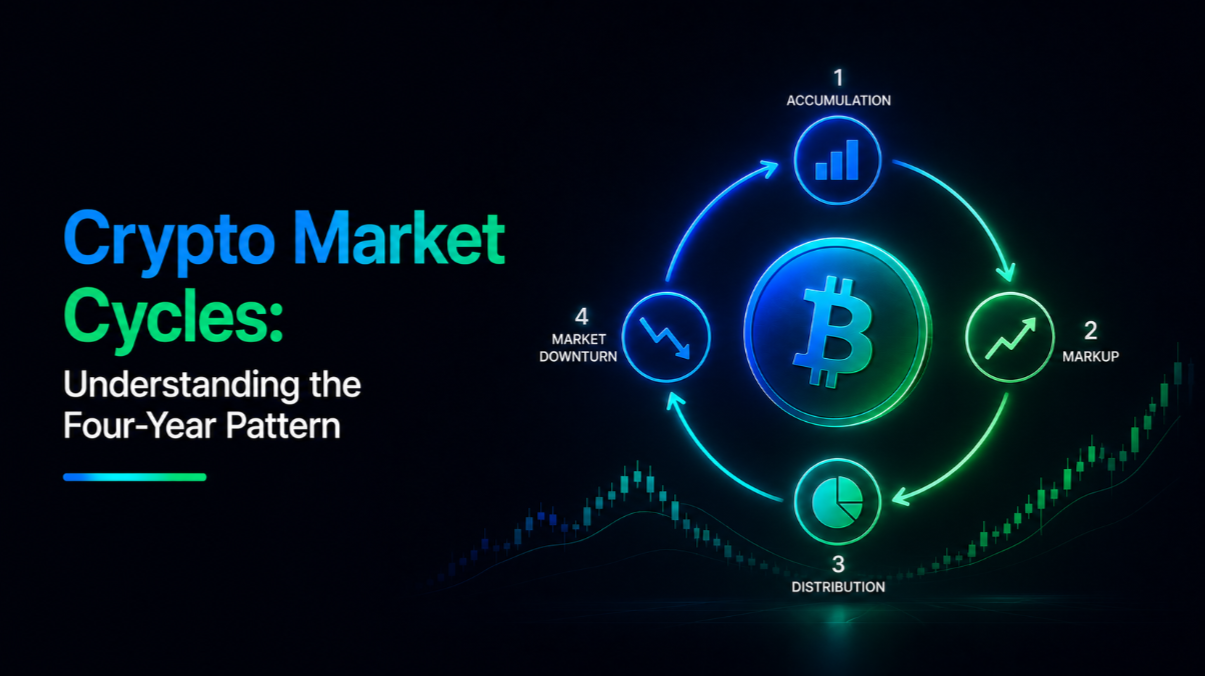
The four phases
Phase 1: Accumulation
- Post-bear low. Prices stabilize after months of decline.
- Volume is low. Media coverage is minimal or negative.
- Most previous cycle's retail buyers have capitulated and left.
- Long-term holders quietly accumulate. Smart money DCA.
- Duration: 6-18 months typically.
Phase 2: Early bull
- Prices begin grinding up on low volume.
- Media coverage returns cautiously.
- Long-term holders continue accumulating. Some early retail returns.
- BTC dominance is often high — money flows to majors first.
- Duration: 6-12 months.
Phase 3: Bull market
- Momentum builds. Volume expands.
- Media coverage becomes positive, then breathless.
- Retail flood in. Altcoins outperform Bitcoin.
- Institutional players make announcements.
- Prices rally 100-500%+ across the phase.
- Duration: 8-16 months.
Phase 4: Euphoric top and bear
- New coins pump on nothing. Everyone is bullish.
- Mainstream news coverage of crypto rich stories.
- Institutional flows peak. Retail piles in near tops.
- Then: sharp correction, cascade of leverage liquidations.
- Bear market: 12-24 months. Drawdowns of 70-85% from peaks.
Historical cycles reviewed
Cycle 1 (2011-2013):
- BTC: $2 (2011 low) → $1,150 (2013 peak) = +57,000%.
- Then to ~$150 by 2015 = -87% drawdown.
Cycle 2 (2015-2017):
- BTC: $150 → $20,000 = +13,200%.
- Then to $3,200 = -84% drawdown.
Cycle 3 (2018-2021):
- BTC: $3,200 → $69,000 = +2,050%.
- Then to $15,500 = -77% drawdown.
Cycle 4 (2022-2025+):
- BTC: $15,500 → past $100k in 2024.
- Ongoing at time of writing.
Note: percentage rallies have decreased each cycle as market cap has grown. Drawdowns have decreased slightly. Bull runs have shortened, bears have shortened. The pattern persists in shape but not in magnitude.
The Bitcoin halving connection
Bitcoin's block reward halves every 210,000 blocks (~4 years):
- 2012 halving: 50 BTC → 25 BTC.
- 2016 halving: 25 → 12.5.
- 2020 halving: 12.5 → 6.25.
- 2024 halving: 6.25 → 3.125.
Each halving has been followed by a major bull run within 6-18 months. The connection is debated:
- Supply narrative: reducing new issuance creates supply shock, driving prices up.
- Coincidence: four-year cycles may be driven by other factors (Fed cycles, tech cycles) that happen to align with halvings.
- Reflexivity: the halving becomes a Schelling point for expectations, causing traders to buy in anticipation.
Whatever the actual mechanism, halvings have preceded bulls with remarkable consistency. Whether this continues in future cycles remains to be seen.
How to position across the cycle
Accumulation phase:
- DCA aggressively. This is when you build your long-term position.
- Focus on BTC and ETH. Avoid speculative altcoins.
- Ignore the boredom — this is when smart money buys.
Early bull phase:
- Continue DCA. Position should already be established.
- Consider small allocations to top altcoins if you understand them.
- Do NOT sell yet — the bull has more room.
Bull phase:
- Hold. Trim slightly if positions become concentrated.
- Rebalance mechanically (quarterly).
- Take some profit off the table as prices exceed your original targets.
- Increase stablecoin reserves gradually.
Euphoric top / early bear:
- Trim more aggressively.
- Move gains to stablecoins earning yield.
- Do NOT try to catch the exact top — nobody does.
- Prepare for the coming bear market by having dry powder.
Bear phase:
- Do NOT panic sell.
- Continue DCA when it hurts most — this is where accumulators are made.
- Ignore hostile coverage. The narrative always turns bearish at bottoms.
The behavioral mistakes to avoid
- Buying tops. Retail typically enters heavily during phase 3-4, exactly when experienced investors are trimming.
- Selling bottoms. Retail typically capitulates in phase 5 (bear), locking in maximum losses.
- Chasing altcoins during phase 3. Altcoins rally hardest at cycle tops, then lose 90%+ into bear markets. Most never recover.
- Believing "this time is different." The specific narratives change; the cycle shape doesn't.
- Trying to time the exact top or bottom. Nobody has done this consistently. Mechanical rules beat gut decisions.
Will cycles continue in the future?
The dampening thesis:
Institutional adoption (ETFs, corporate treasuries, banking integration) is bringing more diverse capital and longer time horizons. This could reduce cycle amplitude — future drawdowns might be 30-50% rather than 80%+.
The persistence thesis:
Retail participation remains dominant globally. Leverage products are more accessible than ever. Reflexive dynamics haven't gone away. Cycles could continue with similar magnitude for another decade or more.
Prudent view: cycles likely continue for at least this decade, possibly with slowly dampening amplitude. Do not bet the portfolio on either "cycles are dead" or "cycles will be identical."
Understanding crypto's cycle structure is what separates the investor who compounds through multiple cycles from the one who buys near tops and sells near bottoms repeatedly. The pattern is not a secret — it's been visible for over a decade. What's hard is emotional discipline through the extremes.
Related: Bull vs Bear Market · Crypto Portfolio Diversification · Long-Term Holding vs Day Trading.