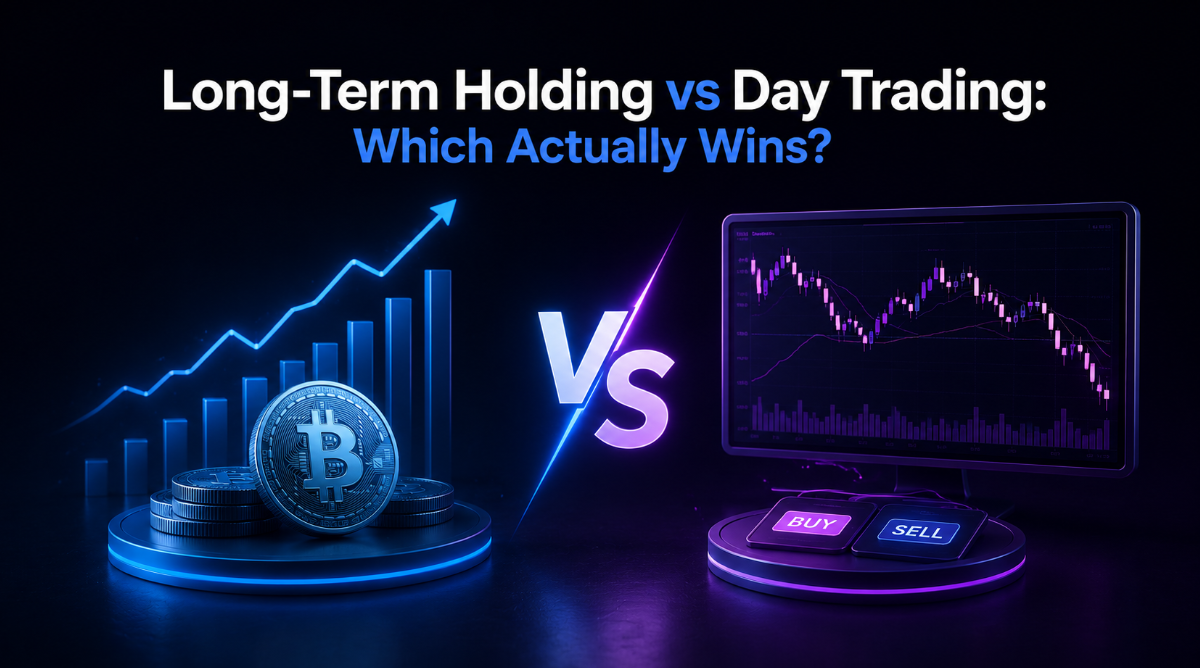
The debate between long-term crypto holding and active day trading has strong opinions on both sides. This guide brings actual data to the question: what retail traders earn on average, what long-term holders earn, when each approach makes sense, and how to structure a hybrid portfolio if you insist on trying both. Spoiler: for 90%+ of retail participants, holding beats trading. But the case is more nuanced than either camp usually admits.
The data on retail trader performance
Across markets — stocks, forex, and crypto — retail day trader performance data is consistently bad.
- A widely-cited Brazilian study of day traders showed 97% lost money over 300+ days of trading.
- US broker data (RobinHood, Interactive Brokers) shows the median retail day trader underperforms an S&P 500 index by 5-10% annually.
- Blockchain analytics on crypto traders show even worse results: 70-80% of active accounts have negative net returns over any 6-12 month window.
- The dispersion is extreme: a small minority makes outsized returns; the majority loses.
Survivorship bias makes trading look better than it is. Successful traders publish content, teach courses, and get media attention. Failed traders quietly stop trading. The public perception of trader success is dramatically higher than reality.
Why holding usually wins in crypto specifically
1. Long-term price appreciation is exceptional.
BTC and ETH have delivered strong multi-year returns since inception. Any strategy that has you out of the market during major upswings structurally underperforms holding.
2. Trading friction compounds.
Fees (0.1-0.5% per trade), spreads (0.05-0.2%), slippage (variable), and taxes (short-term rates on frequent trades) add up to 2-5% annually of assets traded. Over 5 years this is 10-25% of capital eroded.
3. Emotional decisions during volatility.
Crypto's 30-50% drawdowns test everyone. Traders make more decisions during these periods, and the decisions tend to be wrong (selling low, buying high). Holders make no decisions during drawdowns — the discipline is enforced by strategy.
4. Time in market > timing the market.
Missing the 10 best days in any 5-year crypto period cuts returns dramatically. The best days often follow the worst days (traders who capitulated at the bottom missed the recovery). Simply being invested continuously captures these.
When trading might make sense
1. You genuinely enjoy market analysis.
If chart-reading and macro analysis are hobbies you'd do anyway, trading with a small portion (5-10% of crypto allocation) can be reasonable — the education has value even if returns are negative. Treat it as entertainment spending.
2. You have specific edge.
Rare but real: some traders have edges in specific niches (funding rate arbitrage, MEV, specific altcoin categories). If you can articulate your edge and back-test it rigorously, trading can work. This is not most people.
3. Tactical hedging of large positions.
A holder with $500k in BTC might use small perp futures shorts to hedge specific short-term risks without triggering capital gains taxes on the underlying. This is technically "trading" but is really risk management, not alpha generation.
4. You're very early career and time is your biggest asset.
A 22-year-old with a small portfolio can afford to lose it all in trading experiments while learning skills that might pay off in career trajectory. The absolute dollar cost is low; the potential learning is high.
The most defensible hybrid approach
If you want to have some active exposure while protecting the core:
- Long-term core: 90-95% of crypto allocation. BTC and ETH. Cold storage. Never traded.
- Trading sleeve: 5-10% of crypto allocation. In a separate exchange account, kept mentally separate.
Rules for the trading sleeve:
- Never top up after losses. When it's gone, it's gone.
- Never use funds from the core to expand the trading sleeve.
- Withdraw profits (if any) to the core position quarterly.
- Treat losses as tuition. Do not chase losses.
- Track every trade in a spreadsheet. Review quarterly for lessons.
- If the sleeve grows to more than 15% of total crypto allocation, take profits back to core.
This structure lets you enjoy trading without exposing your foundational wealth. Most hybrid participants find that after a year, they either (a) discover they enjoy holding more, or (b) confirm they're not skilled traders and stop.
The mistakes traders make that holders avoid
- Over-leveraging. Any leverage in crypto's volatility environment eventually liquidates you. Holders never face this.
- Emotional revenge trading. After a loss, doubling down or making bigger trades. Holders don't.
- Chasing headlines. Trading on news is competing with algorithms that priced it in seconds ago. Holders ignore news.
- Overtrading during boredom. Making trades to feel productive. Holders default to no action.
- Underestimating tax drag. Every trade is a taxable event. Holders defer taxes indefinitely (in most jurisdictions).
The holder mistakes that traders sometimes avoid
To be fair — holding is not without its failure modes:
- Ignoring cycle tops. A hold-forever mentality can leave you exposed to full 80% bear drawdowns. Sophisticated holders trim into euphoria without becoming full traders.
- Emotional attachment. Long-term positions can become identity. This makes rational rebalancing harder.
- Concentration risk. Multi-year holds can grow into dangerously large positions relative to total wealth. Trimming is prudent.
The sophisticated holder rebalances mechanically (quarterly or on threshold breaches), trimming positions that have grown too concentrated. This captures gains without becoming a full trader.
The tax reality
In most jurisdictions, tax treatment massively favors long-term holding:
- US: Long-term capital gains (holdings > 1 year) taxed at 0-20%. Short-term gains taxed as ordinary income (up to 37%).
- UK: Annual capital gains allowance for holdings; frequent trading may be treated as trading income at higher rates.
- EU (varies): Many countries have holding-period exemptions or lower rates for long-term positions.
A trader making 50% gross returns might net 25-30% after taxes. A holder making 30% gross might net 26-28%. The gap between trading and holding shrinks significantly after taxes.
For full tax framework: Crypto Taxes Beginner Guide.
The evidence is unequivocal: for 90%+ of retail participants, buy-and-hold beats active trading in crypto. The exception is the small fraction with genuine edge, professional infrastructure, or specific hedging needs. If you're not in one of those categories, holding is not "the boring option" — it is the empirically superior strategy.
Continue learning
Related: Dollar Cost Averaging in Crypto · Crypto Risk Management · How to Read Crypto Charts · Building Your First Crypto Portfolio.