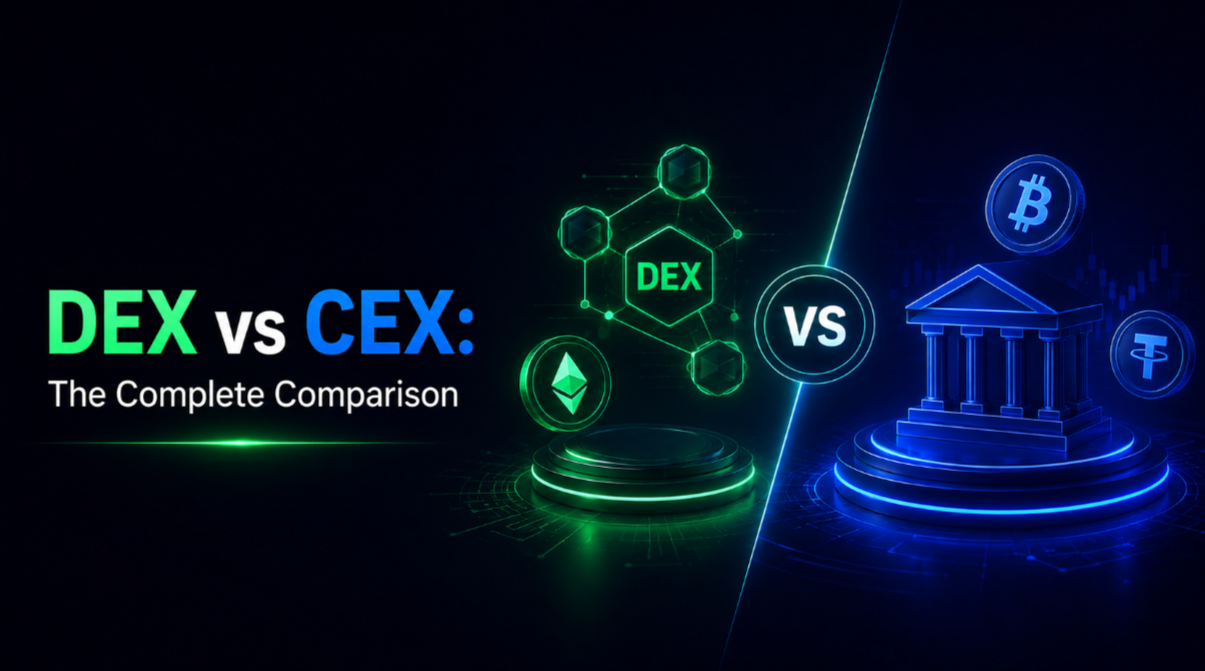
Centralized and decentralized exchanges answer the same question — how do I trade crypto? — with very different architectures. This guide compares them head-to-head across security, custody, fees, listings, and UX. By the end you'll understand when to use each, and why most sophisticated crypto users routinely use both.
The core architectural difference
CEX (Centralized Exchange)
- A company operates the exchange (Coinbase, Kraken, Binance, Bitstamp).
- You create an account with email + password + KYC.
- You deposit crypto to the exchange's wallets; they hold it on your behalf.
- Orders match against other users' orders on an internal order book.
- The exchange is regulated in its jurisdiction, must comply with local laws.
DEX (Decentralized Exchange)
- A smart contract on a blockchain (Uniswap, Curve, Balancer, Jupiter on Solana).
- You interact directly from your wallet — no account, no KYC.
- You never deposit — the smart contract holds funds only for the duration of your swap.
- Orders match against a liquidity pool via an automated pricing formula (not an order book).
- Nobody operates it; the code runs autonomously.
For the underlying mechanics of DEX pricing, see Automated Market Makers Explained and Liquidity Pools Explained.
Custody: the biggest difference
On a CEX, you hold an IOU — a claim against the exchange's balance sheet. If the exchange fails, gets hacked, or freezes your account, you may lose access to your funds. Mt.Gox (2014, $500M lost), QuadrigaCX (2019, $190M lost), FTX (2022, $8B+ lost), Celsius (2022, $12B locked) — the pattern repeats.
On a DEX, you retain custody the entire time. The smart contract holds funds for the seconds of a swap, then returns them to your wallet. Nobody can freeze your account. Nobody can seize your funds.
This is why "not your keys, not your coins" is fundamental. For long-term holdings and any meaningful amount, DEX + self-custody wallet beats CEX.
Security comparison
CEX security failures:
- Exchange insolvency or fraud (FTX, Celsius).
- Regulatory freezes (accounts locked for months during investigations).
- Hacks of exchange hot wallets (Mt.Gox, Bitmart, KuCoin).
- Individual account compromises (weak 2FA, SIM-swap).
DEX security failures:
- Smart contract bugs (Curve pools drained June 2023).
- User signing malicious transactions (phishing).
- Front-end compromises (attacker swaps the legitimate frontend for a phishing clone).
- Rug pulls on newly-listed tokens (specific to trading unknown tokens, not the DEX itself).
The pattern: CEX risk concentrates catastrophically (billions lost in a single failure). DEX risk distributes more granularly (specific protocols or trades affected).
Fee comparison
CEX fees (typical 2026):
- Trading: 0.1-0.5% per side (maker/taker).
- Withdrawal: fixed fee per token.
- Deposit: usually free (bank transfer), 2-4% (card).
DEX fees:
- Swap fee: 0.05-0.3% per swap (goes to liquidity providers).
- Gas fee: variable (cents on L2, dollars on Ethereum mainnet).
- Slippage: implicit cost for large trades against small pools.
For small trades on Ethereum mainnet, CEX is often cheaper (gas dominates). For any trade on Layer 2 or Solana, DEX is often cheaper. For very large trades (>$100k), aggregators splitting across pools can match or beat CEX pricing.
Token access
CEX: trades a curated list. Coinbase supports ~200 tokens; Binance ~500. Any listing goes through a gatekeeping process.
DEX: trades any token that has a liquidity pool. This means access to hundreds of thousands of tokens — including new launches, memecoins, and long-tail assets. Also includes scams and rug pulls freely.
For early-stage tokens and long-tail exposure, DEX is the only option. For blue-chip tokens (BTC, ETH, SOL, XRP), both work.
UX and complexity
CEX UX:
- Familiar to anyone who has used a stock brokerage.
- Password reset, customer support, dispute resolution.
- Mobile apps with polished interfaces.
- Direct fiat integration.
DEX UX:
- Requires wallet setup, understanding of gas fees.
- No customer support — mistakes are permanent.
- Web-first (mobile is improving via WalletConnect and injected wallets).
- Fiat requires a separate on-ramp service.
By 2026, the DEX experience has improved dramatically (account abstraction, gasless transactions on some L2s), but the gap to CEX simplicity remains real for total beginners.
How sophisticated users combine both
A common workflow:
- Fiat on-ramp via a CEX (Coinbase, Kraken).
- Withdraw to a self-custody wallet (MetaMask, Rabby, Ledger).
- Bridge to an L2 (Base, Arbitrum).
- Trade on DEXs for anything not available on the CEX, or for DeFi participation.
- Bridge back and off-ramp via CEX when converting to fiat.
This maximizes custody control (most time on DEX/self-custody) while using CEX where it's genuinely better (fiat conversion).
When to prefer CEX
- First-time crypto purchase.
- Fiat on/off ramp.
- Large market orders in major pairs.
- Users uncomfortable with self-custody.
- Active day trading (better UX for order management).
When to prefer DEX
- Any token not listed on major CEXs.
- Preserving custody of funds.
- DeFi participation (lending, yield, LPing).
- Users in jurisdictions with limited CEX access.
- Anyone building long-term positions in self-custody.
DEX vs CEX is not either/or. The right answer for most users in 2026 is both: CEX as fiat gateway, DEX as everything else. Sophisticated users hold minimal balance on CEXs — just enough to move fiat — and keep the rest in self-custody where they interact with DEXs when needed.
Related: Automated Market Makers Explained · Liquidity Pools Explained · best crypto exchanges 2026.