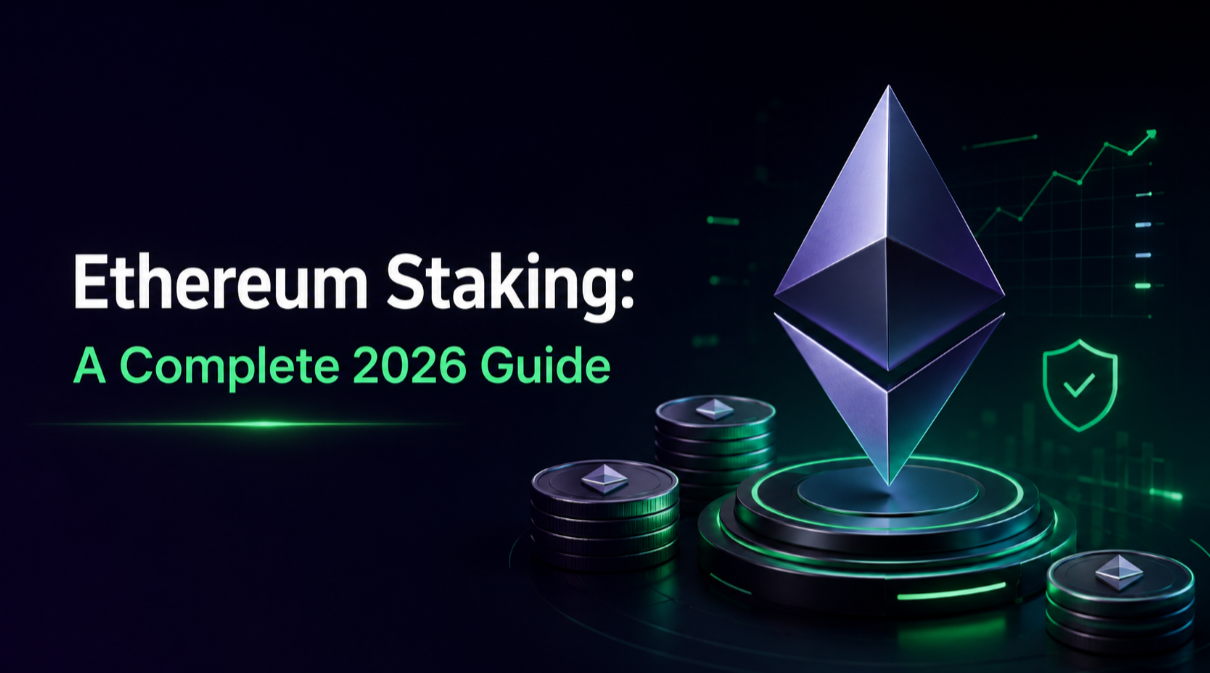
Ethereum staking lets you earn 3-5% APR on ETH in exchange for helping secure the network. In 2026, over 25% of all ETH is staked. This guide covers the four main approaches — solo, liquid, pooled, and exchange staking — with the specific trade-offs of each, real yields, and how to pick the approach that fits your situation. If you hold ETH, staking is one of the highest-value passive returns available; if you hold enough ETH, running your own validator is one of the most technically satisfying things in crypto.
Why Ethereum staking exists
Ethereum switched from proof-of-work mining to proof-of-stake in September 2022 ("The Merge"). Instead of miners racing to solve puzzles, validators lock 32 ETH as collateral and take turns proposing new blocks. If they behave, they earn ETH rewards. If they cheat or go offline, they lose part of their stake.
This design makes Ethereum ~99.95% more energy-efficient than pre-Merge, and enables anyone with 32 ETH to help secure the network. Below that amount, you can still participate via liquid or pooled staking.
For the underlying consensus mechanism, see Proof of Stake vs Proof of Work.
The four staking approaches
1. Solo staking (run your own validator)
- Requires: 32 ETH per validator, hardware (either physical or cloud VPS), technical setup.
- Yield: highest — 3-5% APR gross, no fees taken.
- Complexity: significant — you're responsible for uptime, backups, and updates.
- Best for: technically comfortable users with 32+ ETH who want maximum yield and decentralization.
2. Liquid staking (Lido, Rocket Pool, Frax)
- Requires: any amount of ETH.
- Yield: 3.5-4.5% APR after protocol fees.
- Complexity: low — deposit ETH, receive stETH/rETH/frxETH, done.
- Bonus: the receipt token can be used in other DeFi to earn additional yield.
- Best for: most users with < 32 ETH or those who want optionality.
3. Pooled staking (Rocket Pool node operator, DVT services)
- Requires: less than 32 ETH — Rocket Pool node operators put up 16 ETH plus RPL tokens; recent DVT services allow smaller amounts.
- Yield: comparable to solo staking with slight fee discount for pooling.
- Complexity: moderate — some node operation without full 32 ETH commitment.
- Best for: technically inclined users with 8-24 ETH.
4. Exchange staking (Coinbase, Kraken, Binance)
- Requires: any amount of ETH held on the exchange.
- Yield: 2.5-4% APR after exchange fees (usually 25% of gross rewards).
- Complexity: minimal — click a button.
- Trade-off: exchange counterparty risk, some jurisdictional restrictions.
- Best for: users who prefer regulated custody and don't mind lower net yield.
How liquid staking works in detail
Since liquid staking is the most common approach in 2026, worth understanding it deeply.
Lido (largest by TVL):
- Deposit ETH into Lido's smart contract.
- Receive stETH tokens 1:1 with your deposit.
- The stETH balance in your wallet rebases daily to reflect accumulated rewards (or use wstETH — a non-rebasing wrapper preferred by DeFi apps).
- You can hold, spend, or use stETH in DeFi at any time — it stays liquid.
- To unstake, either withdraw via Lido's exit queue (a few days) or swap stETH → ETH on a DEX (instant, minor slippage).
Rocket Pool:
Similar UX but more decentralized. Node operators put up 16 ETH plus RPL collateral to run validators. Users deposit any amount of ETH into the pool and receive rETH. Yield is comparable to Lido; the receipt token (rETH) does not rebase but appreciates in value against ETH.
For the full DeFi ecosystem context: What Is DeFi?.
The risks of each approach
Solo staking risks:
- Slashing: if your validator misbehaves (proposes conflicting blocks, goes offline for extended periods), you lose part of your stake. Preventable with good practices.
- Downtime: if your validator is offline, you miss rewards. Not slashing, but a real yield drag.
- Withdrawal delays: exiting the validator queue takes a few days when the network is busy.
Liquid staking risks:
- Smart contract risk: bugs in Lido or Rocket Pool contracts could theoretically drain funds. Both are heavily audited but risk isn't zero.
- Depeg risk: stETH has historically traded at slight discounts to ETH during stressed markets (e.g., the 2022 3AC/Celsius crisis). Usually resolves quickly.
- Centralization risk: Lido controls a large percentage of staked ETH, which some argue creates systemic risk.
Exchange staking risks:
- Counterparty risk: exchange could fail. Not zero probability in crypto history.
- Regulatory risk: US SEC has intermittently challenged exchange staking as unregistered securities offering.
Yield stacking with liquid staking
One of liquid staking's biggest advantages: you can use the receipt token in additional DeFi strategies to layer more yield on top.
Example strategies:
- stETH as collateral for borrowing. Deposit stETH into Aave, borrow stablecoins, deploy stablecoins for additional yield. Net: staking APR + lending spread. Adds liquidation risk.
- stETH in liquidity pools. Curve's stETH/ETH pool pays trading fees on top of staking rewards. Yields ~4-6% blended.
- Pendle fixed-yield tokenization. Sell future staking yield now at a fixed rate. Trade upside optionality for certainty.
Each layer adds smart contract risk. Rule of thumb: don't stack more than 2-3 layers, and understand each layer's failure mode.
Setting up solo staking (high level)
For those with 32+ ETH and technical inclination:
- Buy or provision hardware — either a dedicated home server (Rocket Pool NodeSet, Dappnode) or a VPS ($20-50/month).
- Install Ethereum client software — you need both a consensus client (Prysm, Lighthouse, Teku) and an execution client (Geth, Nethermind, Besu). Diversify by choosing clients different from the majority to reduce correlated slashing risk.
- Sync both clients (takes 1-3 days).
- Generate validator keys using the official launchpad (launchpad.ethereum.org).
- Deposit 32 ETH per validator via the launchpad. Wait for activation (queue can be days to weeks).
- Monitor uptime, run backups, update clients periodically.
Solo staking is a real hobby. Users who enjoy it treat it as decades-long infrastructure engagement. Users who don't should use liquid staking.
Ethereum staking is one of the few crypto activities where boring, passive holding earns real returns. 3-5% APR on ETH is not exciting on its face, but stacked over decades on an appreciating asset, it becomes meaningful. For long-term ETH holders, not staking is leaving money on the table.
Continue learning
Related: What Is Ethereum? · Ethereum Layer 2 Explained · Yield Farming Explained · Ethereum Gas Fees Explained.