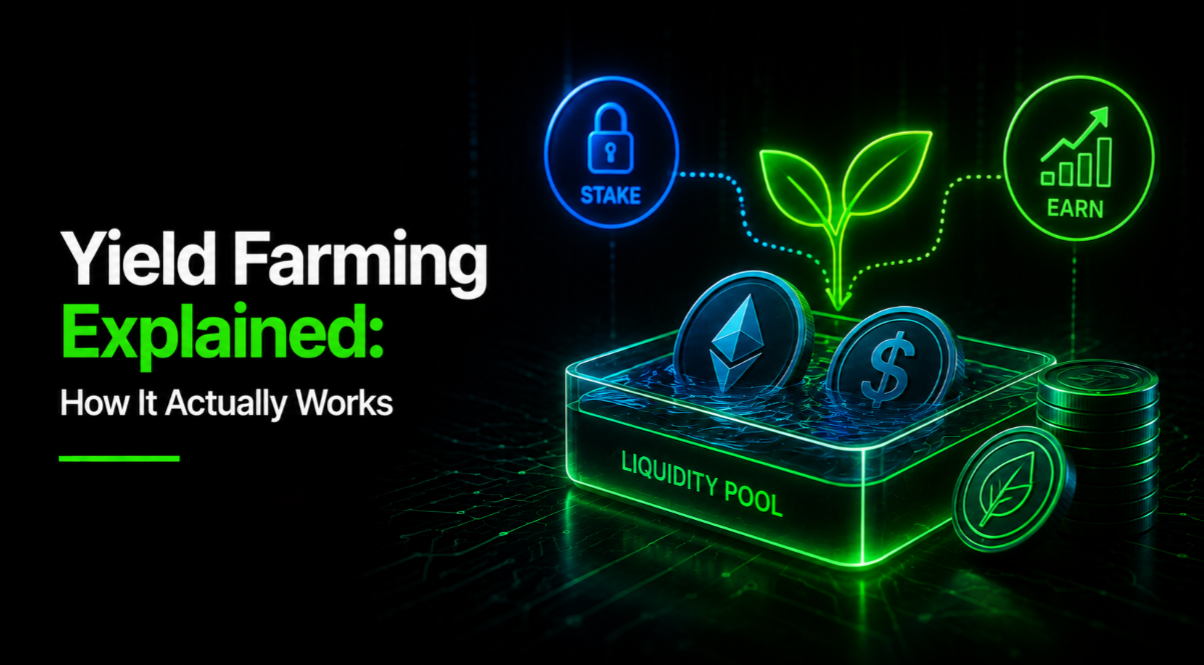
Yield farming is the practice of deploying crypto into DeFi protocols to earn returns. In its most sustainable form it's a legitimate way to earn 3-15% APR on stable capital. In its most extreme form (the 2020-2021 "DeFi summer" era with 10,000% APYs) it was mostly a house of cards that collapsed spectacularly, taking billions with it. This guide separates real yield from unsustainable emissions, walks through the strategies still working in 2026, and covers the specific risks that turn passive yield into active loss.
The one-sentence explanation
Yield farming = putting your crypto to work in DeFi protocols to earn more crypto, at APYs ranging from "high-yield-savings-adjacent" to "obviously a Ponzi."
The main sources of legitimate DeFi yield are lending interest, DEX trading fees, staking rewards from block production, and modest protocol token emissions used to bootstrap growth. Understanding which source generates a given APY is the single most important skill in yield farming.
The four sources of yield
1. Lending interest
You deposit capital into a lending protocol (Aave, Compound, Morpho). Borrowers borrow against overcollateralized crypto and pay interest. The interest flows to depositors. Yields are algorithmically set by supply and demand — 2-8% APR is typical.
2. DEX trading fees
You provide liquidity to a DEX pool (Uniswap, Curve, Balancer). Every swap that uses the pool pays a fee (usually 0.05-0.3%). Fees flow proportionally to LPs. Yield varies from 1% for boring pairs to 20%+ for high-volume volatile pairs — but higher-volume volatile pairs also have higher impermanent loss.
3. Staking rewards
You stake native tokens to secure a proof-of-stake blockchain (ETH, SOL, ATOM) and earn newly-minted tokens as reward. Yields: 3-15% depending on the chain, though inflation of the reward token can offset gains.
4. Protocol token emissions
A protocol prints its own governance token and distributes it to LPs/depositors as an incentive. This can produce huge advertised APYs (100%-100,000%) but the token usually dumps faster than the yield accrues. Sustainable when emissions are modest (5-20% APR on top of real yield); catastrophic when emissions dominate the advertised return.
Real yield vs emissions: the critical distinction
The single most important thing to understand about any yield opportunity: WHERE the yield comes from.
Real yield
- Paid in a stable, valuable asset (USDC, ETH, BTC).
- Sourced from real economic activity (fees, interest, block rewards).
- Sustainable indefinitely — the source doesn't depend on new depositors.
- Realistic magnitudes: 2-15% APR.
Emissions-based yield
- Paid in the protocol's own governance token.
- Sourced from token printing, not economic activity.
- Sustainable only until new depositors stop arriving.
- Often advertised as 100-100,000% APY.
- Almost always ends in the token collapsing.
A useful rule of thumb: if an advertised APY exceeds what a US regulated money market fund pays plus 15%, ask hard where it comes from. If the answer is "governance token emissions," assume the yield is unsustainable.
Working strategies in 2026
1. Stablecoin lending on established protocols
The simplest sustainable yield farm. Deposit USDC into Aave on Base or Arbitrum. Earn 3-6% APR from borrower interest. Compound continuously. Low risk (mature contracts, audited, battle-tested).
For deeper mechanics, see Lending Protocols Explained.
2. Curve stablecoin liquidity pools
Provide liquidity to Curve's 3pool or similar (all stablecoins). Earn 1-4% from trading fees, plus CRV emissions and often 3rd-party token bribes. Minimal impermanent loss because all pool tokens are pegged to $1.
3. Ethereum liquid staking
Deposit ETH into Lido or Rocket Pool. Receive stETH or rETH representing your staked position. Earn 3-5% APR from validator rewards. The receipt token can be used in other DeFi protocols to layer additional yield.
4. Pendle yield tokenization
A newer strategy where you buy yield-generating positions at a discount (locking in fixed APY) or trade the yield component separately. More complex; higher potential returns for those who understand it.
5. Delta-neutral vault strategies (advanced)
Combine long spot positions with short perpetual futures to earn funding rate + yield while eliminating price exposure. Ethena, Neutral Trade, and similar protocols implement this. Complexity is high; risk of specific tail events is real.
The five risks that eat returns
1. Smart contract risk
Bugs in DeFi code have caused billions in losses. Poly Network ($611M), Ronin Bridge ($625M), Wormhole ($325M), Euler ($200M) — even audited, established protocols have been drained.
Mitigation: use protocols with multi-year track records and multiple audits. Never chase yield in unknown protocols.
2. Impermanent loss
Providing liquidity to an AMM pool means you're selling the appreciating asset for the depreciating one at every price move. If both tokens move together (stablecoins, similar-cap alts), IL is minor. If prices diverge sharply (ETH/USDC when ETH doubles), IL can eat significant returns.
See Impermanent Loss Explained for the math.
3. Governance token dumps
If your advertised yield is 80% in a governance token, and the token drops 80% during your farming period, you break even before considering fees and IL. Most emissions-based yield ends this way.
4. Bridge risk
Farming across chains means moving assets via bridges. Bridges have been the most-hacked category in crypto history. Every bridge you use adds risk.
5. Compound complexity
Farming strategies that compose multiple protocols (deposit A into protocol X, use receipt in protocol Y, borrow to farm in protocol Z) sum the risks of every layer. A bug or exploit anywhere in the chain can cascade.
The mistakes farmers keep making
- Chasing headline APY. "This new farm is paying 5,000%!" Almost always a Ponzi. Stick to sustainable yields.
- Ignoring gas costs. On Ethereum mainnet, $10 gas fees can eat 20% of a $50 harvest. Farm on Layer 2s where gas is under $0.10.
- Not accounting for taxes. Many yield-farming activities create taxable events on every harvest. Track everything.
- Reinvesting into loss-making positions. If a farm is paying you tokens that are dumping, taking profits and rotating is smarter than compounding into a falling asset.
- Concentrating in one protocol. A smart contract exploit could zero out an over-concentrated position. Spread across protocols even at some yield cost.
A realistic yield farming portfolio for 2026
An example allocation for a $10,000 stablecoin position focused on sustainable yield:
- $4,000 USDC deposited to Aave on Base (~4% APR, low risk)
- $3,000 in Curve 3pool with CRV rewards (~4-8% APR, moderate)
- $2,000 in stETH via Lido (~4% APR, ETH exposure + staking)
- $1,000 in Pendle fixed-yield tokens (~7-10% APR, moderate)
Blended expected return: ~5-6% APR. Not exciting. But sustainable, understandable, and unlikely to zero out overnight. This is what "real" yield farming looks like in 2026.
The 2020 promise of "DeFi will replace traditional finance with 10,000% yields" was always mathematically absurd. The 2026 reality is more useful: modestly better yields than banks, permissionless access, and real risks that require active management. Farmed correctly, DeFi generates real returns. Farmed carelessly, it removes capital faster than any other financial product.
Continue learning
Related: What Is DeFi? · Liquidity Pools Explained · DeFi Risks Explained · Ethereum Staking Guide.