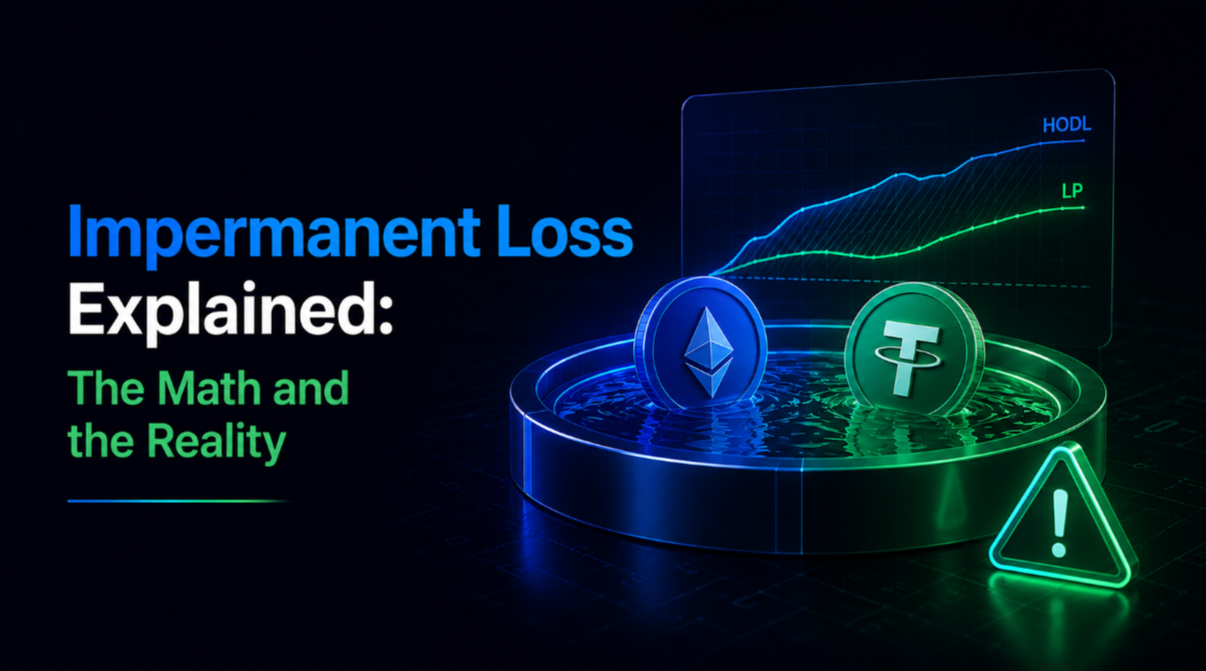
Impermanent loss is the risk that surprises more first-time liquidity providers than any other. Users see "Provide liquidity, earn 30% APY!" and don't realize that IL can more than offset those returns. This guide covers the exact math, worked examples across common scenarios, when IL actually becomes permanent, and specific strategies to mitigate or avoid it entirely.
The mechanic in plain language
When you deposit two tokens into an AMM pool (say ETH and USDC), you've implicitly given the pool permission to trade between them as prices move. Because the AMM formula keeps the product of the two token amounts constant, the pool automatically:
- Sells the appreciating token when its price rises.
- Buys the depreciating token when its price falls.
This is the opposite of what a rational HODLer would do. If ETH doubles, you'd prefer to keep all your ETH. But the pool has been selling ETH the whole way up, leaving you with less ETH and more USDC than you started with.
The exact math (Uniswap V2)
For a 50/50 constant-product pool, if the price ratio between the two tokens changes by factor r (r = new_price / old_price), the IL is:
IL = 2 × sqrt(r) / (1 + r) - 1
Values at common ratios:
- r = 1.25 (25% price move): IL = 0.6%
- r = 1.5 (50% price move): IL = 2.0%
- r = 2 (2x): IL = 5.7%
- r = 3 (3x): IL = 13.4%
- r = 4 (4x): IL = 20.0%
- r = 5 (5x): IL = 25.5%
- r = 10 (10x): IL = 42.5%
Note: IL is symmetric — a 2x price INCREASE creates the same IL as a 2x price DECREASE.
Worked example
Setup:
You deposit 1 ETH and 3,000 USDC into a Uniswap V2 pool when ETH = $3,000. Pool constants: x=1, y=3,000, k=3,000. Your position value: $6,000.
Scenario A: ETH doubles to $6,000
- Arbitrageurs buy ETH from your pool until the pool price matches the market.
- Pool must maintain k = 3,000. So if new price is $6,000/ETH, new pool composition: 0.707 ETH and 4,243 USDC (check: 0.707 * 4,243 ≈ 3,000).
- Your position value: 0.707 * $6,000 + $4,243 = $8,485.
- If you had just held: 1 * $6,000 + $3,000 = $9,000.
- IL: $9,000 - $8,485 = $515, or 5.7% of hold value.
Scenario B: ETH halves to $1,500
- Arbitrageurs sell ETH into your pool until pool price matches.
- New pool composition: 1.414 ETH and 2,121 USDC.
- Position value: 1.414 * $1,500 + $2,121 = $4,242.
- If held: 1 * $1,500 + $3,000 = $4,500.
- IL: $4,500 - $4,242 = $258, or 5.7% of hold value.
Symmetric IL regardless of direction. Only the magnitude of the price change matters.
When it becomes permanent
IL is called "impermanent" because it disappears if the two tokens' prices return to the original ratio. In practice:
- If you deposit ETH/USDC when ETH is $3,000, and withdraw when ETH is $3,000 again, IL is zero (you got back the original amount of each token).
- If you withdraw when ETH is at any other price, IL becomes realized.
For assets that trend long-term (ETH going up over years), IL rarely reverses — the "impermanent" label is somewhat optimistic.
Fees vs impermanent loss
The whole point of providing liquidity is that the trading fees you earn compensate for the IL. Whether they do depends on:
- Pool trading volume. More trades = more fees.
- Pool TVL. Your share of fees is your share of the pool.
- Fee tier. 0.05% vs 0.3% vs 1% affects per-swap revenue.
- Price volatility. More volatility = more IL AND more arbitrage-driven volume (which pays fees).
Rule of thumb:
For a volatile pair to be profitable, sustained trading volume needs to be 20-40%+ of pool TVL daily. Anything below and IL likely dominates fees.
Curve stablecoin pools are profitable at much lower volumes because IL is essentially zero. Uniswap V3 concentrated positions in high-volume ranges can be profitable even at higher volatility. But retail LPs consistently underperform holding when they LP volatile pairs at random.
Uniswap V3 amplifies both sides
Uniswap V3 introduced concentrated liquidity — LPs specify a price range in which their liquidity is active. This amplifies capital efficiency:
- Fees earned per dollar in-range: 5-100x higher than V2.
- IL for the same price move within range: 5-100x higher than V2.
- When price exits the range: you're fully in one token, no fees earned, and IL is realized.
V3 LP requires active management. Set-and-forget V3 positions frequently underperform equivalent V2 positions.
Strategies to minimize or avoid IL
1. Provide liquidity to stablecoin or pegged-asset pools.
USDC/USDT/DAI pools on Curve. stETH/ETH pools. wBTC/BTC pools. IL is essentially zero because tokens track each other closely.
2. Use Uniswap V2 for broader ranges.
Lower capital efficiency, less IL for the same price move. Better for passive LPs.
3. Hedge with perps (advanced).
Short an equivalent notional of the asset on a perp exchange. Reduces IL exposure but adds funding costs and management complexity. Rarely worthwhile for retail.
4. Choose pools where volume-to-TVL is high.
Well-arbitraged blue-chip pairs (ETH/USDC on major DEXs) tend to have volumes that overcome IL.
5. Do not LP volatile new tokens.
The pattern that consistently loses money: LPing new-launch tokens for high advertised APYs. IL plus token dumps usually wipes principal.
Impermanent loss is not a bug — it's a feature of how AMMs price assets deterministically without market makers. Understanding it turns LP from lottery to reasoned yield strategy. Ignoring it turns it into a slow bleed most first-time LPs don't notice until they withdraw.
Related: Liquidity Pools Explained · Automated Market Makers Explained · Yield Farming Explained.