Liquidity pools are the engine of DeFi. Every DEX runs on them. Billions of dollars in yield come from them. But they're also where many first-time DeFi users lose money — to impermanent loss they didn't understand, to smart contract exploits they didn't evaluate, or to unsustainable yields that collapsed. This guide covers exactly what liquidity pools are, how to earn from them safely, and the specific traps that catch new LPs.
What a liquidity pool actually is
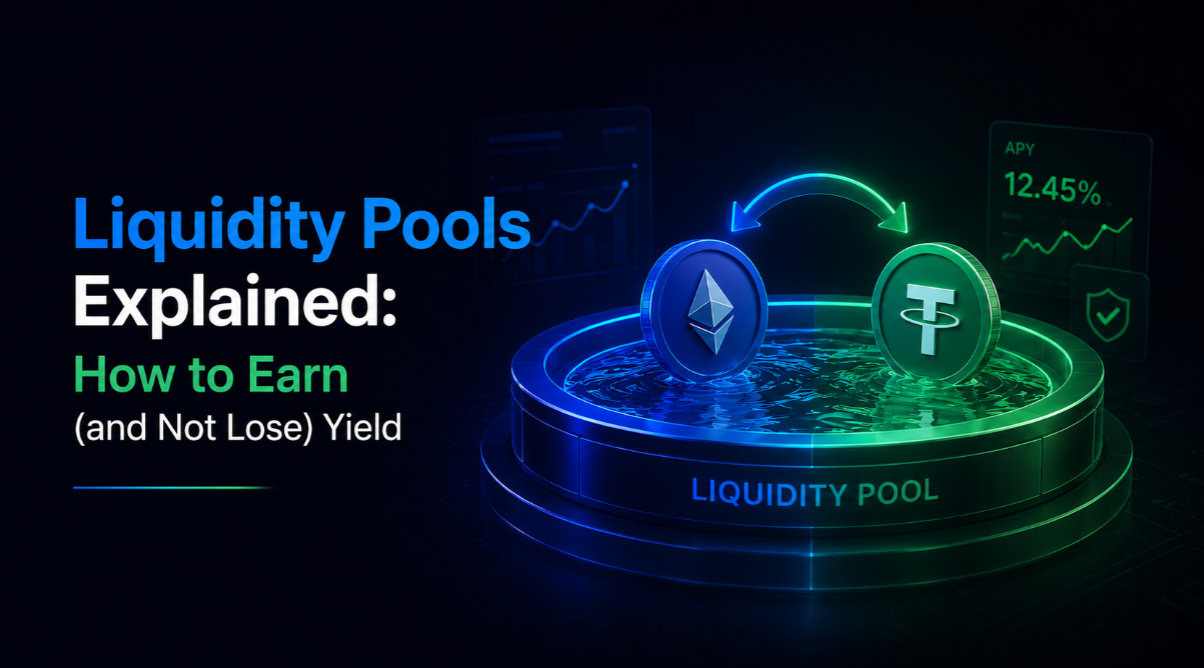
A liquidity pool is a smart contract holding two or more tokens. Traders swap tokens against the pool at prices determined by the pool's composition (via an AMM formula). Liquidity providers (LPs) deposit tokens into the pool and earn a share of trading fees.
The workflow of providing liquidity to a Uniswap V2 pool:
- You have $500 of ETH and $500 of USDC.
- You go to Uniswap, click "Add Liquidity," select ETH/USDC pool.
- You approve the tokens and deposit both. The pool records your share.
- You receive LP tokens (ERC-20 tokens) representing your ownership of the pool.
- As people trade against the pool, they pay fees (0.3% of each swap). Your share of those fees accumulates.
- To withdraw, you burn your LP tokens and receive your share of the pool's current composition, including any accumulated fees.
For the underlying math, see Automated Market Makers Explained.
The three sources of LP yield
1. Trading fees
The primary sustainable yield. Every swap pays a fee (typically 0.05-0.3%) that goes to LPs proportional to their share. Popular pools generate more fees; niche pools generate less.
2. Protocol emissions
Some protocols reward LPs with additional tokens (their own governance tokens, or third-party incentives). This can meaningfully boost yield but often ends when incentives dry up.
3. Bribes / vote incentives
On Curve and similar protocols, other protocols can "bribe" gauge voters to direct emissions to their pool. Sophisticated LPs stack these bribes on top of base yield.
Sustainable yield mostly comes from source 1. Emission-heavy pools often produce headline APYs that vanish as the emission token dumps.
Impermanent loss: the risk everyone underestimates
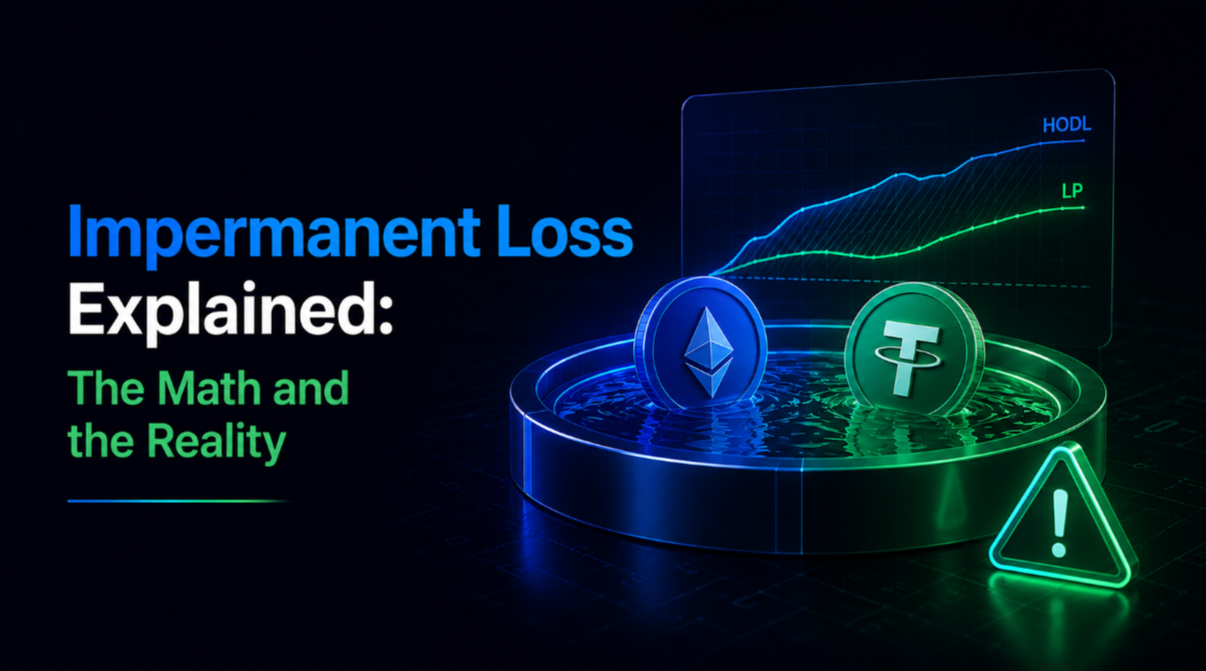
When you deposit two tokens into a pool, you have a synthetic position: the pool automatically sells whichever asset appreciates for whichever depreciates. This maintains the target ratio but produces worse returns than holding both tokens separately.
Real example:
- You deposit 1 ETH and 3,000 USDC (ETH at $3,000) into a pool.
- ETH price doubles to $6,000. Arbitrageurs buy ETH from your pool until price matches.
- Result: pool ends with ~0.71 ETH and ~4,243 USDC (product still equals initial 3,000).
- Your position value: 0.71 * $6,000 + $4,243 = $8,503.
- If you had just held: 1 * $6,000 + $3,000 = $9,000.
- IL = $497, or about 5.5% of the appreciated value.
Fees earned during that period reduce (and can offset) impermanent loss. But if the fees don't exceed IL, you've underperformed a simple hold.
For the full math and mitigation strategies, see Impermanent Loss Explained.
Pool selection: which pools actually make money
Low-risk, low-yield: stablecoin pools
- Curve 3pool (USDC/USDT/DAI): 2-4% APR.
- Curve Frax pools: 3-6% APR.
- Uniswap V3 stablecoin pools with tight ranges: 5-15% APR.
- IL is negligible because all tokens are pegged to $1.
Medium-risk, medium-yield: pegged-asset pools
- Curve stETH/ETH: 3-8% APR.
- Balancer wstETH/ETH: similar.
- IL is low because both assets are Ethereum derivatives.
High-risk, high-yield: volatile pairs
- Uniswap V3 ETH/USDC concentrated liquidity: can earn 15-40% APR in optimal ranges, but IL and gas costs can eat much of it.
- New-token pairs: high fees from volatility, high risk of rug pulls and IL.
For beginners, start with stablecoin pools. Add pegged-asset pools once you understand the workflow. Volatile pairs require active range management.
The mistakes new LPs make
- Chasing headline APY. A pool paying 500% APY almost certainly has emission tokens dumping faster than the yield accrues.
- Ignoring gas costs. On mainnet Ethereum, $50 gas fees can eat the first month of yield on a small position. Use L2s.
- Not accounting for impermanent loss. Yields are advertised in isolation; IL is not deducted. Real return = fees earned - IL.
- Providing liquidity to unaudited protocols. Smart contract risk in DeFi is real. Stick to protocols with multi-year track records.
- Concentrating in a single pool. A protocol exploit could zero the entire position. Diversify across pools.
- Not tracking taxes. Some jurisdictions treat pool deposits as taxable events. Every fee collection is potentially income.
A practical LP strategy for 2026
A realistic 6-12 month LP strategy for a $10k stablecoin position:
- Bridge $10k USDC to Base or Arbitrum L2 (cheap gas).
- Deposit $5k to Aave USDC pool (~4% APR, lowest risk).
- Deposit $3k to Curve stablecoin pool (~4-6% APR with CRV rewards).
- Deposit $2k to Uniswap V3 USDC/DAI tight-range pool (~6-10% APR).
- Blended expected return: ~5-6% APR sustainable.
Boring but real. This is what durable DeFi yield looks like — not the 500% APY of headline farms.
Liquidity provision is not passive investing. It requires actively selecting pools, managing IL, and rotating as opportunities shift. Done well, it produces real risk-adjusted returns. Done carelessly, it produces losses no traditional investment can match. The tool is powerful; the responsibility is real.
Related: Automated Market Makers Explained · Impermanent Loss Explained · Yield Farming Explained · DeFi Risks Explained.