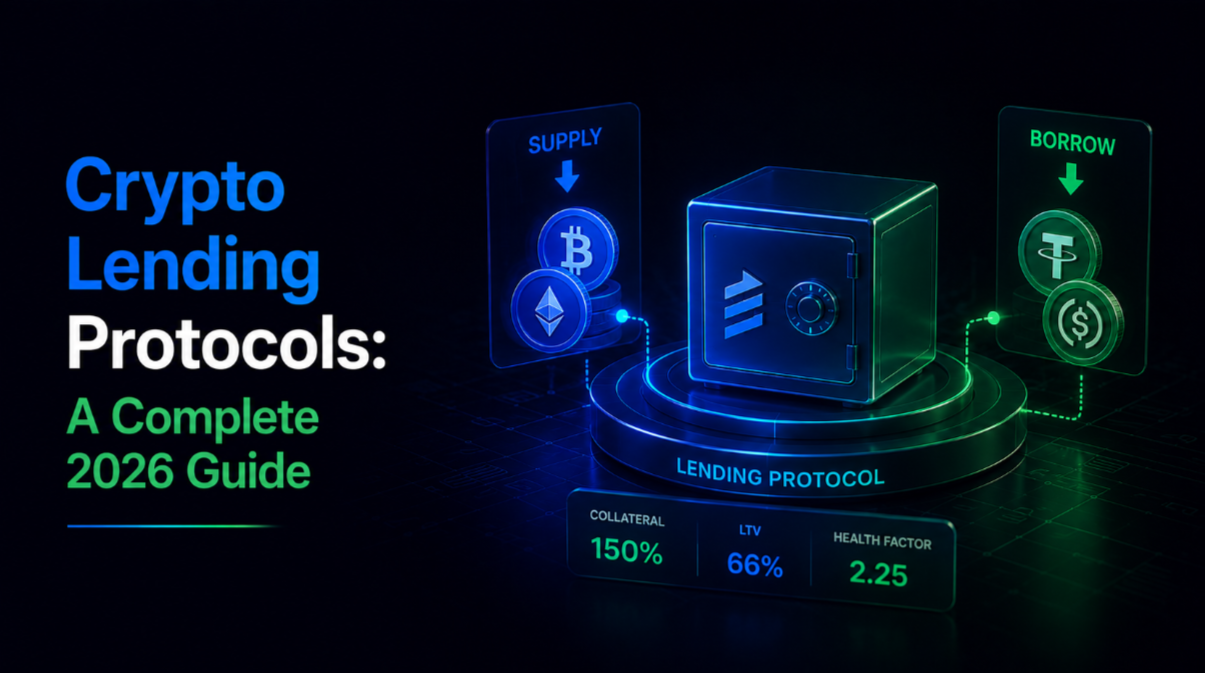
Crypto lending protocols let you earn yield by depositing crypto or borrow against your crypto without selling. They're one of the most useful and battle-tested DeFi primitives. This guide covers exactly how they work, compares the major protocols in 2026, walks through both the depositor and borrower workflows, and explains the specific mistakes that turn passive lending into active loss.
How overcollateralized lending works
Unlike traditional lending, DeFi loans require the borrower to deposit MORE value than they borrow. This "overcollateralization" is what makes trustless lending possible.
Example workflow:
- You deposit 1 ETH ($3,000) into Aave as collateral.
- Aave says: "You can borrow up to 75% of collateral value" — so $2,250.
- You borrow 1,000 USDC. Your loan-to-value (LTV) is now 33%.
- You use the USDC for whatever purpose.
- You pay ongoing interest on the loan (say 5% APR = ~$50/year).
- When you want to close: repay the USDC + accrued interest, get your ETH back.
If ETH price drops enough that your LTV exceeds Aave's liquidation threshold (say 80%), Aave sells some of your ETH to repay the loan and imposes a liquidation penalty.
The two sides: deposit and borrow
As a depositor:
- Deposit crypto to earn interest paid by borrowers.
- No lock-up period — withdraw anytime (subject to protocol liquidity).
- Interest rates float based on utilization — high borrower demand = higher rates.
- Receipt tokens (aUSDC on Aave, cUSDC on Compound) represent your deposit and can often be used elsewhere in DeFi.
As a borrower:
- Deposit collateral, borrow other assets up to protocol limits.
- Pay interest on borrowed amount.
- Manage LTV to avoid liquidation.
- Common uses: leverage (borrow to buy more), stablecoin liquidity without selling, tax-efficient access to value (borrowing isn't a taxable event; selling is).
The major protocols compared (2026)
Aave
- Largest lending protocol by TVL for most of 2020-2026.
- Founded 2017. Multiple version upgrades (V1→V4).
- Supports 30+ assets across Ethereum, Base, Arbitrum, Polygon, Optimism, Avalanche.
- Isolation mode for riskier assets.
- GHO — Aave's native stablecoin.
- Most conservative default choice.
Compound
- The original DeFi lending protocol (founded 2018).
- Compound V3 focuses on individual "markets" (USDC market, ETH market) rather than a universal pool.
- Simpler design, slightly lower TVL than Aave.
Morpho
- A peer-to-peer matching layer that runs on top of Aave/Compound.
- Matches borrowers directly with lenders when possible, splitting the interest rate spread.
- Result: lenders earn more, borrowers pay less.
- Newer (launched 2022) but heavily audited and adopted by sophisticated users.
Spark
- Part of the Sky/MakerDAO ecosystem.
- Borrow DAI/USDS against ETH, stETH, wBTC.
- Access to the DAI Savings Rate (currently 4-8%).
- Best for users specifically wanting to interact with the DAI ecosystem.
Liquidation risk in detail
The most important risk for borrowers. Every position has three key parameters:
- LTV (Loan-to-Value): debt / collateral. Grows as you borrow more or collateral value drops.
- Liquidation threshold: the LTV at which liquidation triggers (typically 75-85%).
- Liquidation penalty: the discount at which your collateral is sold (typically 5-15%).
Example:
You borrow $1,000 against $2,000 ETH. LTV = 50%. If ETH drops 30%, collateral value becomes $1,400, LTV becomes 71%. Still safe (below 80% threshold). If ETH drops another 15%, collateral value becomes $1,190, LTV = 84%. Position gets liquidated: enough ETH is sold at a 10% discount to repay the loan. You lose about $150 in the penalty.
Rules to avoid liquidation:
- Keep LTV well below maximum (e.g., 40% when max is 75%).
- Monitor positions during high volatility.
- Add collateral when values drop significantly.
- Do NOT borrow against a single volatile asset for long-term positions.
- Set up alerts on services like DeFiSaver or Instadapp.
Practical strategies
Strategy 1: Stablecoin savings
Simplest use. Deposit USDC on Aave (Base or Arbitrum). Earn 3-6% APR. No liquidation risk (you're not borrowing). Withdraw anytime.
Strategy 2: Borrow stablecoins against ETH
You hold ETH long-term. You need $5,000 for expenses. Instead of selling ETH (triggering taxes and losing exposure), deposit $15,000 of ETH, borrow $5,000 USDC. LTV of 33%. You pay 5-8% interest but keep ETH exposure and defer taxes.
Strategy 3: Loop for leverage (advanced)
Deposit ETH, borrow USDC, buy more ETH with USDC, deposit that, borrow again. Amplifies exposure to ETH. Amplifies liquidation risk symmetrically. Only for sophisticated users who understand the mechanics.
Strategy 4: Yield loop (advanced)
Deposit stETH (earning ~4% staking yield), borrow USDC, deploy USDC in yield strategy earning 6-8%. Net: stETH yield + spread. Adds smart contract risk and correlation risk.
Common lending mistakes
- Borrowing at high LTV during quiet markets. A 60% LTV during quiet times becomes 90% during a flash crash. Leave margin for surprises.
- Not monitoring during high volatility. Positions can go from safe to liquidated in hours during crashes.
- Depositing to unaudited "high yield" protocols. Any lending protocol offering 20%+ APR on stablecoins likely has hidden risk.
- Borrowing volatile assets. Borrowing more ETH to speculate = leverage. If wrong, you owe back MORE ETH than you have.
- Ignoring gas costs. On mainnet, opening/closing positions can cost $50-100. On L2s, cents.
Crypto lending done conservatively is one of the safest yield-generating activities in DeFi. Done aggressively (high LTV, leverage loops, chase-yield rotations) it can wipe out entire portfolios in a single crash. The tool is powerful; the discipline required is real.
Related: What Is DeFi? · Yield Farming Explained · DeFi Risks Explained.