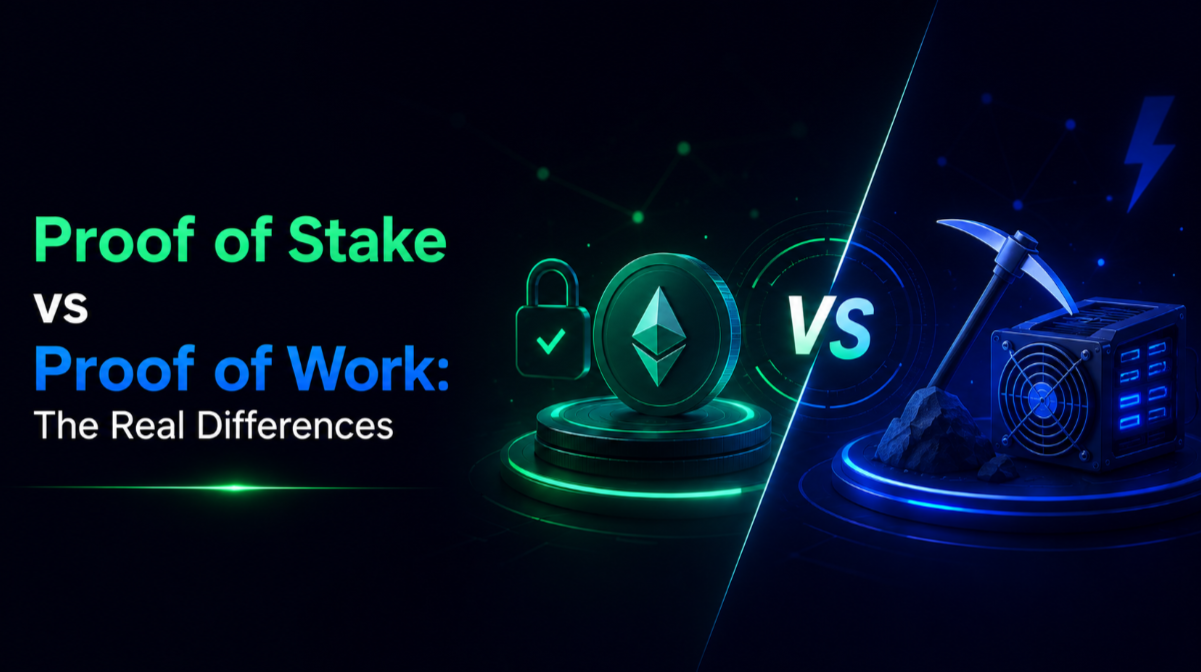
Every public blockchain needs a way to decide who adds the next block. Proof of work (PoW) and proof of stake (PoS) are the two dominant answers. Bitcoin uses PoW; Ethereum switched to PoS in 2022. This guide compares them head-to-head: how each actually works, real energy usage, decentralization trade-offs, and why the two largest crypto assets chose different approaches.
How proof of work actually works
Miners run specialized computers that repeatedly guess random numbers, combining them with pending transaction data and hashing the result. When a miner finds a hash meeting the network's difficulty target, they broadcast the completed block. Other nodes verify it in milliseconds and add it to their copies of the blockchain.
Key features:
- Each block takes ~10 minutes on Bitcoin.
- Miners spend real electricity trying trillions of combinations per second.
- The winning miner receives newly-minted BTC (3.125 BTC per block in 2026) plus transaction fees.
- To rewrite history, an attacker needs more computing power than the entire honest network — cost is billions of dollars in equipment and electricity.
For a full walkthrough see How Does Bitcoin Work?.
How proof of stake actually works
Validators lock 32 ETH each as collateral (called a "stake"). The protocol randomly selects one validator each 12-second slot to propose the next block. Other validators attest to the block's validity. If a validator misbehaves — proposes invalid blocks or goes offline for extended periods — they lose part or all of their stake.
Key features:
- Each block takes 12 seconds on Ethereum.
- Validators run standard computers, not specialized hardware.
- Rewards paid in ETH, typically 3-5% APR of staked amount.
- To rewrite history, an attacker needs to own or control 51% of staked ETH — currently over $100 billion worth. The attempt would collapse ETH's value, destroying the attacker's own capital.
See Ethereum Staking Guide for the participant's perspective.
The energy comparison
Bitcoin (PoW): ~150 TWh/year. Comparable to a mid-sized country. Comes primarily from grid electricity, with growing share from stranded/renewable sources.
Ethereum (PoS): ~0.01 TWh/year — a 99.95% reduction from pre-Merge Ethereum. Comparable to a small town.
The energy debate:
- PoW defenders: the energy IS the security. Reducing it would reduce Bitcoin's attack resistance. Also: increasingly, mining is done with otherwise-wasted energy (flare gas, curtailed renewables).
- PoS defenders: equivalent security via financial stake, not energy. If you can achieve security without the energy cost, why not? Better for environmental and regulatory positioning.
- Neither dismisses the other: both work as consensus mechanisms; the question is which trade-offs matter more.
Decentralization comparison
Both mechanisms tend toward some concentration in practice.
Bitcoin PoW concentration:
- Top 3 mining pools produce ~65% of blocks.
- Mining industrialized — most miners run in large data centers.
- Entry barriers: expensive ASICs, cheap electricity, industrial-scale operations.
Ethereum PoS concentration:
- Top 5 staking entities (Lido, Coinbase, Binance, Kraken, Rocket Pool) control most stake.
- Solo staking has grown but is minority.
- Entry barriers: 32 ETH per validator (~$100k), technical setup.
Neither is perfectly decentralized. Both have some concentration risks. The specific risks differ (physical/geographical for PoW, economic/regulatory for PoS).
Attack cost comparison
Bitcoin PoW 51% attack: estimated $10-20 billion in equipment plus $5-10 billion in electricity, and destroys the attacker's own investment if BTC price collapses.
Ethereum PoS 51% attack: requires acquiring 51% of staked ETH — approximately $50-100 billion at 2026 prices, and would be slashed if used to attack, destroying the capital.
Both networks are prohibitively expensive to attack economically. In practice, neither has been successfully 51%-attacked.
Why Bitcoin sticks with PoW
- Bitcoin's value proposition IS the immutable security backed by real-world energy. Changing this changes what Bitcoin is.
- The community strongly values conservative changes — no consensus mechanism swap would ever pass.
- PoW has a 15+ year track record of no successful attacks.
- Bitcoin's fixed 21M supply combined with declining block subsidies means fees will eventually pay for security. PoW's external cost matches this design.
Why Ethereum switched to PoS
- Environmental positioning for regulatory and institutional acceptance.
- Enables staking yield, giving ETH holders a native return.
- Reduces issuance dramatically (from ~4% annual inflation to <0.5%), often deflationary via burns.
- Enables sharding and other scaling roadmap features that were harder under PoW.
- Better economic security-to-cost ratio at Ethereum's market cap.
Other consensus mechanisms worth knowing
- Delegated Proof of Stake (DPoS): Used by EOS and some others. Token holders vote for a small set of validators. Faster but more centralized.
- Proof of History (PoH): Used by Solana. Combines with PoS. Enables much higher throughput at cost of more hardware requirements.
- Proof of Space and Time: Used by Chia. Miners commit disk space instead of computation. Novel but small market.
PoW versus PoS is not "old versus new" or "wasteful versus efficient." It's two different answers to the same problem, each with strengths matched to different use cases. Bitcoin's digital-gold thesis fits PoW. Ethereum's programmable-computer thesis fits PoS. Both are here to stay.
Related: How Does Bitcoin Work? · What Is Ethereum? · Ethereum Staking Guide · Blockchain Technology Explained.