Blockchain is a public database that many people run copies of, where new entries are added in blocks and cryptographically linked so no one can secretly rewrite history. That is the whole concept. Everything else — mining, staking, gas, smart contracts — is engineering detail supporting that design. This guide explains what a blockchain actually is, how it stays secure without any central authority, what makes it different from a regular database, and what its real-world uses actually are (versus the ones that were oversold).
The one-sentence definition
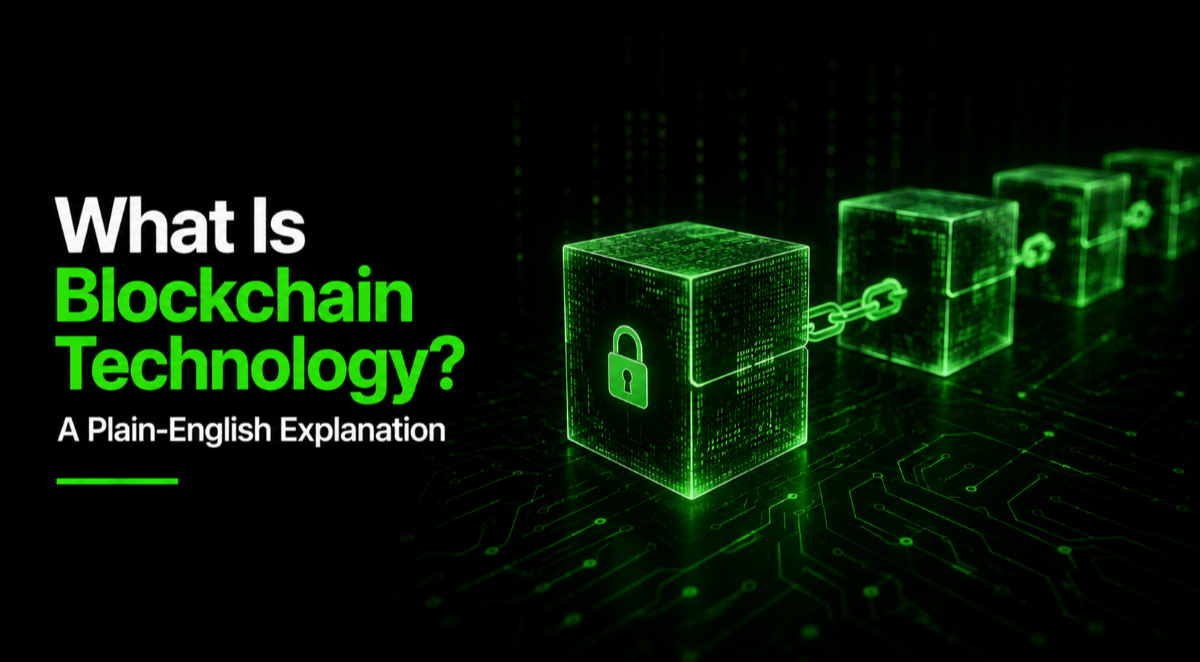
A blockchain is a public, append-only database maintained by many independent operators, where each new batch of entries is cryptographically linked to the previous batch.
That structure — a chain of blocks, each referencing the previous one via a hash — is what gives the blockchain its name. Change one block and every subsequent hash breaks. Rewriting history means recomputing every subsequent block, which the network as a whole makes expensive.
What "many people run copies of" actually means
On a public blockchain like Bitcoin or Ethereum, thousands of independent operators run "nodes" — computers that maintain full copies of the database and enforce the consensus rules locally. When you send a transaction, it propagates to nearby nodes, then to their peers, and within seconds the entire network has a copy in its pending queue.
When a new block gets added, every node independently verifies it. If a miner (or validator) tries to include an invalid transaction, every honest node rejects the block. This is the enforcement mechanism — the rules are enforced by consensus, not by any central authority.
This is why Bitcoin can survive without a CEO, and why Ethereum can operate without any company running it. See How Does Bitcoin Work? for a deeper walkthrough of the underlying mechanics.
The two ways new blocks get added
Every public blockchain needs a way to decide who adds the next block. Otherwise, thousands of nodes would each try to add different blocks simultaneously. The two dominant approaches:
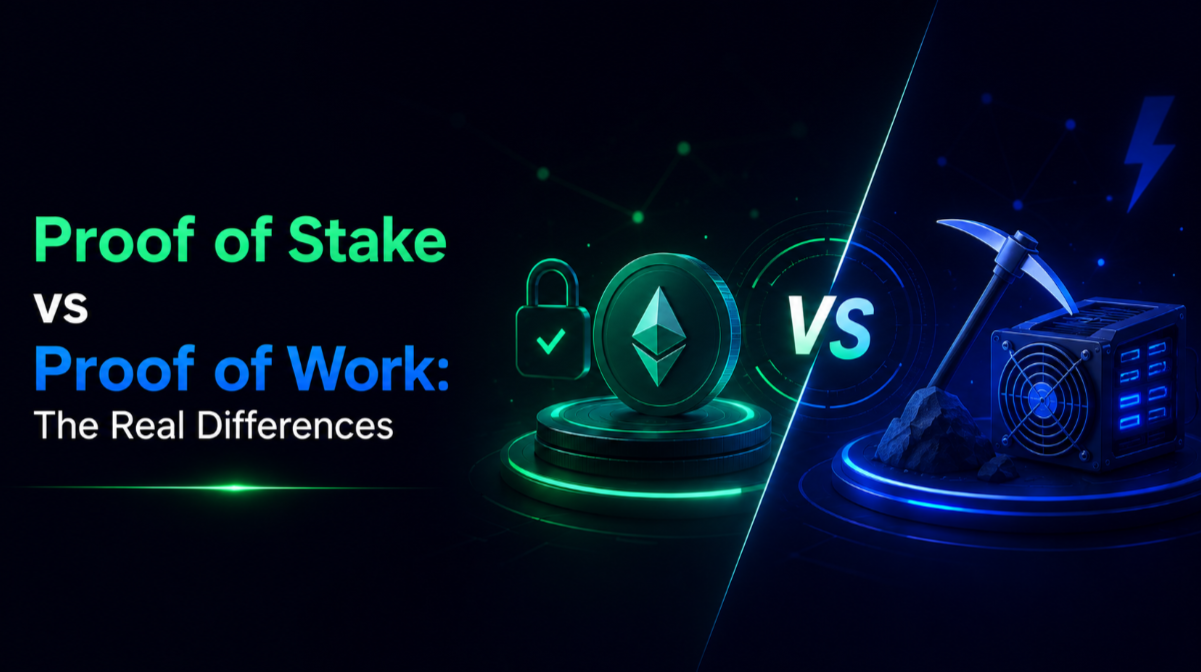
Proof of Work (Bitcoin)
Miners compete to solve a computational puzzle. The first to find a valid solution gets to add the next block and receives newly-minted bitcoin. The puzzle is designed to require enormous energy investment, which makes rewriting history prohibitively expensive.
Proof of Stake (Ethereum since 2022)
Validators stake tokens as collateral and take turns proposing new blocks. If they behave, they earn rewards. If they cheat, they lose their stake. This achieves similar security without the massive energy consumption.
For a full comparison of the two, see Proof of Stake vs Proof of Work.
What makes blockchain different from a database
A regular database:
- One entity controls it.
- That entity can edit any record at any time.
- Read access can be public or restricted; write access is always restricted.
- Handles millions of operations per second.
- Costs pennies per million operations.
A public blockchain:
- Thousands of operators maintain copies.
- Past entries are effectively immutable — modifying them requires redoing all subsequent cryptographic work.
- Both read and write access are open to anyone.
- Handles 10-1,000 operations per second, depending on the chain.
- Costs dollars to cents per operation.
This is a trade-off, not an upgrade. Databases are much faster and cheaper for use cases where you trust a single operator. Blockchains matter when you specifically need "no one can secretly change this record" as a guarantee.
Real use cases in 2026
After 15+ years of experimentation, the use cases that actually work:
- Cryptocurrency. Digital money without a central issuer. Bitcoin remains the largest by market cap.
- Stablecoins. Dollar-pegged tokens (USDC, USDT, DAI) that move at internet speed and cost. Used heavily for cross-border transfers.
- Decentralized finance (DeFi). Lending, trading, and yield services without banks. See What Is DeFi?.
- NFT ownership. Provable digital ownership records. Real use cases include gaming assets, membership passes, and creator monetization.
- Cross-border remittance. Sending stablecoins on a Layer 2 costs cents vs 5-10% for Western Union.
- Supply chain provenance. Some working systems for tracking diamonds, food, and luxury goods.
Use cases that were oversold and rarely work in practice:
- Voting. Blockchain doesn't solve identity verification, which is the hard problem in voting.
- Healthcare records. Regulated data with strict access controls fits databases, not public chains.
- Real estate deeds. The legal enforcement layer is off-chain; the blockchain part adds little.
- HR credentials. The verification of "did this person actually work at Google?" is off-chain.
The pattern: blockchain adds value when you need trustless coordination among untrusting parties. It adds little when a trusted party already exists or when the underlying data comes from off-chain sources.
Public vs private blockchains
The term "blockchain" covers two very different things:
Public blockchains (Bitcoin, Ethereum, Solana)
- Anyone can join, read, and write (subject to fees).
- Truly decentralized — no single operator.
- Slow and expensive per transaction.
- Real censorship resistance.
Private / permissioned blockchains (Hyperledger, R3 Corda)
- Controlled access — participants must be approved by an operator or consortium.
- Faster and cheaper than public chains.
- Not truly decentralized — the operator can change rules.
- Trade-off: usually a distributed database with extra complexity, not a real blockchain in the political sense.
Most "enterprise blockchain" projects are private chains. They provide some benefits (shared record among consortium members) but don't offer the "trustless" property that public chains do. When someone says "blockchain," ask which type — they behave very differently.
Layer 1s and Layer 2s
Public blockchains face a scaling trilemma: they can be decentralized, secure, or fast — but not all three at once. Modern architectures address this via layered designs.
Layer 1 (L1):
The base blockchain (Bitcoin, Ethereum, Solana). Provides maximum security and decentralization at the cost of throughput.
Layer 2 (L2):
Chains built on top of an L1 that batch transactions and settle to the L1 periodically. Users get L1-adjacent security with 10-100× lower fees and higher throughput. Ethereum L2s include Base, Arbitrum, Optimism, Scroll, Linea.
For a deeper dive on Ethereum L2s, see Ethereum Layer 2 Explained.
What blockchain does NOT guarantee
A common myth: "if it's on the blockchain, it must be true." Not quite:
- Blockchain guarantees that a signed transaction was validly submitted. It does not guarantee that the underlying claim is true.
- A tokenized real estate deed on the blockchain does not create legal ownership. It creates a record that a specific wallet holds a token that CLAIMS to represent that deed.
- An NFT saying "this is the original artwork" does not verify authenticity. It verifies that a specific wallet minted a token pointing to a specific file.
- A supply-chain blockchain record saying "this coffee is from Ethiopia" does not verify origin. Someone off-chain has to input that data correctly.
Blockchain is a very good coordination and settlement layer. It is not a truth machine. The distinction is important when evaluating "blockchain use case" pitches.
The right question is not "should this use a blockchain?" — most things should not. The right question is: "am I trying to coordinate value or truth among parties who do not trust each other, without any of them controlling the record?" If yes, blockchain fits. If no, use a database.
Continue learning
Related deeper reads: How Does Bitcoin Work? · What Is Ethereum? · Proof of Stake vs Proof of Work · Ethereum Layer 2 Explained.