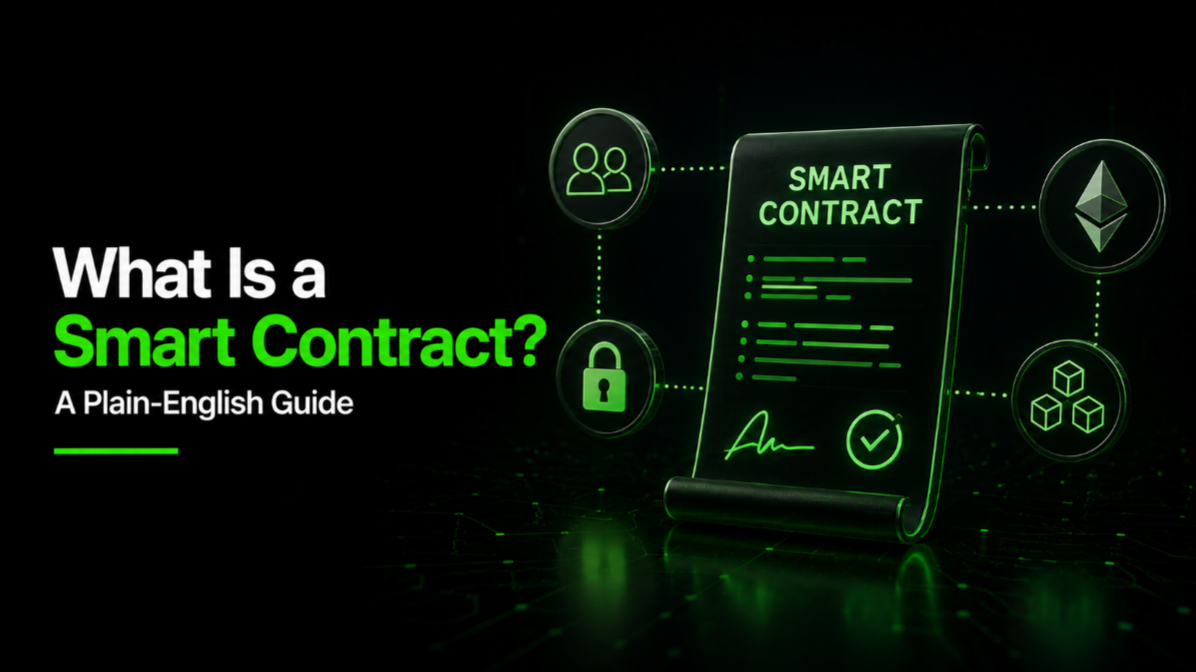
A smart contract is a program stored on a blockchain that runs automatically when triggered. It is not a legal contract. It is software with predefined rules that executes exactly as written, no matter who you are or where you are. This one concept — putting arbitrary code on a public blockchain — is what turned crypto from "digital money" into the entire DeFi, NFT, and Web3 ecosystem. This guide explains what smart contracts actually are, how they work, real production examples with dollar volumes, and the real risks you should understand.
The one-sentence definition
A smart contract is a program on a blockchain that anyone can call, whose code runs deterministically according to its rules, and whose state everyone can verify.
That is the entire concept. Once deployed, the contract runs forever. No company hosts it. No maintainer can shut it down (unless the code explicitly allowed for it). No middleman decides who gets to use it. Users interact directly with the code by sending transactions from their wallets.
The vending machine analogy
A vending machine is the physical-world analog. You insert money, press a button, and receive a snack — no cashier required. The machine's rules are hardcoded and predictable. You don't need to trust the vendor; you trust the machine.
A smart contract works the same way, except with digital money and digital operations. Instead of "insert coin, press A, get snack," it might be "send 1 ETH, receive 3,000 USDC" (a token swap) or "deposit 10 ETH as collateral, borrow 6,000 USDC" (a lending operation).
The critical difference: a smart contract doesn't need to be physically located anywhere. It runs on the blockchain, accessible to anyone with a wallet, from anywhere in the world, 24/7.
How a smart contract actually works
A smart contract is written in a programming language — Solidity for Ethereum and EVM-compatible chains, Rust for Solana. Developers compile the code and deploy it to the blockchain as a transaction. Once deployed, the contract has an address (similar to a wallet address). Anyone can send transactions to that address, triggering the contract's functions.
The typical workflow, using a token swap as an example:
- You visit uniswap.org, connect your wallet, and enter "swap 1 ETH for USDC."
- The interface constructs a transaction calling Uniswap's smart contract with your parameters.
- You sign the transaction with your wallet's private key.
- Your wallet broadcasts the signed transaction to the Ethereum network.
- Validators include it in the next block. The Uniswap smart contract's code executes: it takes your ETH, calculates the swap ratio based on its pool, and sends you USDC.
- Within about 12 seconds, the swap is complete, on-chain, and irreversible.
No employee at Uniswap participated. No customer support was needed. The code executed exactly as written, verifiable by anyone with an internet connection.
Real production examples in 2026
The smart contracts you actually interact with as a crypto user in 2026:
- Uniswap V4 — The largest decentralized exchange. Processes tens of billions of dollars per month in swaps. Every trade is a smart contract call.
- Aave — The largest lending protocol. Over $20 billion in deposits. All lending logic executes in smart contracts, without any human loan officer.
- USDC — Circle's stablecoin. Each of the 40+ billion USDC in circulation is a smart contract record. Transfers, mints, and burns all execute on-chain.
- OpenSea, Blur, Magic Eden — NFT marketplaces. All ownership transfers happen through smart contracts.
- Lido — Ethereum liquid staking. Users deposit ETH, get stETH; a smart contract manages the staking on their behalf.
- Ethereum Name Service (ENS) — The system behind human-readable names like "vitalik.eth." All name registrations are smart contract transactions.
For deeper coverage of the DeFi ecosystem that runs on smart contracts, see What Is DeFi?.
What smart contracts CAN do
- Programmable money movement. Automatic escrow, subscription payments, revenue splits between multiple parties, conditional transfers.
- Permissionless financial services. Anyone with a wallet can access lending, trading, insurance, derivatives — without an application process.
- Verifiable rules. You can inspect the code before interacting. No hidden fees, no fine print — the smart contract's source code is the entire agreement.
- Composability. Smart contracts can call other smart contracts. Complex financial products (yield vaults, aggregators, multi-step strategies) build on simpler primitives.
- Global access. Same code, same rules, same experience for a user in Tokyo, Buenos Aires, or Lagos.
What smart contracts CANNOT do
Understanding the limits is as important as understanding the capabilities.
- Access data outside the blockchain (natively). A smart contract cannot check the weather, look up a stock price, or read your email. External data requires oracles — separate systems (Chainlink, Pyth) that publish data on-chain in a form smart contracts can read.
- Reverse mistakes. Once executed, transactions cannot be undone. If a bug in the code drains funds, those funds are gone unless the code included specific admin functions.
- Enforce anything off-chain. A smart contract can enforce "if X happens on-chain, transfer Y." It cannot enforce "if you don't deliver the widget, the customer gets a refund" — the widget delivery is off-chain and needs someone (or an oracle) to report it.
- Adapt to changing law. A smart contract executes its code. Compliance with tax laws, sanctions, or KYC requires wrapper systems or off-chain enforcement.
The real risks
1. Code bugs and exploits
The largest risk. Smart contracts hold billions of dollars. If a bug in the code lets an attacker drain the contract, funds are gone. Notable losses:
- Poly Network (2021): $611M drained via a signature verification bug (mostly returned by the attacker).
- Ronin Bridge (2022): $625M stolen via compromised validator keys.
- Wormhole Bridge (2022): $325M stolen via a signature verification bug.
- Euler Finance (2023): $200M drained via a donation-attack vector (mostly returned after negotiation).
Defense: use protocols with multi-year track records, multiple independent audits, active bug bounties, and strong public documentation. Avoid new or unaudited protocols. See
DeFi Risks Explained for more.
2. Malicious approvals (ice phishing)
A user signs a transaction that grants unlimited spending permission to a malicious contract. Later, that contract drains their tokens. This is one of the most common ways individual DeFi users lose funds.
Defense: never approve unlimited token spend when a specific amount is possible. Revoke stale approvals every few months (revoke.cash, etherscan token approval checker).
3. Governance attacks
Many protocols have governance tokens that let holders vote on changes. If an attacker acquires enough tokens (through flash loans or market buys), they can pass malicious proposals.
Defense: prefer protocols with vote delay periods, timelocks on treasury actions, and diverse token distribution.
4. Composability risks
Because smart contracts can call each other, a bug in Protocol A can cascade into Protocol B, C, and D that depend on it. This is called "composability risk" and is unique to DeFi.
Defense: understand your DeFi positions' dependencies. If your yield strategy depends on 5 protocols working correctly, your risk is the union of all 5.
The immutability trade-off
Smart contracts are typically immutable — you cannot change the code after deployment. This is both their greatest strength and greatest weakness.
- Strength: No one can modify the rules after you've committed funds. Uniswap can't change its fee structure to your disadvantage retroactively.
- Weakness: Bugs cannot be fixed easily. Emergency patches require complex proxy patterns or admin functions that create their own risks.
Most modern protocols use "upgradeable proxies" that let developers deploy new versions of the code while preserving state and address. This helps with bug fixes but introduces new trust: whoever controls the upgrade keys can change the contract behavior.
A smart contract is a promise you can verify. Traditional business relies on the promise-maker's reputation and legal system to enforce agreements. Smart contracts move the enforcement into the code itself — which is more reliable when the code is correct, and more devastating when it isn't.
Continue learning
The natural next reads: What Is Ethereum? · What Is DeFi? · DeFi Risks Explained · Blockchain Technology Explained.