Choosing the right crypto exchange in 2026 is one of the most important decisions a trader can make. With hundreds of platforms competing for your attention — centralized powerhouses processing billions in daily volume, and decentralized protocols where you keep full custody of your assets — the landscape has never been richer or more complex. This guide cuts through the noise: we compare the top 5 CEX and top 3 DEX platforms, break down fees, KYC requirements, security, and geographic restrictions, and give you a clear framework for picking the exchange that actually fits your goals.
What Is a Crypto Exchange?
A crypto exchange is a marketplace where buyers and sellers trade digital assets. Exchanges match orders, provide liquidity, and in many cases act as custodians of user funds. They range from fully regulated, bank-grade platforms like Coinbase, to permissionless on-chain protocols like Uniswap that run entirely on smart contracts.
Every exchange has three core components: an order book (or automated market maker), a matching engine, and a settlement layer. Understanding which model a platform uses — and what trade-offs come with it — is the first step toward making an informed choice.
- Order book exchanges (Binance, Kraken): buyers and sellers post limit/market orders that the engine matches.
- AMM-based DEXs (Uniswap, Curve): liquidity providers deposit token pairs into pools; trades execute against the pool at algorithmically determined prices.
- Hybrid models (dYdX, Hyperliquid): off-chain order books settled on-chain for speed without sacrificing self-custody.
CEX vs DEX: Core Differences
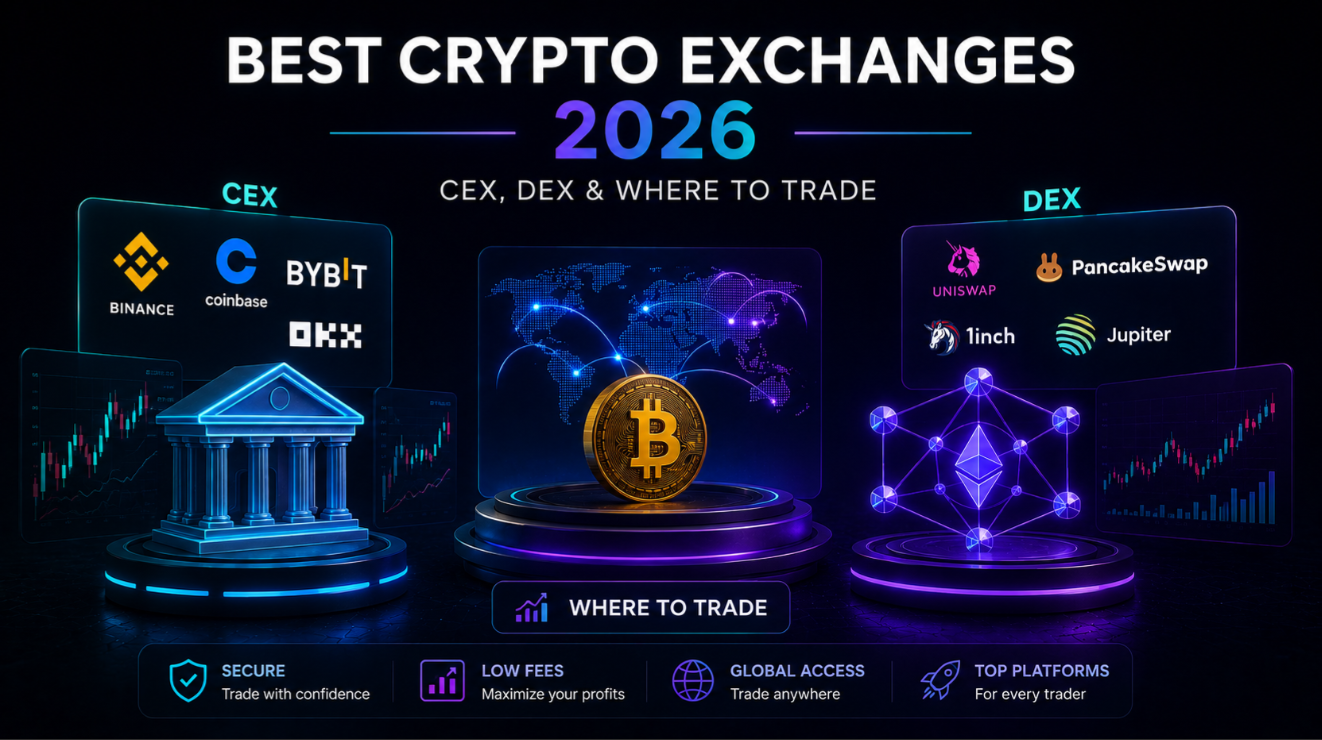
Centralized exchanges (CEX) and decentralized exchanges (DEX) represent fundamentally different philosophies. CEXs are operated by a company, hold user funds in custodial wallets, and act as an intermediary. DEXs are smart-contract protocols — no company controls them, no KYC is required, and you trade directly from your own wallet.
- Custody: CEX holds your keys; DEX — you hold your keys.
- KYC: CEX requires identity verification; DEX requires only a wallet.
- Liquidity: CEX generally has deeper order books for majors; DEX liquidity can fragment across pools.
- Speed: CEX off-chain matching is near-instant; DEX speed depends on the blockchain (Ethereum ~12 s, Solana ~400 ms).
- Fiat on-ramp: CEX supports bank transfers, cards; DEX requires crypto already in your wallet.
- Regulatory risk: CEX accounts can be frozen; DEX positions are controlled solely by your private key.
Neither model is universally superior. Most active crypto users maintain accounts on both — a CEX for fiat on/off-ramps and high-volume trading, and a DEX for DeFi-native strategies, long-tail tokens, and self-sovereign access.
Top 5 Centralized Exchanges (CEX) in 2026
1. Binance — World's Largest by Volume
Binance processes more daily trading volume than the next three CEXs combined. Its product suite is unmatched: spot, perpetuals, options, copy-trading, staking, Launchpad for new projects, and a native blockchain (BNB Chain). Fees start at 0.1 % spot (reduced by BNB holdings or high volume), and Binance Futures fees are as low as 0.02 % maker / 0.05 % taker. The main trade-off is regulatory complexity — Binance operates under multiple regional entities and has faced enforcement actions in several jurisdictions.
Full review: Binance review.
2. Coinbase — Best for US Retail & Institutional
As a publicly listed company (NASDAQ: COIN), Coinbase is the gold standard for regulatory compliance in the United States. Advanced Trade (formerly Coinbase Pro) brings maker fees down to 0 % at high tiers. Coinbase Institutional serves hedge funds and corporations. The downside: standard retail fees (up to 1.49 %) are the highest in this list. Its Base L2 network is a growing DeFi hub.
Full review: Coinbase review.
3. Bybit — Derivatives & High-Leverage Trading
Bybit built its reputation on perpetual contracts — its interface, liquidation engine, and risk controls are purpose-built for derivatives traders. In 2024–2025 Bybit expanded aggressively into spot, copy-trading, and the Bybit Web3 wallet. Maker/taker fees on perpetuals are 0.01 % / 0.06 %. Bybit is not available in the US or several other restricted markets.
Full review: Bybit review.
4. Kraken — Regulated, Secure, Trusted
Kraken has operated since 2011 without a major hack — a remarkable record. It was among the first exchanges to obtain a US bank charter (Wyoming SPDI). Kraken Pro offers 0 % maker fees up to $50 k monthly volume, and the exchange holds a strong reputation in Europe and Canada. Product breadth is narrower than Binance, but Kraken's security track record and regulatory standing are unmatched.
Full review: Kraken review.
5. OKX — Full-Stack Web3 Platform
OKX has transformed from a derivatives exchange into a comprehensive Web3 ecosystem. Its built-in Web3 wallet connects to hundreds of dApps across 90+ blockchains without leaving the app. Spot and futures fees are competitive (0.08 % taker). OKX's NFT marketplace, DEX aggregator, and Earn products round out a platform that blurs the line between CEX and DeFi gateway.
Browse all exchange ratings: Crypto Exchange Ratings.
Top 3 Decentralized Exchanges (DEX) in 2026
1. Uniswap — The AMM that Started DeFi
Uniswap V4 introduced "hooks" — custom logic that can be attached to any pool, enabling dynamic fees, on-chain limit orders, and TWAMM (time-weighted average market making). It remains the most forked protocol in crypto and the default reference for DeFi liquidity. Available on Ethereum, Arbitrum, Optimism, Base, Polygon, and more. Default swap fee: 0.3 % for most pools, with 0.05 % and 1 % tiers also available.
Full review: Uniswap review.
2. Hyperliquid — On-Chain Perpetuals, CEX Speed
Hyperliquid launched its own L1 blockchain optimized for on-chain order books with sub-second finality. Unlike most DEX perpetual protocols, Hyperliquid uses a fully on-chain limit-order book rather than an AMM — so you get the familiar CEX trading experience without surrendering custody. No KYC. Native token HYPE governs the protocol. Daily volume regularly exceeds $2 B, making Hyperliquid the largest decentralized perps venue by volume.
3. Jupiter — Solana's DEX Aggregator & Perps
Jupiter aggregates liquidity across all Solana DEXs — Orca, Raydium, Meteora, and dozens more — to route your swap through the optimal path. Its perpetuals product (JLP pool) lets traders open leveraged positions up to 100× on SOL, ETH, and BTC with sub-cent transaction costs. Jupiter's launchpad (Jupiter Start) has become the go-to venue for new Solana token launches. For Solana-native traders it is the single most important DeFi URL.
Track live prices of these assets on our Bitcoin market page.
KYC vs No-KYC: What You Need to Know
Know Your Customer (KYC) is the identity verification process required by regulated financial entities. All major CEXs require at minimum a government ID; some require a selfie, proof of address, and source-of-funds documentation for large withdrawals.
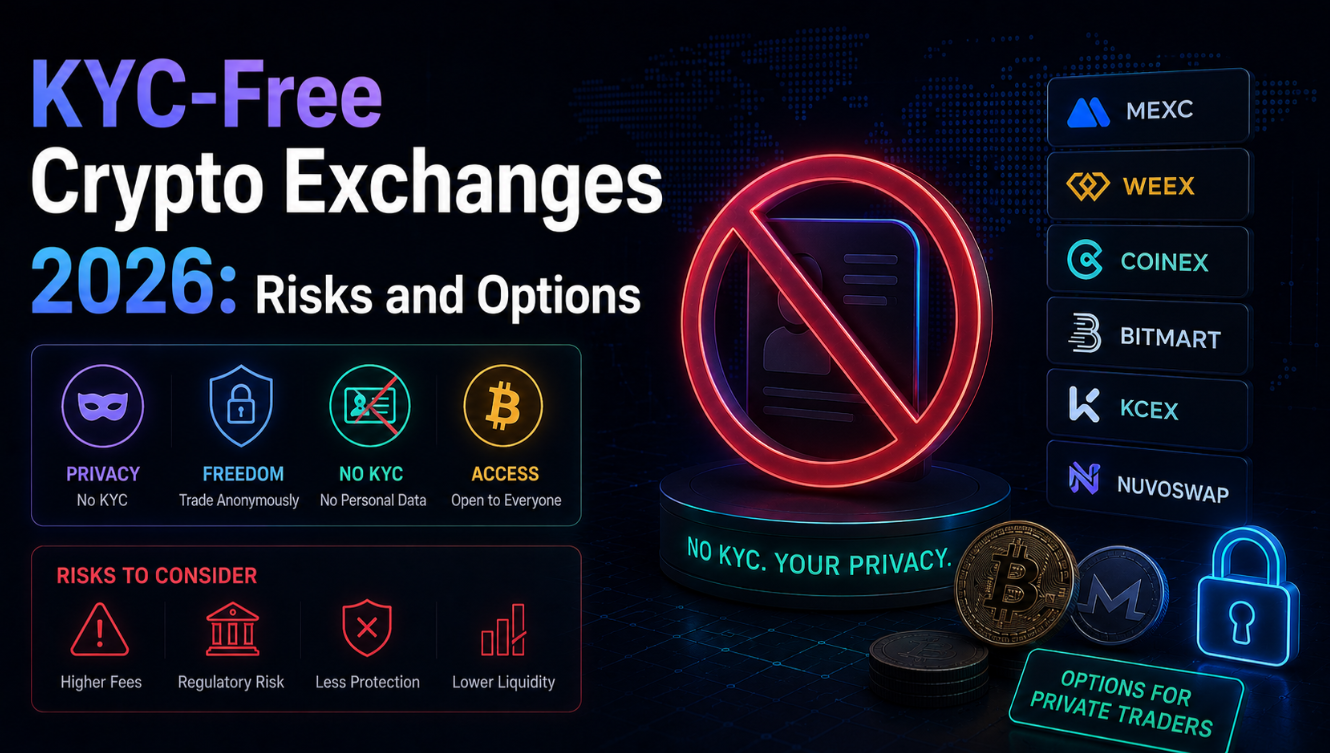
DEXs and some offshore CEXs operate without KYC. No-KYC exchanges typically allow small withdrawals (e.g., 2 BTC/day on Bybit without KYC) but limit fiat on-ramps. The trade-offs:
- KYC advantages: fiat on/off-ramps, higher limits, account recovery, regulatory protection.
- KYC risks: data breach exposure, government subpoena access, potential account freeze.
- No-KYC advantages: privacy, censorship resistance, no documentation burden.
- No-KYC risks: no recourse if funds are lost, limited fiat options, possible legal grey area depending on jurisdiction.
For most beginners, completing KYC on one regulated exchange (Coinbase, Kraken) is the pragmatic choice. Advanced users often keep a portion of assets on self-custodied DEX positions as a hedge against platform risk.
Fee Comparison: CEX & DEX Side by Side
Fees vary dramatically across platforms and depend on your trading volume tier, whether you use a native token discount, and the asset pair. Below are typical effective fees for a new retail user with <$10 k/month volume:
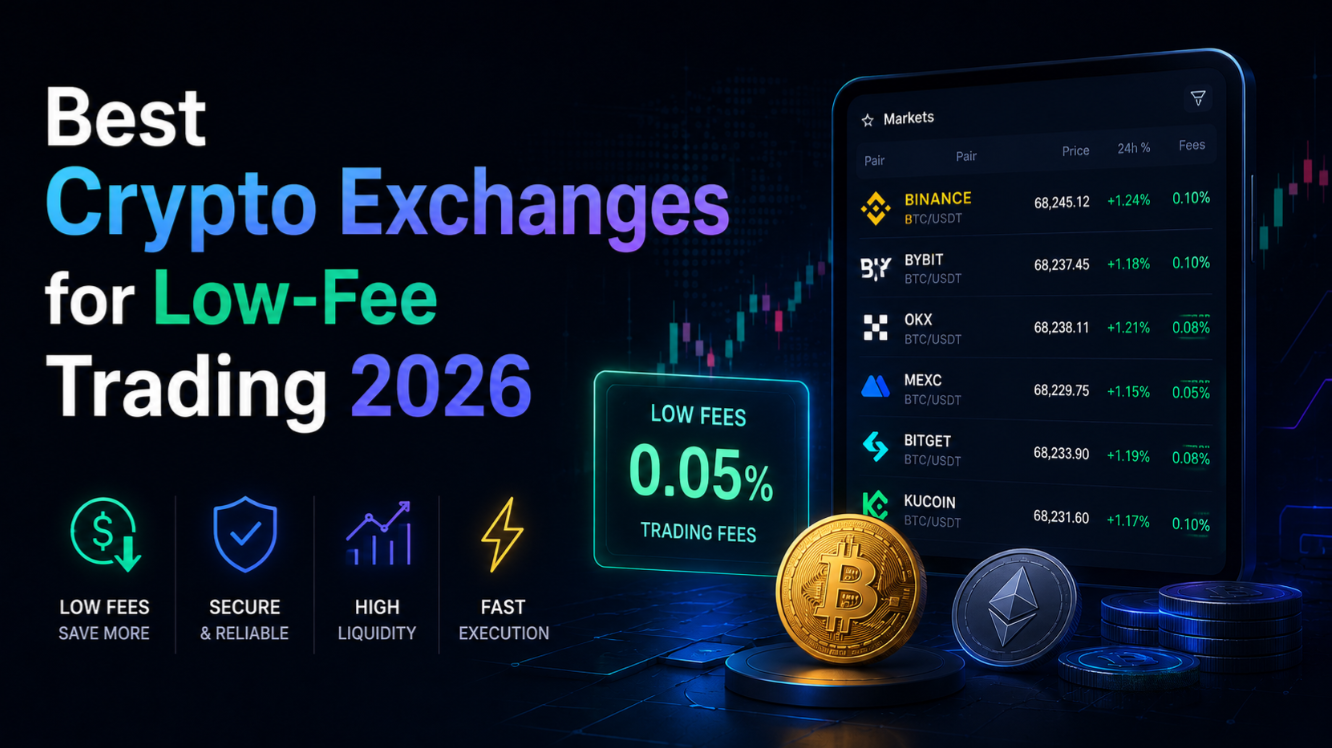
- Binance Spot: 0.10 % taker / 0.10 % maker (–25 % with BNB)
- Coinbase Advanced: 0.60 % taker / 0.40 % maker (base tier)
- Bybit Spot: 0.10 % taker / 0.10 % maker
- Kraken Pro: 0.26 % taker / 0.16 % maker
- OKX Spot: 0.10 % taker / 0.08 % maker
- Uniswap V4 (0.3 % pool): 0.30 % (no maker/taker split) + gas ~$0.50 on L2
- Hyperliquid Perps: 0.025 % taker / 0.002 % maker (subsidized by protocol)
- Jupiter Swap: 0.1–0.3 % depending on route + ~$0.001 Solana gas
Hidden fees to watch: withdrawal fees (CEX), slippage on large DEX swaps, spread on instant-buy widgets (often 1–3 %), and funding rates on perpetual positions that can compound aggressively.
Security Checklist: How to Protect Your Assets
The exchange you choose is only as safe as the security practices you enforce on your account. Use this checklist before you deposit:
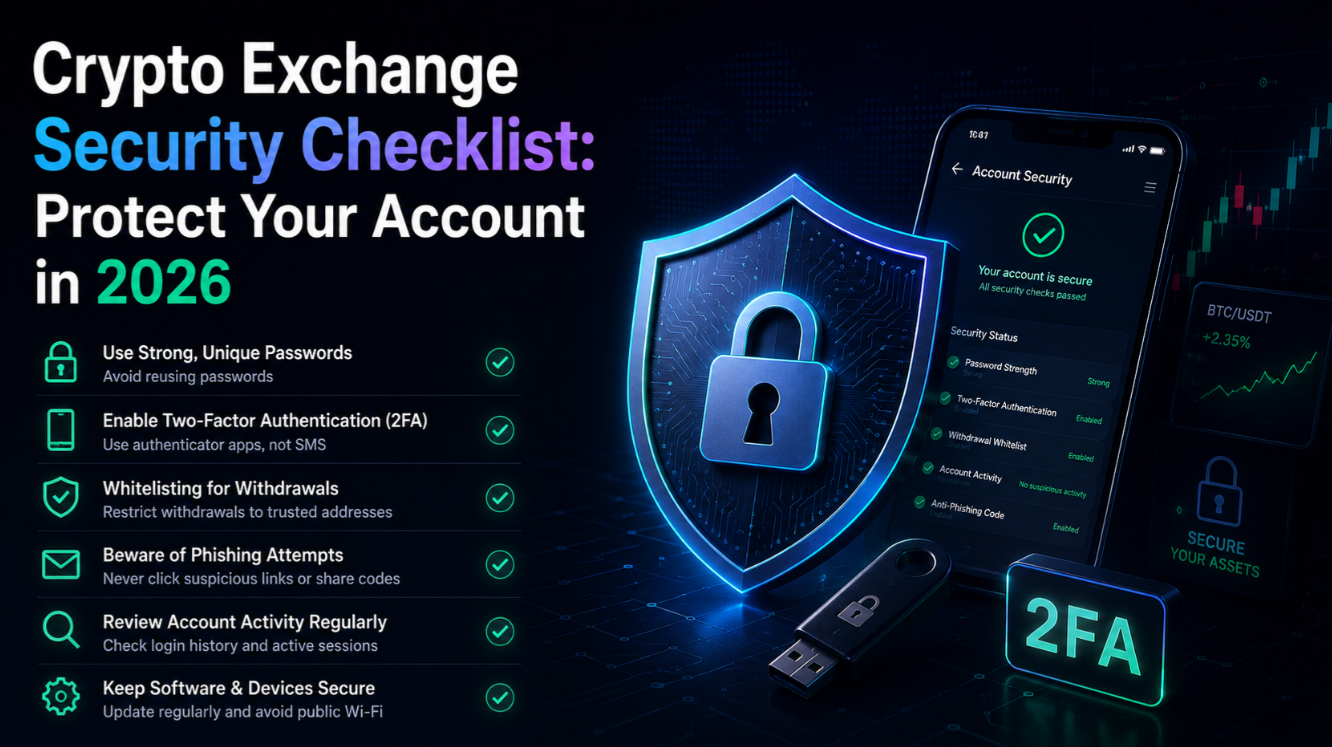
- Enable hardware-key 2FA (YubiKey or similar). SMS 2FA is vulnerable to SIM-swap attacks.
- Use a unique, strong password stored in a password manager — never reuse credentials.
- Whitelist withdrawal addresses: restrict withdrawals to pre-approved wallets with a 24–48 h delay for new addresses.
- Enable anti-phishing codes (Binance, Bybit, OKX): a secret phrase displayed in every genuine email from the exchange.
- Verify the URL every time — bookmark the exchange rather than searching. Phishing domains are active.
- Limit API key permissions: grant only read + trade; never grant withdrawal permissions to third-party bots.
- Keep the bulk of your holdings in cold storage. Only keep on exchange what you need for active trading.
- Check Proof-of-Reserves: reputable exchanges (Binance, Kraken, Bybit, OKX) publish regular on-chain attestations.
Rule of thumb: the exchange is a trading tool, not a savings account. Move profits to a hardware wallet.
Geographic Restrictions: Who Can Use What
Exchange availability is fragmented by regulation. Here is a practical breakdown for 2026:
- United States: Coinbase, Kraken, Gemini, Crypto.com fully licensed. Binance.US (limited), Bybit, OKX, and the global version of many exchanges are unavailable. DEXs are generally accessible.
- European Union: Most major CEXs operate under MiCA (Markets in Crypto-Assets) licenses. Binance, Kraken, Coinbase, OKX all active.
- United Kingdom: FCA-registered exchanges only (Coinbase, Kraken). Binance.com withdrew FCA registration in 2023 but returned under a new registration in 2025.
- Canada: IIROC-registered platforms (Coinbase, Kraken). Binance exited Canada in 2023 and has not yet re-registered.
- Australia: AUSTRAC-registered. Binance, OKX, Coinbase, Kraken all active.
- Sanctioned jurisdictions (Iran, North Korea, Cuba, Russia partially): all regulated CEXs block access; DEXs are technically accessible via VPN but may breach sanctions laws — seek legal advice.
Always verify the exchange's current availability in your country on its official website, as regulatory status changes frequently.
How to Pick the Right Exchange for You
There is no single best exchange — the right answer depends on your profile. Use this decision matrix:
- New to crypto, want to buy with fiat: start with Coinbase (US) or Kraken (global). Clean UX, strong compliance, fiat rails.
- Cost-conscious spot trader: Binance or OKX — best fee tiers, deepest liquidity across hundreds of pairs.
- Active derivatives / futures trader: Bybit or Binance Futures. Both offer advanced charting, portfolio margin, and deep perpetuals liquidity.
- DeFi-native / Ethereum ecosystem: Uniswap V4 on Arbitrum or Base. Low gas, maximum pool selection.
- High-frequency perps without KYC: Hyperliquid. On-chain order book, no sign-up required, deepest decentralized derivatives liquidity.
- Solana-native trader: Jupiter for swaps and leveraged positions. Sub-cent fees, fastest settlement.
- Privacy-focused: non-custodial DEXs (Uniswap, Jupiter) + a privacy L2 or mixer for on-ramp/off-ramp.
- Institutional / large volume: Coinbase Prime, Kraken Institutional, or Binance VIP — all offer OTC desks, prime brokerage, and custody.
For a ranked list of exchanges with detailed scores across 12 criteria, see our Exchange Ratings hub.
Risks to Keep in Mind
Every exchange carries risk — no platform is immune. The collapse of FTX in November 2022 wiped out billions in user funds overnight and remains the starkest modern lesson. Key risks to evaluate before depositing:
- Counterparty risk: custodial CEX holds your funds — insolvency or hack means potential loss. Mitigate by diversifying across platforms and using cold storage.
- Smart contract risk: DEX funds can be drained if a vulnerability is exploited. Prefer audited protocols with long track records and active bug-bounty programs.
- Regulatory risk: exchange operations can be suspended or restricted by government order. Maintain the ability to withdraw to self-custody at any time.
- Liquidity risk: low-cap tokens may have thin order books on CEX and high slippage on DEX pools. Check depth before entering a large position.
- Operational risk: exchange downtime during volatile markets is common — maintain backup accounts and set limit orders rather than relying on market orders during chaos.
Conclusion: CEX + DEX — A Balanced Approach
The best crypto traders in 2026 use both centralized and decentralized exchanges strategically. A regulated CEX provides the fiat on-ramp, compliance comfort, and deep liquidity you need for most trading. A DEX wallet — whether on Ethereum via Uniswap or Solana via Jupiter — gives you uncensorable access to DeFi yields, new token launches, and full self-custody.
Start with one reputable CEX, complete KYC, and buy your first Bitcoin or Ethereum. Then explore a DEX wallet once you're comfortable with seed phrases and gas fees. Review exchange ratings regularly — the landscape shifts fast, and yesterday's leader can become tomorrow's cautionary tale.
Track real-time prices: Bitcoin price.