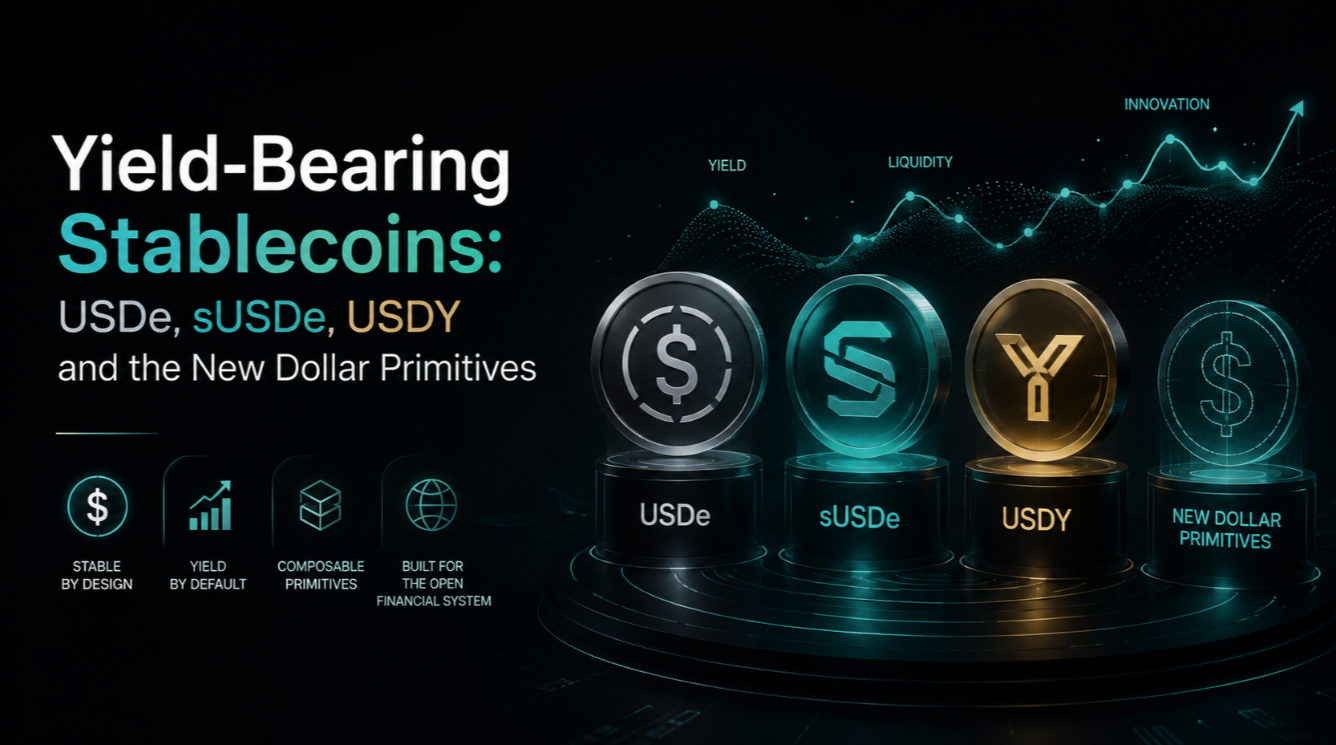
By April 2026, the stablecoin market crossed roughly $311 billion in total supply. About 7% of that — somewhere north of $20 billion — sits in tokens that pay their holders interest directly. Three years ago, this category barely existed. Today, Ethena's USDe is the third-largest stablecoin in circulation, Ondo's USDY trades on five chains with $740M in supply, and BlackRock's BUIDL has crossed $2.5B in AUM and become accepted collateral on Crypto.com, Deribit, and the M0 stablecoin platform.
The shift matters because it changes what a stablecoin is. A traditional stablecoin — USDC, USDT — is a payment rail that pays nothing. A yield-bearing stablecoin is a payment rail bolted onto a yield strategy, and the holder absorbs both. That second part is what most "what is USDe" explainers skip.
This guide breaks down the three real yield mechanisms in production today, the specific products that use each, the failure modes you accept when you hold them, and the regulatory shift that is about to reshape the entire category. If you currently park idle capital in USDC, this is the decision matrix.
The three mechanisms that generate yield
Every yield-bearing stablecoin in 2026 fits one of three architectures. The wrapper looks similar — you hold an ERC-20, the redemption value drifts up over time or your balance rebases — but the source of the yield, and therefore the source of the risk, is completely different.
Tokenized Treasury yield. The issuer holds short-duration US Treasuries (typically 3-month T-bills) and bank deposits in a regulated off-chain vehicle. Interest from those instruments flows through to the token. This is what USDY, BUIDL, OUSG, and USDM do. The yield in April 2026 sits around 4.3-4.7% APY, set by the front end of the Treasury curve. The mechanism is essentially a money-market fund with a blockchain wrapper.
Delta-neutral basis trade. The issuer holds long crypto collateral (ETH, BTC, liquid staking tokens) and opens equal-and-opposite short positions in perpetual futures. The portfolio is dollar-neutral by construction: collateral drops 50%, the short prints, net USD value is unchanged. The yield comes from the perpetual funding rate (which is positive most of the time because longs pay shorts in bull markets) plus staking rewards on LST collateral. This is what Ethena's USDe and sUSDe do. APY has run 10-15% through 2026 with spikes above 20% in high-funding regimes.
DSR-style protocol revenue. A DeFi protocol earns revenue from lending fees, RWA collateral, or stability fees and distributes it via a savings rate. Sky's sUSDS pays roughly 4-4.5% APY in early 2026 from a mix of RWA holdings and protocol stability fees. The yield is governed by the protocol's allocator and changes through DAO votes.
The Treasury path is the simplest to understand and the easiest to model. It's a duration bet on US short rates — when the Fed cuts, your yield compresses. The basis-trade path is more interesting and more fragile: yield comes from market structure, not from rates, which is why it can pay double-digit APY even after Fed cuts, but also why it can collapse to zero or negative in a matter of weeks.
USDe and sUSDe: the synthetic dollar that runs a hedge fund inside
Ethena's USDe is the product that put yield-bearing stablecoins on the map. As of Q1 2026, USDe sits at roughly $5.9 billion in supply with sUSDe (the staked, yield-accruing version) at around $2.8 billion. The ratio of staked to unstaked — roughly 47-55% across recent quarters — is the cleanest gauge of how confident the holder base is in the yield mechanism at any given moment.
The mechanism is a textbook delta-neutral basis trade. To mint 1 USDe, Ethena takes $1 worth of crypto collateral (a mix of stETH, spot BTC, USDT, USDC, and other approved assets) and opens a short position in perpetual futures sized to offset the spot exposure. If ETH falls 50%, the short prints 50% in profit terms; the net dollar value of the portfolio stays at $1. That is what "delta-neutral" means in practice: the portfolio has zero sensitivity to the underlying asset's price.
Critically, the collateral does not sit on a centralized exchange. Ethena uses what's called Off-Exchange Settlement (OES) — collateral remains in institutional custody (Copper, Fireblocks, Ceffu) and only PnL settles back and forth with the exchange. This is the structural protection against an FTX-style counterparty failure: even if Binance, Bybit, or OKX collapses overnight, Ethena's collateral is not on their books.
The yield, paid out to sUSDe holders, comes from two sources. Source one is the perpetual funding rate. In a bull market, leveraged longs pay funding to shorts every eight hours; Ethena is permanently short, so it permanently receives that funding. Historical funding on ETH and BTC perps has averaged 8-12% annualized over multi-year periods, with spikes well above 30% during euphoric phases. Source two is staking rewards on the LST portion of the collateral — stETH currently yields around 3.2% APY, and that flows through.
The two-token design is what trips most people up. USDe is the base token; you can use it freely as DeFi collateral, in LPs, as a payment medium. It pays no yield. sUSDe is what you get when you stake USDe in the Ethena protocol — it's an ERC-4626 vault share whose redemption value rises over time as the protocol drips rewards in over rolling 8-hour intervals. Holding USDe earns nothing. Holding sUSDe earns the basis trade. You unstake sUSDe back to USDe with a 7-day cooldown.
Why would anyone hold the non-yielding version? Because most DeFi protocols accept USDe as collateral but treat sUSDe as a different (and often less liquid) asset. If you want to lever USDe into a Pendle PT or use it on Aave, you typically hold USDe. If you just want to park capital and earn, you hold sUSDe.
USDY and BUIDL: Treasuries with a transfer agent
USDY and BUIDL look superficially similar to USDe — they're both ERC-20 tokens, both pay yield, both quote APYs in the same ballpark — but mechanically they're closer to a money-market fund unit than to a synthetic dollar. They hold T-bills, and they pass the interest through.
Ondo's USDY is the broader-distribution product. It's structured as a senior unsecured note issued by Ondo USDY LLC, a Delaware bankruptcy-remote vehicle that holds the underlying portfolio: short-duration US Treasuries (custodied through Morgan Stanley) plus bank demand deposits at multiple FDIC-insured banks. As of late April 2026, USDY pays 4.65% APY, has $740M outstanding across Ethereum, Solana, Mantle, Sui, Aptos, and Sei, and trades at approximately $1.117 — the premium to $1 reflects accumulated yield since issuance.
USDY uses an accumulating-balance model: the token's redemption value rises over time rather than your balance growing. One USDY today is worth $1.117; in six months at 4.65% it's worth about $1.143. For users who prefer the more traditional rebasing experience, Ondo issues rUSDY (also branded as mUSD on Mantle), a wrapper that maintains a $1 peg and grows your balance instead. Both are interchangeable through a swap contract; the choice is purely about accounting preference.
The hard constraint: USDY is non-US-only. Anyone in the United States, on the OFAC sanctions list, or in a restricted jurisdiction cannot legally hold it. KYC happens at mint; secondary transfers are gated by an onchain blocklist. Issuance follows a cohort model — KYC, USDC deposit, a 40-50 day settlement window before the actual USDY hits the wallet — though once minted, USDY is freely transferable to other whitelisted addresses and composable in DeFi.
BlackRock's BUIDL plays in the same lane but for a different audience. BUIDL is structured as a tokenized share of a BlackRock-managed money-market fund (the USD Institutional Digital Liquidity Fund), tokenized by Securitize, with BNY Mellon as the custodian for the underlying cash and securities. AUM was roughly $2.5 billion in mid-May 2026. It pays around 4.5% APY, distributes dividends monthly (more than $100M cumulatively since launch in March 2024), and is now live on Ethereum, Solana, Polygon, Avalanche, Arbitrum, Optimism, Aptos, and BNB Chain.
The trade-off is access. BUIDL is permissioned and accreditation-gated — minimums historically sat in the $5M range, restricted to qualified institutional buyers. The reach you get as a retail holder is through wrappers: Ondo's OUSG holds BUIDL as collateral, several DeFi-native stablecoins (M0, Frax sfrxUSD) accept BUIDL as backing, and you can get indirect exposure that way. As a direct holding, BUIDL is institutional capital management; USDY is the retail-accessible version of the same idea.
How they actually compare
Most comparison tables flatten these products onto the same axis — "yield 4-5%, low risk" or "yield 10%+, higher risk" — which buries the part that matters. The differences that actually drive outcomes are the source of yield, the redemption mechanics, the regulatory wrapper, and what happens during stress.
Dimension | sUSDe (Ethena) | USDY (Ondo) | BUIDL (BlackRock) |
|---|---|---|---|
Yield source | Perp funding + LST staking | Short-duration T-bills + bank deposits | Short-duration T-bills + repos |
Typical APY (2026) | 10-15%, can spike to 20%+ or compress below T-bill rates | ~4.65% | ~4.5% |
Yield correlation | Crypto market structure (funding rates) | US Fed funds rate / short curve | US Fed funds rate / short curve |
Reserve location | Off-exchange custody (Copper, Fireblocks, Ceffu); shorts on CEXs | Morgan Stanley, FDIC-insured banks | BNY Mellon custody |
Eligibility | Permissionless globally | Non-US KYC required | Accredited institutional only |
Redemption | Mint/redeem at $1 (whitelisted MMs); 7-day unstake for sUSDe | T+1 through Ondo platform | T+0 in-kind to USDC via Circle integration |
Primary risk | Funding goes negative + run on USDe | Issuer default + Treasury duration | Counterparty (BlackRock/BNY) + duration |
Regulatory wrapper | Synthetic dollar (unregulated as such) | Senior unsecured note, non-US distribution | Tokenized 3(c)(7) fund |
The yield gap between sUSDe and the Treasury-backed products is not free money. It's compensation for taking a fundamentally different risk: with USDY or BUIDL you're underwriting the US government's ability to pay short-term debt; with sUSDe you're underwriting the persistent positivity of perpetual funding rates and Ethena's operational ability to manage a multi-billion-dollar derivatives book without a hedging error.
What can actually go wrong
This is the section most beginner guides skip, and it's the only section that matters before you size a position. Yield-bearing stablecoins stack risks from multiple layers; a single product can fail along four independent axes.
Funding rate inversion (sUSDe). Ethena's yield comes from receiving perpetual funding. In a normal market, longs pay shorts. In a sustained bear market or after a leverage flush, funding can flip negative for weeks — shorts pay longs. When that happens, Ethena's strategy loses money on the perp leg. The protocol has a reserve fund (sized at roughly 1.18% of TVL as of Q1 2026) to cushion negative-funding stretches, and the LST yield on the collateral provides a positive baseline. But sustained negative funding combined with a leveraged DeFi unwind is the central risk heading through 2026, and the reserve fund margin is not wide.
Depeg and run risk. USDe maintains its peg through arbitrage by whitelisted market-makers, not through redemption by retail holders. If those MMs stop showing up — because their counterparty risk shoots up, because exchanges halt withdrawals, because the basis trade becomes uneconomic — the peg can drift in secondary markets. sUSDe holders face an additional problem: a 7-day cooldown means you cannot exit on the same day stress hits. If everyone tries to unstake at once, the queue extends. This is run risk, the same dynamic that took down Terra USD, with very different mechanics but the same human behavior.
Issuer and custodian failure (USDY, BUIDL). Treasury-backed products are only as safe as the legal vehicle holding the Treasuries. USDY is structured to be bankruptcy-remote — if Ondo Finance Inc. fails, the LLC holding the Treasuries is supposed to be ring-fenced — but that protection has not been tested in court. BUIDL has BlackRock and BNY Mellon as backstops, which is about as strong as institutional custody gets, but you're still trusting that the custodian's records match the on-chain supply.
Duration risk in disguise. When the Fed cuts rates, the yield on USDY and BUIDL compresses immediately at the short end and over a few months on rolling positions. More subtly, in a rate-cut cycle, demand for tokenized Treasuries can drop just as the underlying yield drops, creating a redemption squeeze. Treat these tokens as duration products, not as cash equivalents that happen to pay interest. Oxford Law and several institutional research desks have made this point through 2025-2026 specifically because the "cash-like" framing understates how rate-sensitive these positions are.
Smart contract and oracle risk. All three products use ERC-20 contracts that have been audited, but they also depend on oracle feeds, off-chain custodians, and (for sUSDe) the integrity of perpetual futures exchanges. Ethena's hedging engine alone is a non-trivial piece of infrastructure that has to maintain delta neutrality across multiple exchanges 24/7.
Regulatory tail risk. This one is new and important. The US GENIUS Act, signed in 2025, explicitly prohibits permitted payment stablecoin issuers (PPSIs) from paying interest or yield to holders "solely in connection with holding or using the stablecoin." Final implementing regulations are targeted for July 2026, with the law taking effect no later than January 18, 2027. The EU's MiCA framework has a parallel prohibition. Neither directly bans synthetic dollars like USDe (which are not classified as payment stablecoins) or tokenized Treasury notes like USDY (which are securities, not stablecoins under the statute). But the regulatory line between "stablecoin that pays interest" and "tokenized security that resembles a stablecoin" is being drawn right now, and it will reshape which products are accessible in which jurisdictions.
Choosing a product for a real portfolio
The honest answer is that no single yield-bearing stablecoin fits every use case. The right framework is to match the product to the role the capital plays.
For idle treasury cash that needs to be liquid within a day and absolutely cannot break the buck, neither sUSDe nor USDY is the right tool. Hold USDC at a regulated custodian, accept that you earn nothing, and use yield-bearing products for capital that has a defined role.
For waiting capital sized at less than 20% of your stablecoin book, with a tolerance for 7-day redemption windows and the possibility of a 1-2% drawdown during stress, sUSDe is the highest-yield option that still benefits from a robust operational design. The yield variability is the feature, not the bug — you're paid because the strategy can lose money.
For longer-duration capital, non-US holders, and anyone optimizing for a regulatory-compliant Treasury exposure with crypto-native composability, USDY is the cleanest product. The yield is lower than sUSDe, but the failure modes are closer to the worst Treasury MMF defaults in living memory, which is to say: very, very small.
For accredited institutional capital, BUIDL or one of its wrappers (OUSG, M0-backed tokens) gives you institutional custody quality with on-chain settlement. The trade-off is access friction, not yield or safety.
A meaningful number of institutional desks now run a tiered structure: USDC for active trading, sUSDS or USDY for waiting capital, and a small sUSDe sleeve for yield enhancement. The mistake to avoid is treating the wrapper as the strategy — what you actually hold is a basis trade, a Treasury position, or a protocol revenue share, and you should size each one the way you'd size that underlying exposure.
What to verify before you deposit
Before holding any yield-bearing stablecoin in size, three checks separate informed positions from yield chasing.
Verify the reserve composition on the issuer's transparency dashboard. Ethena, Ondo, and BlackRock all publish real-time backing data — look at what is actually backing the token today, not what the marketing page describes. For Ethena, check the ratio of stETH to BTC to USDT in collateral and the exchanges currently used for shorts. For USDY, check the bank-deposit-to-Treasury ratio in the most recent attestation.
Check the redemption mechanics for the specific stress scenario you care about. Mint/redeem at $1 by whitelisted market-makers is not the same as a retail redemption right. If you cannot redeem directly, you depend on secondary-market liquidity and arbitrageur appetite. Read the actual terms of service for any redemption guarantees and the fine print about withdrawal limits during stress.
Confirm jurisdictional eligibility. USDY is non-US-only and enforced through onchain blocklisting. BUIDL requires accreditation. sUSDe is permissionless globally today, but MiCA enforcement and GENIUS Act implementation could change which products are accessible in the EU and the US over the next 12-18 months.
The bigger picture
The yield-bearing stablecoin category exists because there was a multi-trillion-dollar arbitrage sitting on the table. Stablecoin issuers earn interest on the reserves backing their tokens; for years, that interest accrued to the issuer (this is why Tether's parent company is one of the most profitable companies in the world per employee). Yield-bearing stablecoins simply pass that interest through to the holder, either directly (USDY, BUIDL) or by reorganizing the reserve into a strategy that earns more (USDe).
The regulatory response in 2026 is a direct reaction to that. Banks lobbied hard against allowing US-based stablecoin issuers to pay yield — there's a Bank Policy Institute paper from January 2026 arguing that yield-bearing stablecoins reduce bank deposits and lending — and the GENIUS Act prohibition is the compromise that emerged. The result is a bifurcated market: tokens classified as payment stablecoins cannot pay yield; tokens classified as tokenized securities or synthetic dollars can, but with different regulatory wrappers and different access constraints.
What this means in practice is that the category is not going away — it's specializing. USDC and USDT will remain payment rails. USDe, USDY, BUIDL, and the next generation of products will become explicit yield products with explicit risk disclosures. The line between a "stablecoin" and an "on-chain money-market fund unit" is being formalized in real time, and the products that figure out how to live cleanly on one side of that line will dominate the next phase.
For holders, the takeaway is simple. Yield-bearing stablecoins are not better USDC. They are different products with different risks and different roles. Treat them as the rate exposure or the basis-trade exposure they actually are, size them accordingly, and verify the mechanism before chasing the APY.