What is a stablecoin and why it matters
Stablecoins are cryptocurrencies designed to maintain a fixed value — typically $1 — by backing each token with assets, algorithms, or a combination of both. They solve crypto's most practical problem: you cannot pay a supplier or save for a month if your currency fluctuates 20% in a week. Stablecoins give you blockchain-level speed and programmability without the volatility.
The three largest stablecoins by market capitalisation in 2026 are Tether (USDT), USD Coin (USDC), and DAI. Together they account for over $180 billion in circulating supply. Each takes a different approach to stability, transparency, and decentralisation — and each carries a different risk profile.
Tether (USDT): the market leader with a controversial history
Tether (USDT) is the oldest major stablecoin and by far the largest, with over $110 billion in circulation as of early 2026. Every USDT is supposed to be backed 1:1 by reserves held by Tether Limited, a company based in the British Virgin Islands and affiliated with the Bitfinex exchange.
Tether's reserve composition has evolved significantly. After years of controversy about undisclosed commercial paper holdings, Tether now reports its reserves as primarily US Treasury bills — over 80% as of its most recent attestation. The attestations are performed quarterly by BDO Italia, though they remain attestations rather than full audits.
- Circulation: Over $110 billion — largest stablecoin by a wide margin.
- Backing: Primarily US Treasury bills, cash, and cash equivalents. Some secured loans and Bitcoin.
- Transparency: Quarterly attestations by BDO Italia. Not a full independent audit.
- Networks: Available on 20+ blockchains including Ethereum, Tron, Solana, Polygon, Avalanche.
- Redemption: Direct redemption available to verified institutional users with $100,000 minimum. Most retail users buy/sell on exchanges.
USD Coin (USDC): the regulated alternative
USD Coin (USDC) was launched in 2018 by Circle and Coinbase through the Centre Consortium. It has become the preferred stablecoin for US-regulated entities, DeFi protocols, and institutional participants who require stronger compliance credentials than Tether provides.
USDC reserves are held exclusively in cash and short-duration US Treasury securities. The reserves are held in segregated accounts at regulated US financial institutions, including BlackRock's Circle Reserve Fund (a government money market fund). Circle publishes monthly attestation reports by Deloitte — one of the Big Four accounting firms — giving USDC the strongest third-party reserve verification of any major stablecoin.
- Circulation: Around $43 billion — second largest stablecoin.
- Backing: 100% cash and short-duration US Treasuries in regulated US institutions.
- Transparency: Monthly Deloitte attestations. Most transparent major stablecoin.
- Networks: Ethereum, Solana, Avalanche, Polygon, Arbitrum, Base, Optimism, and others. Native multichain via CCTP.
- Redemption: Any KYC-verified Circle account can redeem USDC for USD at 1:1. No minimum requirement for individual redemptions.
DAI: the decentralised stablecoin
DAI is a decentralised, overcollateralised stablecoin created by MakerDAO (now rebranded as Sky Protocol). Unlike Tether and USDC, DAI has no single company behind it — it is issued and governed by smart contracts on Ethereum, with parameters set by MKR token holders through on-chain governance.
DAI maintains its peg through overcollateralisation: to mint $100 of DAI, you must lock up at least $150 worth of collateral (ETH, WBTC, staked ETH, or approved tokens). If collateral value falls below the required ratio, the position is automatically liquidated. DAI also holds significant real-world assets (US Treasuries) in its reserve through MakerDAO's RWA strategy, adding yield generation and stability.
- Circulation: Around $5 billion — smaller but highly battle-tested.
- Backing: Overcollateralised crypto + real-world asset treasuries. No single custodian.
- Transparency: Fully on-chain — all collateral visible in real time via daistats.com.
- Networks: Ethereum native; bridged versions on most major chains.
- Governance: MKR token holders vote on all parameters. Fully decentralised.
Reserve quality comparison: which is safest
Reserve quality is the single most important factor in evaluating a fiat-backed stablecoin. A stablecoin is only as safe as the assets backing it and the institution managing those assets.
- USDC wins on reserve quality: Cash + short-duration Treasuries in regulated US institutions, attested monthly by Deloitte. Closest to money market fund standards.
- Tether is improving but lags: Heavily Treasury-weighted now, but quarterly attestations by a lesser-known firm and historical controversies around reserve composition keep risk perception higher.
- DAI is different: On-chain overcollateralisation gives real-time verifiability no fiat-backed coin can match. But crypto collateral introduces volatility and smart contract risk. The RWA diversification has strengthened its peg resilience.
Decentralisation and censorship resistance
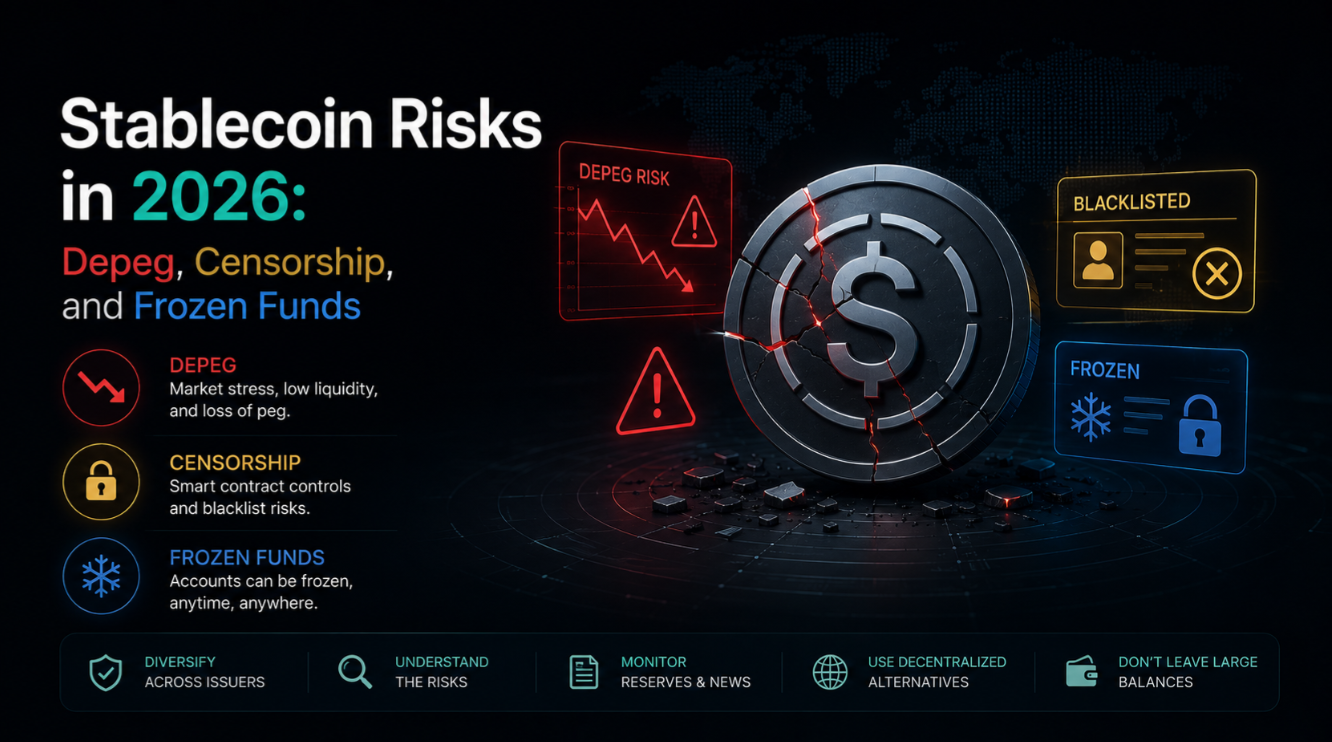
Tether and USDC both maintain address freeze lists. Both issuers can blacklist any wallet, rendering the tokens permanently unmovable. Tether has frozen over $1.5 billion in USDT across hundreds of addresses. Circle has similarly complied with OFAC sanctions and legal orders. If your address is added to a freeze list, your tokens become unmovable.
DAI has no freeze function — no single entity can block a DAI transaction. This makes it far more censorship-resistant for users in jurisdictions where financial sanctions apply or for privacy-sensitive applications.
DeFi integration and yield opportunities
All three stablecoins are deeply integrated in DeFi. USDC is the preferred collateral on Aave and Compound due to its regulatory credibility. DAI is the backbone of MakerDAO's Spark Protocol lending market. USDT dominates trading pairs on centralised exchanges and has the deepest liquidity pools on Tron, which processes the majority of USDT transfers globally.
For yield: DAI holders can lock DAI in the DAI Savings Rate (DSR) contract for a governance-set return, currently around 5–8% APY depending on market conditions. USDC earns competitively on Aave and in Circle's own yield programmes. For more on USDC's institutional infrastructure, see the Coinbase review.
Peg history: how each handled past stress events
The March 2023 SVB banking crisis was the most significant recent test. USDC temporarily depegged to $0.87 when Circle disclosed it held $3.3 billion in deposits at the failed Silicon Valley Bank. The peg was fully restored within 72 hours after US regulators guaranteed SVB deposits. USDT held its peg throughout — its reserves are not held in US bank accounts. DAI depegged slightly (to ~$0.89) due to its large USDC collateral exposure, then recovered.
The lesson: USDC and DAI carry indirect exposure to US banking sector risk. Tether's Treasury-bill-heavy portfolio largely insulates it from bank failure risk, though it introduces issuer counterparty risk with Tether Limited itself.
Which stablecoin is best for which use case
- Trading and CEX pairs: USDT — deepest liquidity on every exchange, accepted everywhere.
- DeFi lending and savings: USDC on Aave/Compound; DAI via Spark DSR for censorship resistance.
- Regulated business payments: USDC — strongest compliance documentation.
- Privacy-sensitive transactions: DAI — no freeze function, no central authority.
- Long-term large balances: USDC for reserve quality confidence; diversify across USDC + DAI for risk distribution.
The risk matrix at a glance
- USDT: issuer risk (Tether Ltd), attestation quality risk, geopolitical jurisdiction risk.
- USDC: banking sector risk (SVB event), issuer risk (Circle), freeze/censor risk.
- DAI: smart contract risk, crypto collateral volatility risk, governance attack risk.
Conclusion: diversification is the smart play
No single stablecoin is risk-free. Professional traders and DeFi users typically hold a portfolio: USDT for exchange liquidity, USDC for yield and DeFi, DAI for censorship-resistant applications. Concentrating entirely in any one stablecoin exposes you to its specific failure mode. Spreading across two or three dramatically reduces the tail risk of any single issuer or mechanism failing.
This article is for educational purposes only. Not financial advice. Stablecoins carry issuer, regulatory, and smart contract risks. Always conduct your own research.