Why stablecoin yield exists
Stablecoin yield is not magic — it comes from somewhere. Understanding the source of yield is the first step in evaluating whether it is sustainable and safe. The primary yield sources in stablecoins are: lending demand (borrowers paying interest), trading fee revenue from liquidity pools, and protocol incentive emissions (governance tokens distributed to attract liquidity).
Lending demand is the most sustainable source: borrowers on Aave or Compound pay variable interest rates, and that interest goes to depositors. When borrowing demand is high (bull markets, leverage-hungry traders), rates rise. In bear markets, rates fall. This yield is real and battle-tested.
The risk spectrum of stablecoin yield
Every yield strategy carries risk proportional to its return. The honest framework is: the higher the APY, the more risk you are accepting somewhere in the stack. Categorising strategies by risk level helps you build a portfolio matching your risk appetite.
- Very low risk (3–7% APY): Aave or Compound supply-side lending of USDC or DAI. Smart contract risk from audited, battle-tested protocols. No liquidation risk. No lock-up.
- Low-medium risk (5–12% APY): Curve stablecoin pools (3pool, FRAX/USDC). Adds liquidity pool risk and CRV token price exposure. Impermanent loss is minimal for stablecoin-only pools.
- Medium risk (8–20% APY): Liquidity mining programmes on newer protocols, leveraged yield strategies, LSD-backed stablecoin pools. Token emissions risk: rewards can disappear overnight.
- High risk (20%+ APY): Ponzi-adjacent emission schemes, new unaudited protocols, structured products with hidden leverage. These APYs rarely last; many protocols exit or get exploited.
Aave: the safest large DeFi lending market
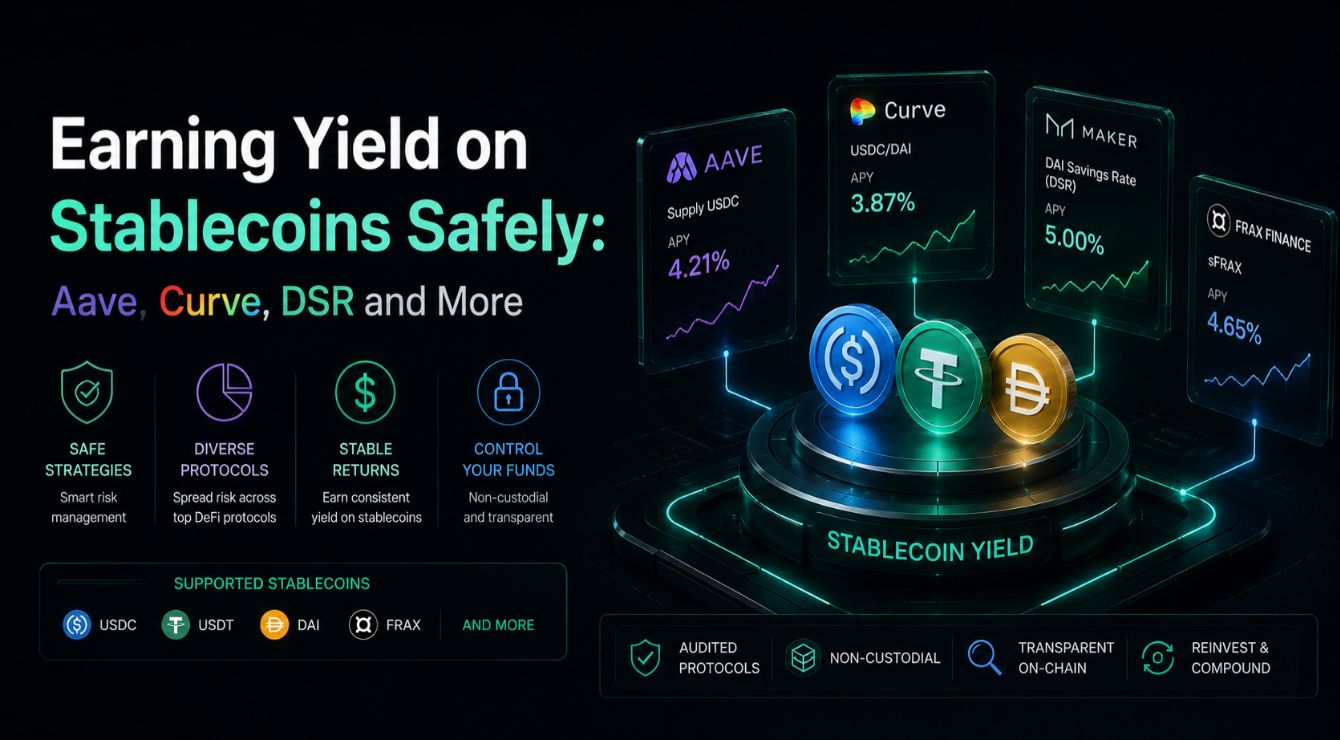
Aave is the largest and most audited DeFi lending protocol with over $15 billion in TVL across Ethereum and multiple L2s. Supplying USDC or USDT on Aave earns the deposit APY from borrowers, with no lock-up period and instant withdrawal.
Aave v3 introduced efficiency mode (emode) and isolation mode, significantly reducing systemic risk from bad debt. Multiple audits from leading firms (OpenZeppelin, Trail of Bits, Consensys), a live $5 million bug bounty, and a Safety Module backstop funded by AAVE stakers provide multiple layers of protection. For most users seeking safe stablecoin yield, Aave v3 on Arbitrum or Base (where gas costs are under $0.10) is the cleanest starting point.
Curve Finance: stablecoin liquidity pools
Curve Finance is optimised for stable-value assets. Its 3pool (USDC/USDT/DAI) is the deepest stablecoin liquidity pool in DeFi. By depositing into the 3pool, you earn trading fees from stablecoin swaps passing through the pool, plus CRV token emissions.
The base fee APY on 3pool is modest (1–4% from fees alone), but CRV emissions boost this to 3–8% for standard depositors, or higher for users who lock CRV for veCRV boosts. Curve is heavily audited and has processed trillions in volume without a direct protocol exploit. The main risk is a stablecoin within the pool depegging, which would cause you to hold more of the depegged asset.
The DAI Savings Rate: yield without a counterparty
The DAI Savings Rate (DSR) lets you deposit DAI into a MakerDAO smart contract and earn yield set by MKR governance. There is no exchange involved, no custody risk from a company — only smart contract risk. The DSR currently pays 5–8% APY and is the simplest stablecoin yield available in DeFi.
The DSR is accessible directly via Spark Protocol (spark.fi), Sky.money (the rebranded MakerDAO interface), or integrated into Aave's DAI market. The rate is funded by MakerDAO's income from lending and real-world assets. It can be lowered or raised by governance vote.
Yield aggregators: automated optimisation
Yield aggregators like Yearn Finance, Idle Finance, and Harvest automatically move stablecoin deposits between the highest-yielding strategies. They handle compounding, harvest governance rewards, and rebalance between protocols. For users who want hands-off stablecoin yield, aggregators offer convenience but add another layer of smart contract risk — the aggregator contract itself.
- Yearn Finance: The oldest and most audited aggregator. USDC and DAI vaults typically earn 5–9% APY through a mix of lending markets and liquidity pools. Strongest security track record.
- Idle Finance: Focused on risk-adjusted yield with Senior/Junior tranches. Senior tranche accepts lower APY in exchange for Junior tranche absorbing first losses.
- Pendle Finance: Allows splitting yield-bearing stablecoins into principal and yield tokens. You can lock in a fixed APY today or buy the yield component at a discount.
Real-world asset (RWA) stablecoins: T-bill yield on-chain
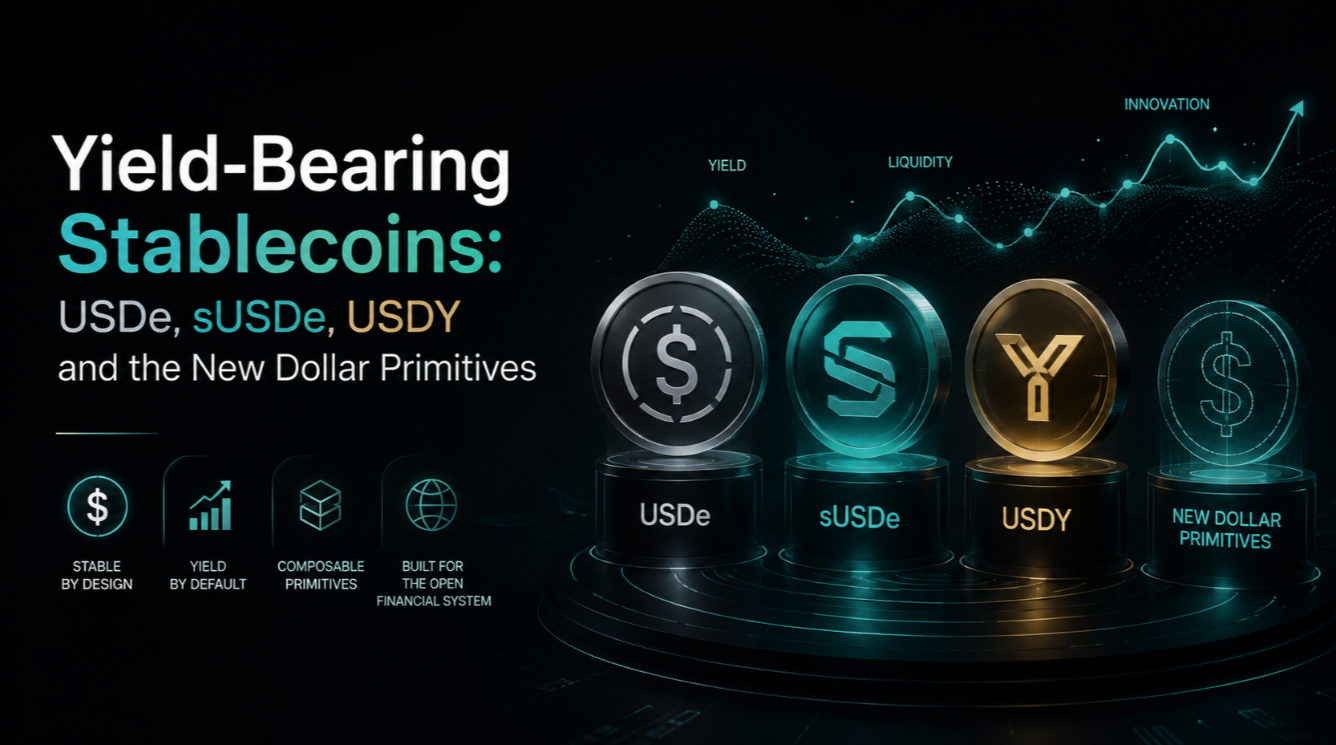
A new category of yield-bearing stablecoins brings US Treasury bill yields directly on-chain. Tokens like USDY (Ondo Finance), BUIDL (BlackRock), and USTB (Superstate) represent tokenised T-bill funds. These earn the current T-bill rate (around 4.5–5.5% as of 2026) with significantly lower DeFi smart contract risk compared to lending protocols.
The trade-off: these tokens require KYC, are restricted to non-US persons or qualified purchasers in some cases, and are less composable in DeFi than standard stablecoins. But for users seeking the safest on-chain dollar yield, tokenised Treasuries represent an increasingly attractive option. See Ethena's USDe for the delta-neutral synthetic approach to yield-bearing stablecoins.
CEX stablecoin yield: simpler but riskier
Centralised exchanges like Coinbase offer stablecoin yield products. Coinbase offers USDC yield directly through its app — currently around 4–6% APY — funded by Circle's T-bill returns. The Coinbase review covers its stablecoin yield product in detail. CEX yield is simpler to access and requires no wallet management, but it introduces counterparty risk: you are lending to the exchange, not holding your own keys.
How to evaluate a new yield opportunity
- Who pays the yield? (Borrowers, trading fees, or token emissions?)
- Is the protocol audited? By whom, and how recently?
- How long has the protocol operated without a significant exploit?
- What is the TVL, and has it been stable or growing?
- Is there a bug bounty programme? What is its maximum payout?
- Can you withdraw immediately, or is there a lock-up?
- What happens to your funds if the protocol is exploited — is there insurance?
A conservative stablecoin yield portfolio
For a user with $10,000 in stablecoins seeking safe yield, a conservative allocation might look like: 40% USDC on Aave v3 (Arbitrum) for liquid, audited lending yield; 30% DAI in the DSR via Spark Protocol for decentralised yield; 20% USDC/USDT in Curve 3pool for fee income; 10% in a tokenised T-bill product for near-zero smart contract risk. This approach diversifies across issuers, yield mechanisms, and smart contracts.
Tax considerations for stablecoin yield
In most jurisdictions, stablecoin yield is treated as ordinary income at the time it accrues. DeFi yield in the form of governance tokens may be taxed at receipt at fair market value. Converting between stablecoins (USDC to DAI, for example) may be a taxable event in some jurisdictions even if there is no gain or loss. Consult a crypto-aware tax professional before deploying significant capital.
Summary: yield source quality ranking
- Lending interest (Aave, Compound): real, sustainable, market-driven.
- Trading fees (Curve, Uniswap): real, sustainable, volume-dependent.
- Real-world asset income (DSR, USDY): real, sustainable, governance or T-bill backed.
- Token emissions (liquidity mining): artificial, temporary, token-price-dependent.
- Ponzi yields (30%+ new protocols): unsustainable, avoid.
This article is for educational purposes only and does not constitute financial or tax advice. All yield strategies carry risk of loss. Past APYs are not indicative of future returns.