The hard truth about stolen cryptocurrency
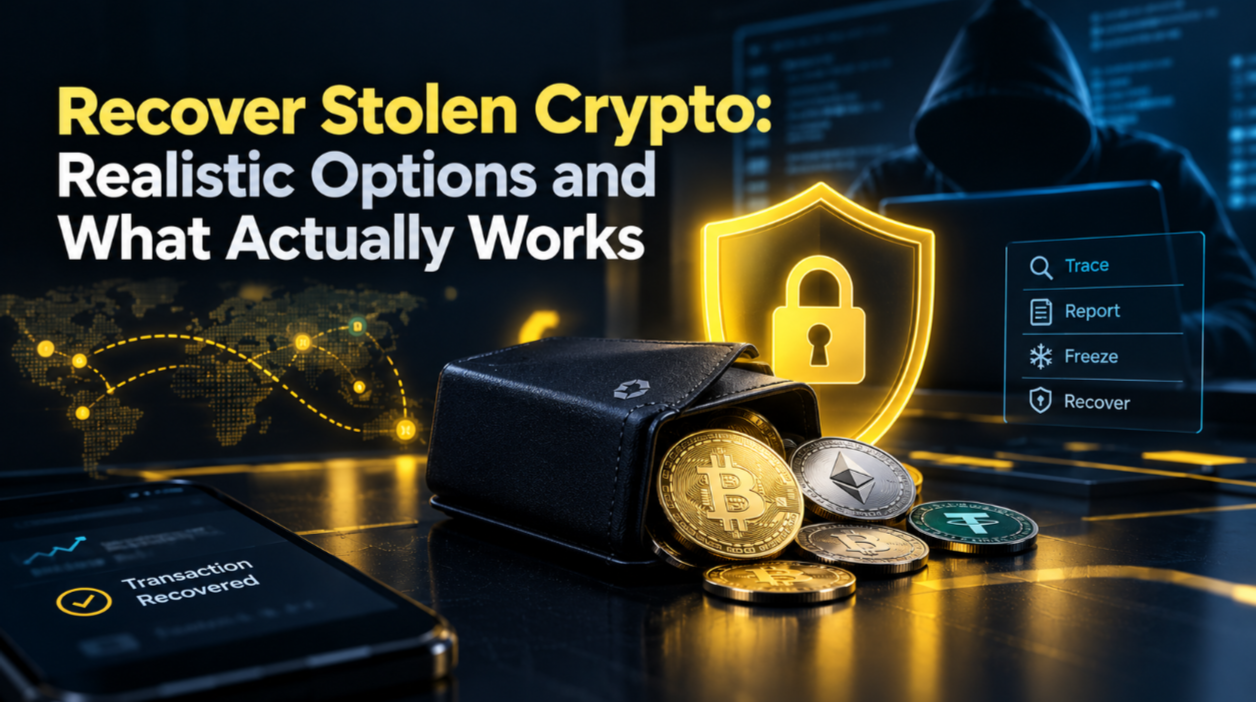
When cryptocurrency is stolen, the realistic prospects for recovery are poor but not zero. The specific recovery options available depend entirely on how the theft occurred, how quickly you detected it, how large the amount is, and which blockchain was involved. Before exploring each pathway, the most important thing to understand is time: every minute that passes after theft reduces recovery chances.
Blockchain transactions are irreversible by design. There is no bank, no payment processor, and no fraud department to call. The decentralisation that makes crypto self-sovereign also makes theft reversal structurally nearly impossible without the attacker's cooperation. Most victims recover nothing. This guide covers what is actually possible — not what feels hopeful.
Immediate steps in the first minutes after theft
- Do not panic-send your remaining assets to a random address. Think clearly.
- Immediately transfer any remaining funds from the compromised wallet to a new wallet on a clean, uncompromised device.
- Record every piece of information about the theft: transaction hashes, attacker's addresses, timestamps, amounts, and how you believe the compromise occurred.
- Do not interact further with the compromised wallet or device — it may still be under attacker control.
- Preserve all evidence: browser history, email headers of any phishing messages, screenshots of any communication with scammers.
On-chain tracing: following stolen funds
Stolen crypto rarely stays in the initial receiving address for long. Attackers move funds through a laundering chain: bridging across chains, swapping tokens, passing through mixers or privacy protocols, and ultimately trying to reach a liquidation point (usually a lightly regulated exchange).
On-chain tracing tools can follow this path. Etherscan, Blockchain.com, and Solscan provide basic transaction history. Professional tools like Chainalysis Reactor, TRM Labs, and Elliptic offer graph-based visualisation of fund flows across chains and bridges. These tools are used by law enforcement and exchange compliance teams.
- Free tools: Etherscan, Blockchain.com, Solscan — sufficient for basic address tracing on individual chains.
- Free investigation platforms: Metasleuth (TRM Labs' public interface) and Breadcrumbs offer limited free cross-chain tracing.
- Professional tools: Chainalysis, TRM Labs, Elliptic — used by law enforcement and compliance teams. Expensive; access typically requires engaging a professional investigator.
Exchange reporting: the most practical recovery path
If stolen funds reach a centralised exchange before being withdrawn to fiat, the exchange can freeze the account and the associated funds. This is the most realistic path to any recovery. Centralised exchanges are KYC-required, meaning the attacker's identity is linked to any account they use to liquidate.
To trigger a freeze, you must act quickly and contact the exchange directly with: the attacker's on-chain address, the transaction hashes showing the theft, and your own transaction records proving ownership of the source funds. Many exchanges have a law enforcement/compliance contact, but they also have customer-facing reporting mechanisms.
- Binance: Has a dedicated law enforcement request portal and a public "stolen funds reporting" form. One of the most responsive exchanges for freeze requests.
- Coinbase: Responds to law enforcement requests and has an internal compliance team that handles fraud reports.
- Kraken: Publishes a law enforcement request process. Files a SAR (suspicious activity report) internally on reported theft addresses.
- Timing: Funds must reach the exchange before withdrawal. Most attackers move fast — a freeze request submitted 48 hours after theft is unlikely to find unfrozen funds.
Filing a police report: necessary for escalation
Even though local police rarely investigate crypto theft directly, filing a police report is a necessary prerequisite for most escalation paths: insurance claims, legal action, engaging a professional recovery firm, or requesting exchange cooperation. A formal case number lends legitimacy to your exchange freeze request.
In the US, also file with the FBI's Internet Crime Complaint Center (IC3) at ic3.gov and report to the FTC at reportfraud.ftc.gov. IC3 aggregates crypto crime reports and periodically runs operations against large-scale crypto theft networks. Individual reports feed into these operations even when no individual case is opened.
Law enforcement engagement: when it is realistic
Law enforcement investigation of crypto theft becomes viable when: the amount is large (typically six figures or more), you have strong on-chain evidence, and the funds have reached identifiable points (exchanges, identified wallets). Below $100,000, dedicated investigation resources are rarely allocated.
FBI Cyber Division, the Secret Service Cyber Investigations, and IRS Criminal Investigation have active crypto theft investigation capabilities and have successfully recovered stolen Bitcoin and ETH in high-profile cases. Europol's EC3 handles EU cases. Engaging these agencies requires going through your local field office or national reporting portal.
- US: FBI IC3, IRS-CI, Secret Service Cyber. Local FBI field offices for in-person reporting for large cases.
- UK: Action Fraud, City of London Police Economic Crime unit, National Crime Agency.
- EU: Europol EC3, national cybercrime units vary by country.
- Realistic expectation: Law enforcement recovery rates for crypto theft are low even with large cases. Recovery happens — but typically only in a small percentage of cases, and timelines are measured in years.
Professional crypto recovery firms: a realistic assessment
A significant industry of "crypto recovery" services has grown up alongside crypto theft. The vast majority are scams — secondary victimisation of already-victimised people. Advance fee fraud is endemic: a "recovery firm" charges an upfront fee, promises results, then disappears. Check our crypto scams guide for a detailed breakdown of recovery scam patterns.
Legitimate recovery services exist but operate differently: they do not charge upfront fees, they provide verifiable case references, and they operate on contingency (a percentage of recovered funds). Firms like Mandiant (Google), Chainalysis Incident Response, and a small number of specialist boutiques do legitimate recovery work. Most require minimum case values of $500,000+.
Smart contract exploits: protocol recovery mechanisms
If the theft occurred via a smart contract exploit rather than a private key compromise, there are additional recovery avenues. Some protocols have emergency pause mechanisms that can halt further losses. Some have governance processes that can vote to reimburse victims from protocol reserves.
The Euler Finance hack in March 2023 saw $197 million exploited, followed by negotiation and return of almost all funds within a month — a rare but notable precedent. Aztec, Indexed Finance, and Mango Markets have also had partial fund returns via protocol governance. These outcomes are atypical and depend entirely on attacker motivation and protocol governance structure.
Insurance for crypto losses
DeFi insurance through Nexus Mutual and InsurAce can cover smart contract exploit losses for covered protocols, if you purchased a policy before the exploit. Premiums are paid in crypto and claims are evaluated by governance vote. Coverage for individual wallets is limited.
Traditional insurance increasingly offers crypto coverage via add-ons to homeowner or cyber insurance policies. Coincover provides theft insurance for hardware wallet users. For large self-custody holdings, Lloyd's of London syndicates offer institutional-grade coverage. These policies have strict custody requirements — check whether your setup qualifies before assuming coverage.
Preventing the situation from ever occurring
The most effective "recovery" is never needing it. The combined stack of a hardware wallet backed by a geographically distributed seed phrase, hardware FIDO2 keys on exchange accounts, multisig for large holdings, and phishing-resistant browsing habits eliminates the vast majority of theft vectors. Review the Ledger review, Trezor review, and hardware wallet ratings for hardware selection guidance.
What cannot be recovered: realistic expectations
- Seed phrase compromised and funds immediately moved: Near-zero recovery chance without exchange freeze cooperation.
- Privacy coin theft (Monero): Functionally unrecoverable — transaction graph is opaque by design.
- Funds through mixers (Tornado Cash): Extremely difficult to trace; success is exceptional.
- Small amounts (under $10,000): Law enforcement will not prioritise; professional firms will not engage; exchange freeze only if funds are still on the exchange.
- Rug pulls and exit scams: Recoverable only if developers are identified and prosecuted — rare, time-consuming, and often international.
This article is for educational purposes only. Not financial advice. Crypto carries significant risk of loss. Always conduct your own research.