What is a multisig wallet and why it matters
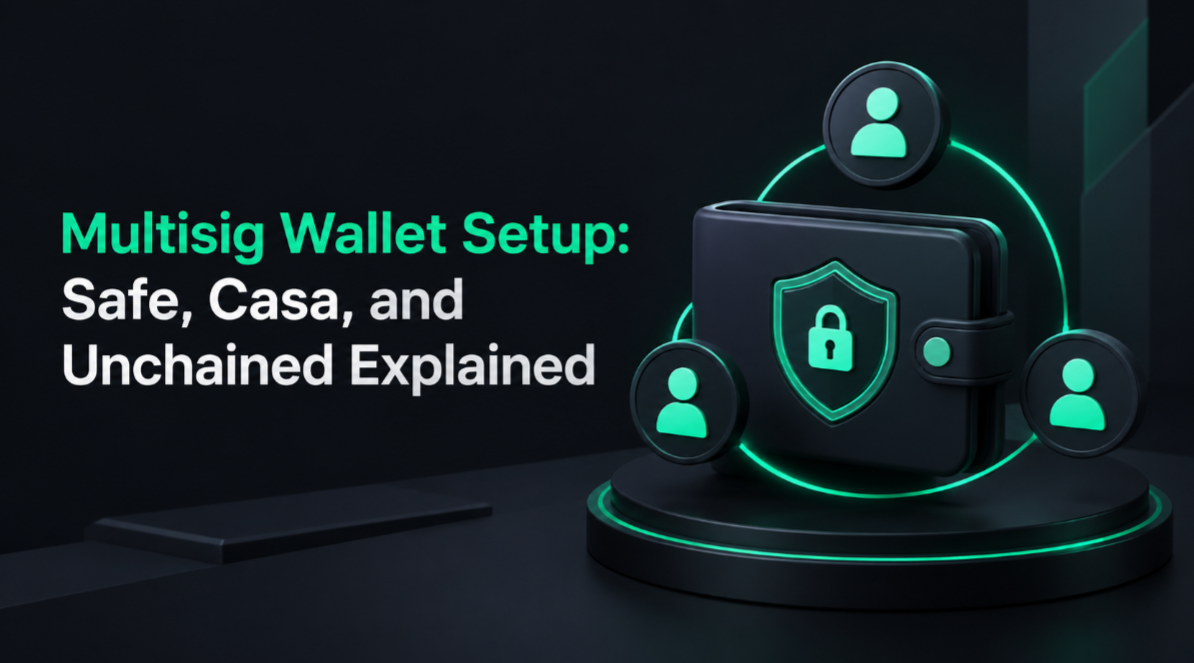
A multisig (multi-signature) wallet requires M-of-N signatures to execute any transaction. Rather than a single private key controlling funds, multisig distributes signing authority across multiple keys. A 2-of-3 setup requires any two of three designated keys to approve a transaction; a 3-of-5 requires three of five. No single key loss or compromise can drain the wallet.
Multisig is the standard security architecture for institutional crypto custody, DAO treasuries, and any individual holding a significant amount. It eliminates the single point of failure that makes single-signature wallets vulnerable to both theft (attacker needs only one key) and loss (user needs only one key but has nothing else if lost).
Safe (formerly Gnosis Safe): the DeFi treasury standard
Safe is a smart contract-based multisig deployed on Ethereum and all major EVM chains. It is the most widely used multisig in the DeFi ecosystem, securing over $100 billion in assets for DAOs, protocols, and individuals. Being a smart contract means it has additional features beyond basic multisig: time locks, spending limits, on-chain governance modules, and support for ERC-4337 account abstraction.
Setting up a Safe wallet involves deploying a contract on-chain (a small gas fee), designating owner addresses (typically hardware wallet addresses), and setting the threshold. Each signing key should be a hardware wallet — this means a Safe with 2-of-3 threshold backed by three hardware wallets provides both multisig protection and hardware key protection on each individual signing step.
- Best for: DeFi power users, DAO participants, teams sharing a treasury, anyone interacting heavily with EVM DeFi protocols.
- Chains: Ethereum, Arbitrum, Optimism, Base, Polygon, BNB Chain, Gnosis Chain, and more.
- Cost: On-chain deployment (Ethereum mainnet ~$20–100 in gas; L2s < $1). No monthly fee.
- Interface: app.safe.global — clean, well-maintained, integrates with most DeFi protocols.
Safe setup walkthrough: 2-of-3 configuration
- Acquire three hardware wallets (Ledger or Trezor) and generate separate seed phrases for each. Store each seed phrase in a different secure location.
- Connect the first hardware wallet to app.safe.global and select "Create new Safe".
- Add all three hardware wallet addresses as owners and set threshold to 2.
- Choose your deployment chain and confirm the deployment transaction on the hardware wallet.
- Test the setup by sending a small amount to the Safe and executing a small test transaction requiring 2 signatures.
- Document the Safe contract address and all owner addresses — store this information securely.
Casa: collaborative custody for individuals
Casa is a commercial service that provides multisig custody for individuals with a key distribution model where Casa holds one key in a standard 2-of-3 setup. Their Premium tier offers a 3-of-5 setup where you hold keys in multiple locations, Casa holds a key, and Casa acts as an emergency recovery key holder.
The value of Casa is the guided setup process, 24/7 support, and inheritance planning features. Casa's key is a recovery option — they cannot unilaterally move your funds because transactions require your signature threshold. Their mobile app guides you through the setup and annual key health checks.
- Best for: Individuals who want multisig protection without managing all infrastructure themselves. Particularly useful for inheritance planning.
- Bitcoin focus: Casa is primarily designed for Bitcoin multisig, though they now support Ethereum.
- Cost: Plans start around $120/year for basic and $480/year for the premium 3-of-5 service.
- Trade-off: Adds service dependency on Casa. If Casa ceases operations, you need their key export protocol. Their PSBT export ensures you are never locked in.
Unchained: collaborative custody for Bitcoin
Unchained Capital offers a 2-of-3 Bitcoin multisig vault where you hold two keys and Unchained holds one. Unlike traditional custodians, Unchained cannot move your funds alone — they are a key recovery counterpart, not a custodian. They also offer IRA accounts and loan products secured by your Bitcoin.
The Unchained model gives you full sovereignty with a professional backup key. Setup is guided and you use your own hardware wallets. Their Caravan tool (open source) lets you independently verify and interact with your vault without using Unchained's interface.
- Best for: Bitcoin holders with $50,000+ who want institutional-grade key management with inheritance support.
- Cost: Basic vault free; premium features and concierge key replacement services have fees.
- Open source: Caravan tool is open source. You can verify and recover independently of Unchained infrastructure.
Bitcoin native multisig: P2SH, P2WSH, and Taproot
Bitcoin has native multisig support at the protocol level. P2SH (Pay-to-Script-Hash) and P2WSH (Pay-to-Witness-Script-Hash) are the established standards for Bitcoin multisig. Taproot (activated 2021) adds more efficiency and privacy — a multisig transaction looks like a single-signature transaction on-chain when using MuSig2 key aggregation.
Both the Trezor and Ledger hardware wallets support Bitcoin multisig natively. Electrum, Sparrow Wallet, and Specter Desktop are the most capable software front-ends for self-managed Bitcoin multisig, with full PSBT (Partially Signed Bitcoin Transaction) support for air-gapped signing.
Key storage for multisig: distribution strategy
The security of a multisig wallet depends on the geographic distribution of its signing keys. Keeping all keys in the same house defeats the purpose — a fire, burglary, or seizure could expose enough keys to meet the threshold.
- 3-key distribution example: Key 1 in home safe, Key 2 in bank safe deposit box, Key 3 with trusted family member or professional custody service.
- 5-key distribution: Home, bank, trusted person 1, trusted person 2, secure cloud-based key service (Casa / Unchained).
- Geographic rule: No two keys should be in the same building, and no single disaster (house fire, flood) should be able to destroy more keys than your threshold minus one.
Multisig for team and DAO treasury management
For organisations, multisig prevents any single employee or team member from unilaterally moving funds. Safe is the industry standard here — every significant DeFi protocol uses Safe for its treasury. A 4-of-7 setup ensures that a small coalition of bad actors or a successful phishing attack on one or two team members cannot drain the treasury.
Organisational multisig setups should include a policy document specifying: who holds each key, what signing threshold is required for different transaction sizes, the rotation process when a team member leaves, and the emergency recovery procedure.
Limitations and challenges of multisig
- Complexity: Multisig transactions take longer — each required signer must be available and online. For time-sensitive DeFi operations, this can be a disadvantage.
- Smart contract risk (Safe): Safe is a smart contract. A vulnerability in Safe's contract code (though none have been exploited at scale) could theoretically be exploited. Safe has been audited many times.
- Inheritance complexity: Your heirs need to understand the multisig structure and access multiple keys. Without clear documentation and planning, multisig can make inheritance harder, not easier.
- Cross-chain limitations: Safe works on EVM chains. Bitcoin multisig is chain-specific. You cannot use the same multisig setup across Bitcoin and Ethereum — they require separate setups.
When you need multisig: a practical threshold guide
- Under $10,000: Single hardware wallet with strong seed phrase backup in two locations. Multisig adds overhead without proportional benefit at this level.
- $10,000–$100,000: Hardware wallet (primary) + documented seed phrase split or Shamir Backup. Consider Safe for DeFi interaction.
- Over $100,000: Multisig is strongly recommended. 2-of-3 hardware wallet Safe for DeFi, or Casa/Unchained for Bitcoin custody.
- Institutional / DAO: Safe with 4-of-7 or similar, all signers using hardware wallets, formal signing policy document.
See our full comparison of wallet security tiers in the hardware wallet ratings section.
This article is for educational purposes only. Not financial advice. Crypto carries significant risk of loss. Always conduct your own research.