Why stablecoins are transforming payments
Sending $500 internationally via a bank wire can cost $25–$50 in fees and take 1–3 business days. Sending $500 in USDC takes under 10 seconds on Solana or Arbitrum and costs under $0.01. This fundamental cost and speed advantage is driving rapid adoption of stablecoin payments for remittances, business-to-business settlements, freelancer payroll, and e-commerce.
The total value of stablecoin transactions settled in 2024 exceeded $10 trillion — more than PayPal and comparable to Mastercard. Stablecoins are no longer an experiment; they are a functioning payment rail used by millions of individuals and hundreds of businesses daily.
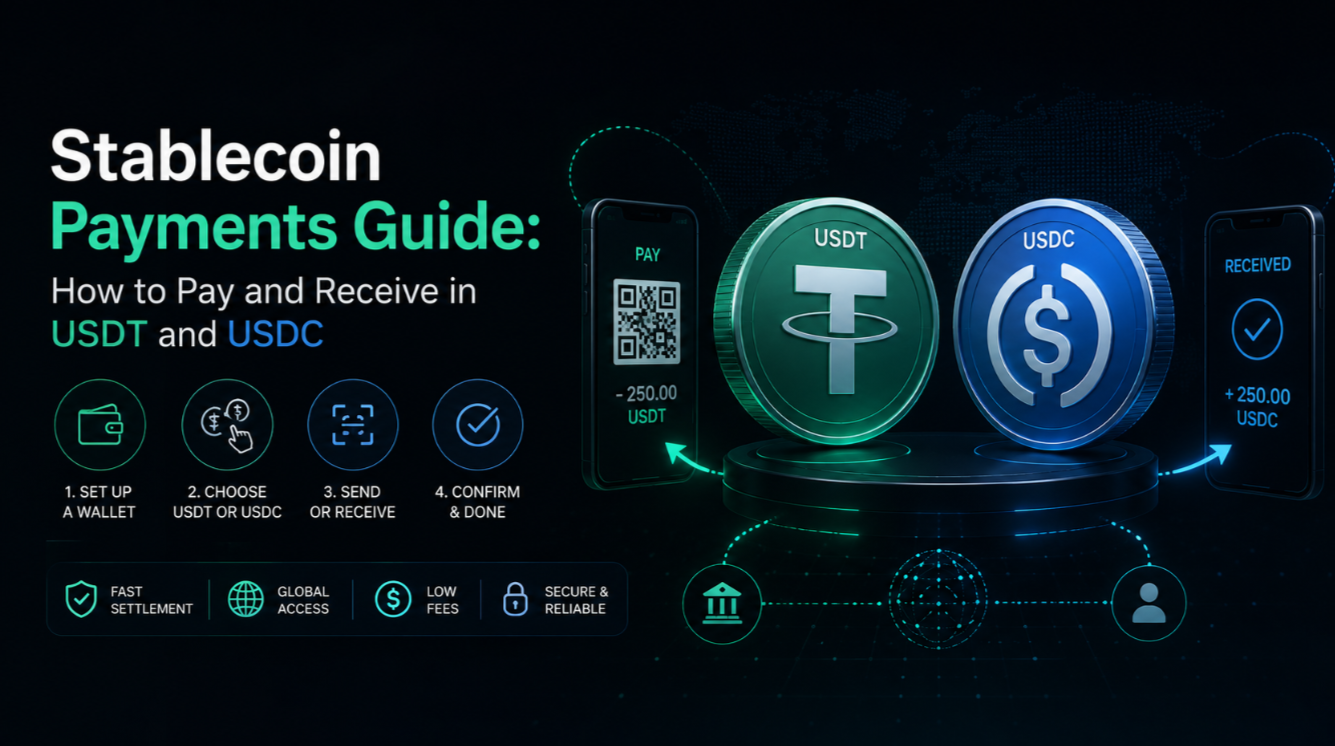
How to receive stablecoin payments: getting set up
To receive stablecoin payments, you need a wallet address. Options range from fully self-custody solutions to exchange wallets and business-grade payment processors.
- Personal self-custody: MetaMask, Rabby, or Phantom (Solana). Download the wallet, generate an address, share it to receive. Full control, no fees to receive, but you manage your own keys.
- Hardware wallet: Ledger or Trezor for larger balances. Provides maximum security for a receiving address. Funds arrive to your hardware wallet address directly.
- Exchange account: Coinbase, Kraken, or Binance deposit addresses. Convenient but introduces custody risk. Not recommended for large regular inflows. See the Coinbase review for details on its receiving infrastructure.
- Business payment processor: Coinbase Commerce, BitPay, NOWPayments, or CoinGate for merchants. These generate unique payment invoices, handle conversion if needed, and integrate with e-commerce platforms.
Which network to use: fees and speed comparison
The network (blockchain) you use for stablecoin payments dramatically affects speed and fees. Choosing the right network is the most important practical decision for regular stablecoin payments.
- Solana: Under $0.001 per transaction, confirmed in under 1 second. Excellent for micropayments and high-frequency transfers. Both USDC and USDT widely available natively on Solana.
- Tron: Low fees ($1–3 typically), fast confirmation. Dominates Tether transfers globally — most exchange USDT withdrawals default to Tron. Very widely supported.
- Arbitrum / Base / Optimism: Ethereum L2s with sub-cent fees and Ethereum-level security. USDC natively supported via Circle's CCTP. Ideal for DeFi-adjacent payment flows.
- Ethereum mainnet: $2–20 per transaction depending on gas. Use only for large transfers where cost is irrelevant relative to amount.
- Polygon: Low fees, widely supported, large ecosystem. Good for merchant payments and apps that need EVM compatibility with low cost.
Sending USDC or USDT: a step-by-step guide
- Confirm the recipient's wallet address and which network they are on (Ethereum, Solana, Tron, etc.).
- In your wallet, select the correct token (USDC or USDT) and ensure you are on the matching network.
- Enter the recipient address. Double-check the first 4 and last 4 characters — never copy from a compromised clipboard.
- Enter the amount. Leave a small ETH, SOL, or TRX balance for gas fees.
- Review the transaction summary and confirm. On hardware wallets, physically confirm on device.
- Share the transaction hash with the recipient as proof of payment.
- Most L2 and Solana transactions confirm in under 60 seconds. Ethereum mainnet may take 1–5 minutes.
Cross-chain transfers: moving USDC between networks
Moving USDC from Ethereum to Arbitrum (or Solana to Ethereum) requires a bridge or Circle's Cross-Chain Transfer Protocol (CCTP). CCTP is the native, trust-minimised way to move USDC across supported chains — it burns USDC on the source chain and mints native USDC on the destination, eliminating the wrapped-token risk of older bridges.
For USDT cross-chain moves, you typically use a bridge protocol (Stargate, Celer, LayerZero-based bridges). These introduce smart contract risk. Always use bridges that have been audited and have substantial TVL — never use an unknown bridge for large transfers.
Business use case: paying freelancers globally in USDC
One of the fastest-growing stablecoin payment use cases is international freelancer and contractor payroll. A US company paying a contractor in Argentina, Turkey, or Nigeria avoids 3–8% currency conversion fees and 2–5 day settlement times. The recipient receives USDC instantly and can either hold it, convert to local currency via a local P2P exchange, or earn yield while holding.
Platforms like Request Finance, Superfluid, and Deel natively support USDC payroll. Superfluid enables streaming payments — paying a contractor $5 per hour continuously in real-time token streams rather than monthly invoices. These primitives have no banking equivalent.
Receiving stablecoin payments as a merchant
For merchants, Coinbase Commerce and BitPay provide the most established stablecoin payment processing. Coinbase Commerce integrates with Shopify, WooCommerce, and custom APIs. Payments arrive in your Coinbase account and can be held as USDC or auto-converted to USD. Coinbase Commerce charges no processing fee — revenue comes from conversion spreads.
For crypto-native merchants who want full self-custody, receiving USDC directly into a multisig wallet (Gnosis Safe) and using accounting tools like Request Finance for invoice reconciliation is increasingly common among Web3-native businesses.
Converting stablecoins to fiat: the off-ramp
Converting USDC or USDT back to USD or other fiat currencies is straightforward via regulated exchanges. Coinbase, Kraken, and Gemini all support instant USDC-to-USD conversion with same-day or next-day bank transfers. Fees range from 0.1–1% depending on method.
For users outside the US or EU, local P2P platforms (Binance P2P) and crypto debit cards (Crypto.com Visa, Coinbase Card) are the primary fiat off-ramp channels. Crypto debit cards let you spend stablecoins at any merchant that accepts Visa or Mastercard, converting at the point of sale.
Tax and compliance implications of stablecoin payments
In most jurisdictions, receiving stablecoin payments for services is taxable income at fair market value at time of receipt. Paying contractors in stablecoins triggers the same withholding and reporting obligations as fiat payments in most countries. Businesses should use crypto accounting software (Koinly, CoinTracker, Cryptio) to maintain accurate records of all stablecoin payment flows.
Security best practices for stablecoin payments
- Always verify the full address before sending: Clipboard hijacking malware replaces copied addresses. Verify first and last 6 characters manually.
- Send a small test transaction first: For any new recipient or high-value payment, send $1 first and confirm receipt before sending the full amount.
- Use hardware wallets for operational wallets holding significant balances.
- Network matters: Sending USDC on Ethereum to a recipient expecting Solana USDC will result in lost funds. Always confirm network before sending.
- Never share your seed phrase or private key with any payment processor or app.
Stablecoin payments vs traditional bank wires: key differences
- Speed: stablecoins settle in seconds; wires take 1–3 business days.
- Cost: stablecoins cost under $0.10 on L2s; wires cost $15–$50.
- Reversibility: wires can sometimes be recalled; blockchain payments cannot.
- Availability: stablecoins work 24/7/365; bank wires work business hours.
- KYC: exchange off-ramps require KYC; wallet-to-wallet transfers do not.
This article is for educational purposes only. Cryptocurrency regulations vary by jurisdiction. Consult a legal and tax professional for guidance specific to your situation.