How crypto exchange fees work: the full picture
The "fee" you pay on a crypto exchange is rarely just the trading commission. Understanding the full fee stack is essential to minimising trading costs. The components are: maker/taker trading fees, spread (the gap between buy and sell prices), withdrawal fees, deposit fees (rare but exist on some networks), conversion fees (for fiat on-ramps), and funding costs on leveraged positions.
Most comparison sites focus only on maker/taker fees. But for small traders, the spread on a market order often costs more than the stated commission. For large traders, withdrawal fees and tier-upgrade requirements matter more. This guide breaks down the true cost of each major exchange across all fee types.
Maker vs taker fees: understanding the difference
Maker orders add liquidity to the order book — limit orders that sit and wait for a matching order. Taker orders remove liquidity — market orders or limit orders that immediately match existing orders. Makers are rewarded with lower fees because they improve market depth. Takers pay more because they consume liquidity.
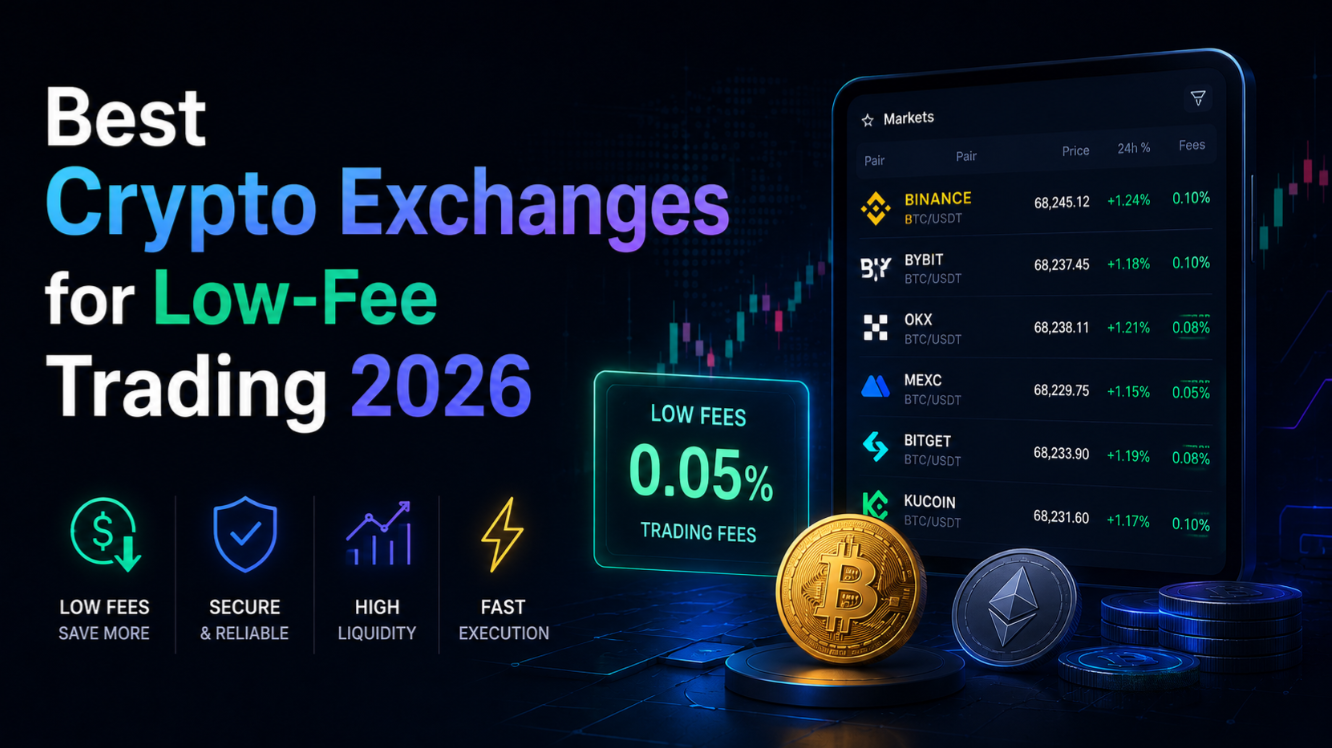
At Binance, the standard maker fee is 0.10% and taker fee is 0.10%. Active traders paying with BNB get 0.075%/0.075%. At the highest VIP tier (50,000+ BTC/month), fees drop to 0.012%/0.024%. At Kraken, base maker/taker are 0.16%/0.26%, but after $50,000 in 30-day volume, they drop to 0.14%/0.24%. The difference between base and high-volume tiers can save thousands per month for active traders.
Binance: market leader in fee efficiency
Binance offers the lowest baseline fees among major exchanges. Standard spot fees of 0.10%/0.10% drop to 0.075%/0.075% when using BNB to pay fees — a 25% discount. The BNB fee discount makes Binance particularly economical for frequent traders who are comfortable holding some BNB.
For futures, Binance charges 0.02% maker / 0.05% taker on USDT-margined contracts. Zero-maker fee is achievable at VIP tier 5 ($5,000 BNB holding + trading volume). Binance's peer-to-peer (P2P) trading has zero platform fees — the cost is built into counterparty spreads. Withdrawal fees are competitive: BTC withdrawal costs 0.0001 BTC, ETH withdrawals on native chain cost 0.0006 ETH.
Kraken: low fees with strong regulatory standing
Kraken's Pro interface (formerly Kraken Pro) offers competitive fees for serious traders. Base maker fee of 0.16% and taker 0.26% are higher than Binance, but for US-regulated trading with full legal protection, these are among the best available. Volume discounts kick in at $50,000/month (0.14%/0.24%) and continue through multiple tiers down to 0.00%/0.10% at $10m/month.
Kraken stands out for stablecoin and fiat pair fees. EUR/USD wire transfers have relatively low fees vs competitors. Kraken does not charge for ACH deposits and has reasonable wire fees. For UK and EU traders, Kraken offers SEPA transfers at low cost — among the most economical fiat on-ramps in the regulated CEX space.
Coinbase Advanced: premium brand, competitive fees for active users
Coinbase's base Coinbase app is expensive — 1.5–2.5% "simplified" fees for casual purchases. But Coinbase Advanced (previously Coinbase Pro) charges 0.06% maker / 0.10% taker at the base level, which is among the lowest in the US market. At $10,000/month volume, fees drop to 0.04%/0.06%.
The gap between Coinbase and Coinbase Advanced is enormous. Any user making more than occasional trades should use the Advanced interface. The same account, same assets, dramatically lower fees. This is one of the most consistently overlooked fee optimisations in retail crypto trading.
Bybit: competitive fees with strong derivatives integration
Bybit charges 0.10% maker / 0.10% taker on spot — matching Binance base rates. On futures, 0.02% maker / 0.055% taker is slightly above Binance's futures rates. Where Bybit differentiates is its unified margin account: spot, futures, and options share a single margin pool, reducing the capital needed to trade across product types.
Bybit's fee discount programme uses BYBIT tokens and trade volume for tier advancement. VIP 1 users ($250,000/month) pay 0.08%/0.08% on spot. For traders primarily in derivatives who also want spot trading, Bybit's unified account reduces total fee friction significantly.
DEXes: when on-chain fees beat centralised options
On Ethereum Layer 2 networks, DEX fees can undercut CEX fees on many pairs. Uniswap v3 on Arbitrum or Base charges 0.01%–0.05% swap fees on major stablecoin and ETH pairs. Gas costs on L2 are under $0.10. For a $10,000 USDC/ETH swap on the 0.05% fee tier, total cost is $5 + negligible gas — comparable to Binance with BNB discount.
DEX advantages over CEX for fee-sensitive trading: no withdrawal fees (assets stay in your wallet), no deposit delay, access to new tokens before CEX listing, and composability with DeFi protocols. Disadvantages: slippage on large trades, variable gas costs during network congestion, and no fiat integration.
Withdrawal fees: the hidden cost that adds up
Withdrawal fees are flat costs charged per withdrawal transaction. They are often ignored in fee comparisons but matter for traders who move assets between platforms. Comparison of BTC withdrawal fees across major exchanges:
- Binance: 0.0001 BTC (≈$6 at $60k BTC)
- Kraken: 0.00002 BTC on-chain (≈$1.20) — among the lowest in the industry
- Coinbase: Variable network fee, typically 0.0001 BTC
- Bybit: 0.0001 BTC standard
- DEX (on-chain): No withdrawal fee — assets stay in your wallet
ETH and ERC-20 token withdrawals vary widely. Kraken charges 0.001 ETH ($2–3), while some smaller exchanges charge 0.005–0.02 ETH. USDT on Ethereum from some exchanges can cost $5–15 per withdrawal. Using USDT on Tron (TRC-20) costs under $1 at most exchanges but requires the receiving party to support Tron.
Fee optimisation strategies for active traders
- Trade spot on Binance with BNB discount: 0.075%/0.075% is the best rate among regulated exchanges for most volume tiers.
- Use limit orders (maker) instead of market orders: On Kraken, the difference between maker (0.16%) and taker (0.26%) is 0.10% per trade — significant for frequent traders.
- Batch withdrawals: Flat withdrawal fees make frequent small withdrawals expensive. Accumulate before withdrawing.
- Use L2 DEXes for stable/ETH pairs: Uniswap on Arbitrum at 0.01% fee tier for USDC/ETH is hard to beat.
- Consider fee token holding requirements: Binance BNB, Bybit's tier system, and Coinbase's volume tiers all reward committed users. Calculate the breakeven point for holding fee tokens.
- Use spot markets for large buys: CEX spot market orders have zero counterparty risk. For immediate large purchases, check the order book depth to estimate real execution cost including spread.
How to compare total cost of ownership across exchanges
True cost comparison requires modelling your specific trading behaviour: how frequently you trade, average trade size, how often you withdraw, and whether you need fiat on-ramps. Build a simple spreadsheet: monthly volume × maker rate (for limit orders) + monthly volume × taker rate (for market orders) + withdrawal count × withdrawal fee = monthly exchange cost.
For most retail traders doing under $10,000/month in volume, the difference between Binance, Kraken, and Coinbase Advanced is under $20/month. Security, regulatory compliance, available assets, and user experience often matter more at this scale. See our exchange ratings for a full cost-benefit breakdown across all major platforms.
Special fee structures worth knowing
- Zero-fee trading promotions: Some exchanges offer zero-fee trading on specific pairs as acquisition marketing. Verify this is not offset by wider spreads before assuming it is genuinely cheaper.
- Staking and earn products: Exchange earn products often have management fees embedded in the rate. Compare the displayed APY with the on-chain rate for the same asset.
- Futures funding costs: On perpetual futures, funding rate costs often exceed trading commissions for positions held multiple days. Factor this into profitability calculations.
- Conversion fees on simple apps: The "Simple" or "Basic" interface on Coinbase, Binance Lite, and similar apps charges 3–5× the Advanced/Pro rate. Always use the professional interface.
Fee information is accurate as of April 2026 and subject to change. Always verify current rates on the exchange's official fee schedule before trading. This is not financial advice.