
What are perpetual futures and why traders prefer them
Perpetual futures (perps) are derivative contracts that let you speculate on crypto prices with leverage — without an expiry date. Unlike quarterly futures that must be rolled over, perps can be held indefinitely. They track the underlying asset's price via a funding rate mechanism: holders of long positions pay short holders (or vice versa) every 8 hours, keeping the perp price anchored to spot.
Perps have become the dominant trading instrument in crypto. Combined open interest across all exchanges regularly exceeds $80 billion. They allow traders to go long or short on Bitcoin, Ethereum, and hundreds of altcoins with leverage from 2x to 125x, making them the highest-volume product in the space.
How the funding rate mechanism works
The funding rate prevents perp prices from diverging permanently from spot. When the perp trades above spot (more buyers than sellers), funding is positive — long holders pay short holders. This incentivises more shorting and fewer longs, pulling the price back toward spot. When perp trades below spot, funding reverses.
Funding is typically settled every 8 hours. At 0.01% per 8 hours (typical neutral rate), holding a $100,000 long position costs $30 per day. During bull runs, funding can spike to 0.1–0.3% per 8 hours — $300–900 per day on the same position. Monitoring funding costs is essential for position management.
Binance Futures — still the highest liquidity venue
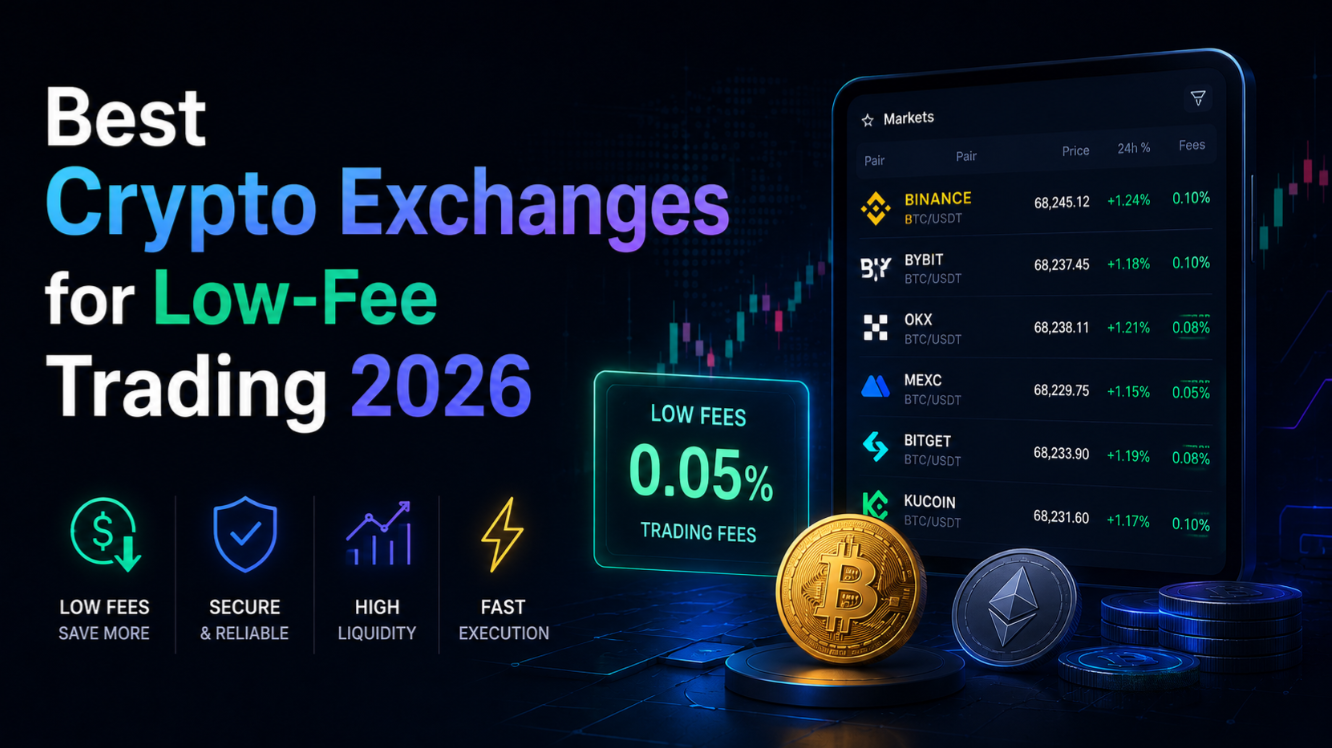
Binance's USDⓈ-M futures platform handles over $50 billion in daily volume, making it the deepest perp market. BTC/USDT perp spreads are typically under $0.50 on a $30,000+ coin. It offers 200+ pairs with up to 125x leverage, a sophisticated order type library, portfolio margin mode, and hedge mode for simultaneous long/short positions.
Fees: 0.02% maker / 0.05% taker for standard accounts. Drops to 0.00% maker for VIP tiers. Insurance fund exceeds $1 billion. Binance uses an auto-deleveraging (ADL) system rather than socialised losses, which protects profitable traders but can close winning positions during liquidation cascades.
Bybit — strong alternative with competitive pricing
Bybit is the second-largest perpetuals exchange by open interest. Its interface is designed specifically for derivatives traders, with advanced order management, conditional orders, and an intuitive position management panel. Bybit's USDT perp fees are 0.02% maker / 0.055% taker — slightly higher than Binance but offset by lower margin requirements and a more transparent insurance fund.
Bybit has invested heavily in copy trading features, allowing retail traders to mirror the positions of top traders automatically. Its unified trading account supports cross-margin across spot, futures, and options, improving capital efficiency for multi-product traders.
Hyperliquid — the DEX disrupting perpetuals
Hyperliquid launched its own Layer 1 blockchain optimised for perpetuals trading and has grown from zero to $5+ billion daily volume in under two years. Unlike CEX perps, Hyperliquid is fully on-chain and self-custody — your collateral sits in a smart contract, not with a company.
Hyperliquid runs a central limit order book (CLOB) on-chain — not an AMM — achieving sub-100ms trade confirmation times. Fees are 0.025% taker, 0.002% maker. The HYPE token governs the protocol and accrues trading fee revenue. Hyperliquid represents a paradigm shift: institutional-grade perpetuals with CEX-like performance but no custodial risk.
OKX Futures — deep altcoin perp market
OKX offers one of the widest altcoin perp selections — over 300 pairs including many small-cap tokens not available on Binance. Its portfolio margin system allows more capital-efficient trading for hedged positions. OKX also offers quarterly futures for traders wanting traditional expiry-date derivatives, and a robust API for algorithmic traders.
Fees: 0.02% maker / 0.05% taker. OKX is headquartered in Seychelles and does not serve US residents. It is one of the few large exchanges to publish real-time proof of reserves since 2022. Check our exchange ratings page for a full security comparison.
dYdX — the established on-chain perp protocol
dYdX v4 runs on its own Cosmos-based appchain, combining the speed of a dedicated blockchain with decentralised custody. It supports 200+ perpetual pairs and processes trades in under 500ms. Unlike Hyperliquid's CLOB model, dYdX v4 uses a fully decentralised validator set to process orders. Trading fees are 0.02% taker / 0.00% maker for most users.
DYDX token stakers secure the chain and earn a portion of protocol revenue. dYdX has been operational since 2019 in various forms and has processed over $1 trillion in total volume — making it one of the most battle-tested on-chain perp protocols.
Key factors to evaluate when choosing a perp exchange
- Liquidity and open interest: Higher OI means tighter spreads and less slippage on large entries. Check CoinGlass for real-time OI rankings.
- Funding rate history: Frequent positive funding means bullish positioning — expensive to hold longs. Use Coinglass or Glassnode to monitor historical funding.
- Insurance fund size: Larger insurance funds mean your profitable trades are less likely to be reduced during liquidation cascades.
- Liquidation engine: Some exchanges use socialised loss (spreads losses across all users); others use ADL (forces profitable traders to exit). Neither is perfect — understand the mechanism before trading.
- Mark price vs index price: Your liquidation is calculated on the mark price (an average across exchanges), not the last traded price. This prevents exchange-specific price spikes from triggering mass liquidations.
- Custody model: CEX perps require depositing collateral with the exchange. DEX perps (Hyperliquid, dYdX) keep collateral in smart contracts.
Risk management essentials for perp trading
Leverage amplifies both gains and losses. At 10x leverage, a 10% adverse move wipes your entire position. At 20x, a 5% move is lethal. Most professional traders use 3–5x maximum leverage for swing trades and never risk more than 1–2% of total capital per trade.
- Always use stop-loss orders: Set them before entering the position, not after. Many traders use the "invalidation point" — the price at which your trade thesis is wrong.
- Monitor funding costs: High funding rates eat into returns for position trades held days or weeks.
- Check liquidation price before entry: All exchanges show estimated liquidation price. Ensure it is below a significant support level.
- Use cross vs isolated margin deliberately: Isolated margin caps your loss to the margin allocated; cross margin can liquidate your entire account.
Comparing the top perp exchanges at a glance
- Binance Futures: Highest volume, tightest spreads, 200+ pairs, 0.02%/0.05% fees, CEX custody.
- Bybit: Strong altcoin selection, copy trading, 0.02%/0.055%, CEX custody.
- Hyperliquid: On-chain CLOB, self-custody, 0.002%/0.025%, 150+ pairs, HYPE governance.
- OKX: 300+ pairs, portfolio margin, 0.02%/0.05%, good for altcoin perps.
- dYdX v4: Decentralised appchain, 200+ pairs, 0.00%/0.02%, DYDX staking.
Regulatory risks for futures traders
Perpetual futures are classified as derivatives and are heavily regulated. Binance, Bybit, and OKX do not serve US residents on their derivatives platforms. US traders are restricted to CME crypto futures, CBOE options, and a handful of regulated domestic platforms. Kraken recently obtained a US futures trading licence — watch for more US-regulated perp venues in 2026. See our full Kraken review for details on its regulated derivatives offering.
This article is for educational purposes only. Perpetual futures are highly leveraged instruments and carry extreme risk of total loss. Not financial advice.