Why KYC-free exchanges exist and who uses them
Know Your Customer (KYC) verification has become standard on regulated centralised exchanges. Governments require it to enforce anti-money laundering (AML) laws and tax reporting obligations. But not everyone affected by these requirements lives under repressive regimes, holds privacy as a core value, or simply wants to exchange small amounts without sharing a passport with a third-party database.
KYC-free options range from fully decentralised protocols (DEXes) that technically cannot collect ID to lightly regulated CEXes that allow small trades without verification. Each option comes with a distinct risk profile. This guide maps the landscape honestly — the options, the tradeoffs, and the legal boundaries you should understand before using them.
Decentralised exchanges: no KYC by design
DEXes like Uniswap, Curve, Jupiter (Solana), and Trader Joe (Avalanche) are smart contract protocols. They have no legal entity requiring ID — you connect a wallet and trade. The protocol code runs automatically and cannot discriminate by identity.
This is the cleanest no-KYC option for spot trading. The tradeoffs are: no fiat on-ramps (you must already hold crypto to use a DEX), no order books (AMM execution with potential slippage), and gas costs. For asset swaps between cryptocurrencies, DEXes are private-by-default and fully functional without any identity disclosure.
Peer-to-peer (P2P) exchanges without ID
P2P platforms connect buyers and sellers directly. Historically, LocalBitcoins (now closed) and Paxful enabled cash trades with no KYC. In 2026, P2P trading has largely consolidated onto major exchange P2P desks (Binance P2P, OKX P2P) that do require account-level KYC, plus emerging decentralised P2P protocols.
Bisq is the most prominent decentralised P2P exchange with no sign-up required. It runs as a desktop application connected to a peer-to-peer network. Trades use on-chain Bitcoin escrow smart contracts and 2-of-2 or 2-of-3 multisig to enforce honest settlement. Fees are around 0.1–0.5%. Liquidity is thin compared to centralised P2P desks.
No-KYC CEXes: how they operate and their limits
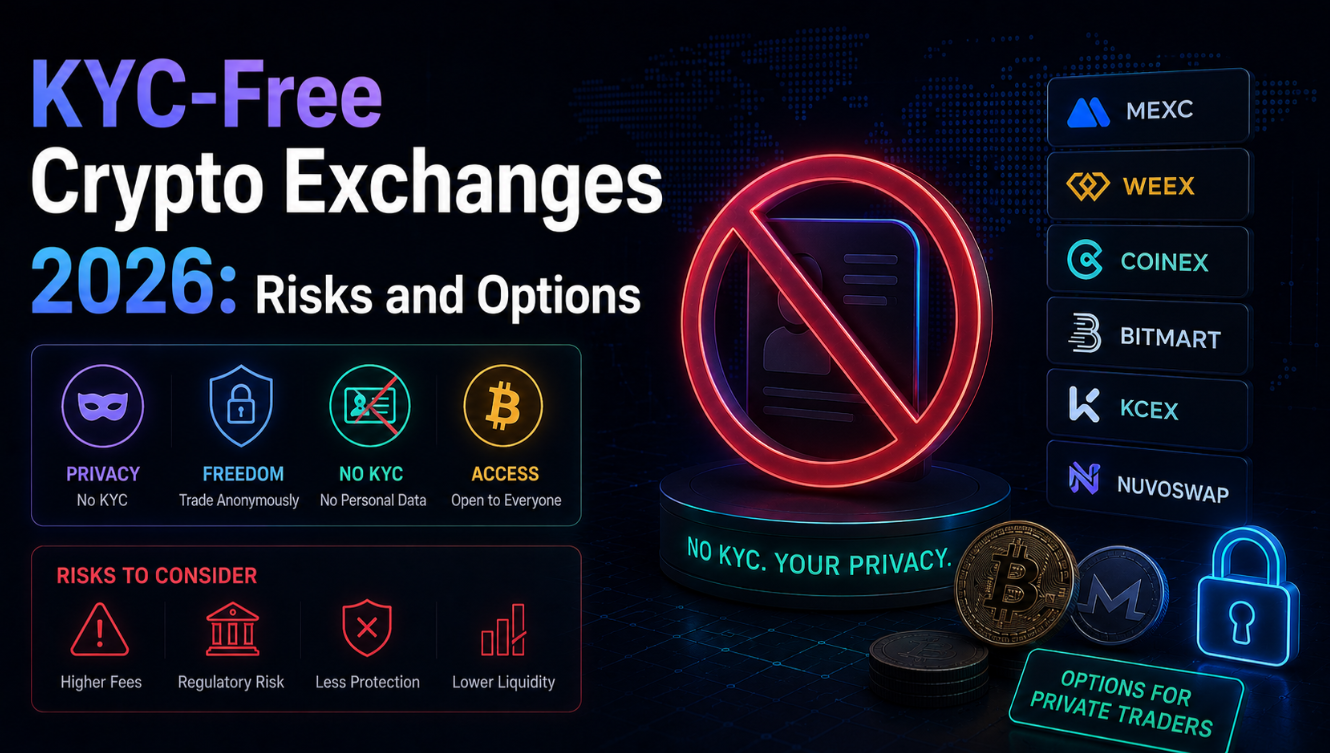
Some CEXes allow limited trading without identity verification. MEXC, KuCoin, and Gate.io historically permitted withdrawals of up to 1 BTC equivalent per day without KYC. These limits tightened significantly after 2023 global regulatory pressure — most now require KYC for any withdrawal above $100–500.
Using a no-KYC tier on a CEX means your trading is recorded on the exchange's servers without an identity attached. However: the exchange knows your IP address, device fingerprint, and deposit addresses. If the exchange is subpoenaed or hacked, this data is exposed. No-KYC tiers on CEXes offer less privacy than they appear to.
On-chain swap services and cross-chain bridges
Services like Thorchain's native RUNE swap, Maya Protocol, and various cross-chain bridges allow swapping Bitcoin for Ethereum or other chains without a centralised intermediary. These are non-custodial — funds flow through smart contracts. There is no sign-up or KYC. However:
- Bridge security risk: Cross-chain bridges have been the most exploited infrastructure in DeFi. Ronin ($625m), Wormhole ($320m), and Nomad ($190m) were all bridges. Only use bridges with multiple audits and significant track records.
- Liquidity limits: Most non-custodial swap services handle smaller amounts. Large swaps ($50,000+) may face significant slippage.
- Transaction trail: All on-chain swaps are permanently recorded on public blockchains. Pseudonymous, not anonymous.
Lightning Network and Bitcoin-native privacy tools
For Bitcoin specifically, the Lightning Network enables fast, cheap transactions with no on-chain trace per individual payment. Lightning nodes do not require KYC. Phoenix Wallet and Breez are popular self-custody Lightning wallets that can receive and send Bitcoin without any identity.
Bitcoin CoinJoin tools (Wasabi Wallet, Joinmarket) allow on-chain transactions to be mixed with other users' transactions, breaking the direct link between input and output addresses. These are legal in most jurisdictions as privacy tools, though some regulated exchanges have flagged wallets receiving CoinJoin outputs as potential policy violations.
Legal considerations for KYC-free trading
Using KYC-free options is not inherently illegal. Privacy is a legitimate interest. However:
- Tax obligations remain regardless of KYC: In most jurisdictions, crypto trades are taxable events. Using a DEX does not exempt you from reporting capital gains.
- AML laws apply to you, not just exchanges: Receiving funds from sanctioned addresses or known criminal wallets can expose individuals to legal liability even without a KYC intermediary.
- Regulated exchanges may reject incoming funds: If you send funds from a DEX or mixing service to a regulated exchange, the exchange's compliance system may flag or freeze the deposit.
- Jurisdiction matters enormously: KYC requirements differ by country. What is permissible in one jurisdiction may be restricted in another.
Risks specific to no-KYC CEXes
No-KYC CEXes face heightened regulatory risk. Exchanges that resisted KYC requirements — Bitmex (CFTC action), Binance (DOJ/FinCEN settlement, $4.3bn fine in 2023) — have faced massive enforcement actions. An exchange operating without KYC today may suddenly implement it or freeze accounts when regulators pressure them.
A no-KYC CEX with custodial control over your assets is doubly risky: it holds your funds AND operates in a grey zone that may result in sudden closure or asset freezes. If the exchange shuts down or is seized, your unverified account has less legal recourse than a KYC-verified account at the same platform.
Privacy coins and their exchange status
Monero (XMR), Zcash (ZEC), and Dash have privacy-preserving transaction features. Several major exchanges (Binance, Coinbase) have delisted privacy coins due to regulatory pressure. Kraken maintains Monero trading for now. Privacy coins are primarily exchangeable on DEXes and P2P platforms. Their on/off ramp to fiat is increasingly restricted.
The most realistic no-KYC strategy in 2026
- Use DEXes (Uniswap on L2, Jupiter on Solana) for crypto-to-crypto swaps — no KYC, self-custody, sub-cent fees on L2
- Use Bisq for Bitcoin P2P purchases with fiat — no sign-up, on-chain escrow
- Use Lightning Network for Bitcoin payments and receipt without on-chain trace
- Avoid no-KYC tiers on custodial CEXes — the privacy is minimal and the custodial risk is real
- Consult a tax professional about reporting obligations in your jurisdiction regardless of KYC status
Staying safe when using no-KYC options
- Verify contract addresses independently: On DEXes, anyone can create a token with any name. Always verify the contract address from the project's official website or reputable aggregators.
- Use hardware wallets: Self-custody without a hardware wallet is meaningfully riskier. Ledger and Trezor both work with all major DEX front-ends.
- Avoid connecting wallets to unaudited protocols: Token approval attacks drain wallets by exploiting unlimited approvals. Regularly audit and revoke approvals at revoke.cash.
- Use a VPN for additional network-layer privacy: DEX front-ends can log IP addresses even without KYC.
This article is for educational purposes only. KYC requirements and the legality of specific exchange types vary by jurisdiction. Nothing here constitutes legal or financial advice. Comply with the laws of your jurisdiction.