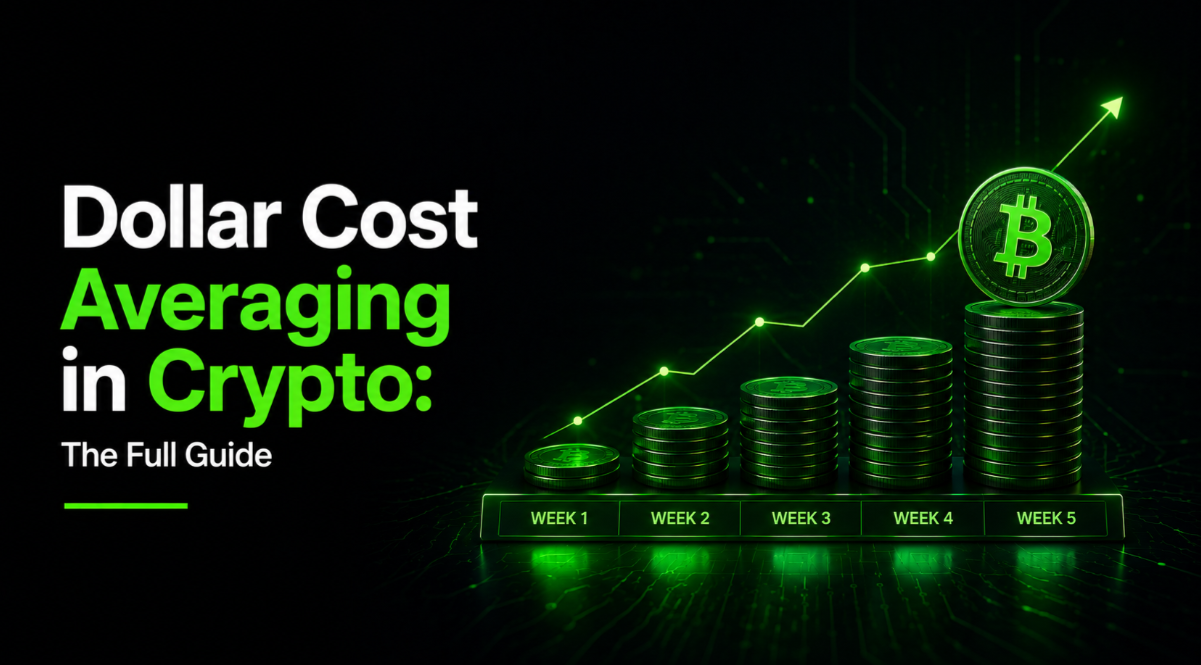
Dollar cost averaging (DCA) means investing a fixed amount at regular intervals — for example, $100 every Sunday — regardless of price. In crypto, DCA has outperformed almost every attempt at market timing over multi-year periods. This guide covers exactly how it works, why it beats timing the market, how to set up automated DCA on major exchanges, real historical results, and the specific mistakes that ruin the strategy.
The one-sentence definition
DCA is buying a fixed dollar amount of an asset on a fixed schedule, forever. That is it. The whole strategy is one sentence.
What makes it powerful is not complexity — it is that automating the decision removes emotion from a domain (crypto markets) where emotional decisions are catastrophic. You do not decide "when to buy" every week; you decided once, up front, and let the schedule execute.
Why DCA works better than timing the market
Two overwhelming pieces of evidence:
1. Nobody can consistently predict short-term crypto prices.
Not the analysts on TV. Not the traders on YouTube. Not the "signals" services. Multi-decade academic research on active management shows that even professional fund managers underperform simple buy-and-hold strategies after fees. In crypto, where volatility is 5-10× higher than stocks, the odds of consistent timing success are even lower.
2. DCA into BTC or ETH has produced strong returns over any 3+ year period since 2015.
A hypothetical investor who put $100 per week into Bitcoin from January 2019 through 2024 — through the COVID crash, through the 2022 bear market, through the collapse of Terra, Celsius, and FTX — ended up with a portfolio worth roughly 3-5× their total contributions. No prediction required. No emotional decisions.
Meanwhile, an investor who "waited for the right moment" during that same period typically ended up with less (missed rallies) or bought at peaks (bought during hype). Trying to be smart cost them. Being boring rewarded them. See Long-Term Holding vs Day Trading for the broader case.
The math: how DCA smooths volatility
A simple example. Say Bitcoin trades at these weekly closes over 5 weeks: $40k, $50k, $30k, $60k, $50k. Average price: $46k.
If you invest $100 per week (DCA):
- Week 1: buy 0.0025 BTC at $40k
- Week 2: buy 0.0020 BTC at $50k
- Week 3: buy 0.0033 BTC at $30k (bigger buy at the dip)
- Week 4: buy 0.00167 BTC at $60k (smaller buy at the top)
- Week 5: buy 0.0020 BTC at $50k
- Total: $500 spent, ~0.0115 BTC accumulated. Average cost per BTC: ~$43.5k.
Your average purchase price of $43.5k is lower than the 5-week average price of $46k. This is the mechanical advantage of DCA — the fixed dollar amount naturally buys more when prices are low.
Over hundreds of buying periods across a full market cycle (bull to bear to bull), this effect compounds significantly.
How to actually set up automated DCA
The specifics for each major exchange in 2026:
Coinbase:
- Click Buy → Recurring Buy.
- Select BTC or ETH (start with one; add more later if desired).
- Set frequency: Daily / Weekly / Bi-weekly / Monthly.
- Set amount: e.g. $50 per week.
- Connect a bank account as the payment source (lower fees than card).
Binance:
- Go to Wallet → Auto-Invest.
- Choose your portfolio (single-asset or multi-asset).
- Set the recurring amount and frequency.
- Fund the auto-invest wallet with the base currency (USDT recommended).
Kraken:
- Buy Crypto → Recurring Order.
- Configure asset, frequency, amount.
- Enable and step away.
For a full comparison of these platforms and their fees, see our best crypto exchanges 2026 guide.
DCA into BTC, ETH, or both?
The two most-defensible DCA targets in 2026 are Bitcoin and Ethereum. These assets have the deepest liquidity, largest institutional adoption, and lowest chance of going to zero. Some allocation frameworks:
- 100% BTC. The most conservative choice. Bitcoin is the crypto asset most closely resembling "digital gold" and has the longest track record.
- 70% BTC, 30% ETH. A balanced portfolio with exposure to both the base layer of value (BTC) and the base layer of Web3 computation (ETH).
- 50/50 BTC/ETH. Slightly more aggressive; captures more upside if Ethereum outperforms.
What we do NOT recommend for DCA: meme coins, altcoins with < 3-year track records, or anything you found on Telegram. DCA rewards persistence in a rising asset; it is punished mercilessly by assets that go permanently to zero.
For live prices of the two default DCA targets: Bitcoin · Ethereum.
How much to DCA: sizing the strategy
A common framework: DCA an amount you would not miss if it disappeared. If losing $50 per week would materially hurt your budget, start with $25. If $100 per week would still leave you with a healthy emergency fund and full retirement contributions, you can scale up.
Rules of thumb that apply to most people:
- Have a fully funded emergency fund (3-6 months of expenses in cash) BEFORE starting DCA into crypto.
- Max out any tax-advantaged retirement account contributions first (in the US, that's 401(k) match + Roth IRA).
- DCA amount = something you can sustain for 3+ years without any interruption.
- Never DCA on credit. If the buy fails because your account is low, that is a signal to lower the amount, not fund it from a credit card.
The mistakes that ruin DCA
1. Stopping during a bear market.
The biggest mistake. Beginners set up their $100/week DCA in a bull market, watch their portfolio drop 60% during a downturn, panic, and pause the recurring buy. This is the exact moment DCA was designed for — buying at low prices. Stopping during the drop and restarting after the recovery is worse than never starting.
2. Changing the amount based on price.
"BTC is at $100k, I'll double my buy this week!" This is timing the market in disguise. The moment your buys are based on price, you're back to the emotional decisions DCA exists to eliminate.
3. DCAing into 20 different coins.
You are not diversifying — you are diluting. If 3 of your 20 coins go to zero (which is likely for most altcoins over any 5-year period), your DCA on those specific coins was pure loss. Concentrate on BTC and ETH.
4. Constantly moving your DCA to a "better" strategy.
Every week, someone will publish a strategy that supposedly beats DCA in backtests. Almost all of these are overfit to specific market conditions and fail in live trading. DCA works because it is boring, not because it is optimal.
5. Not withdrawing to self-custody.
DCA works only if you actually own the coins. If they sit on an exchange that fails, your DCA history is meaningless. Every few months, withdraw your accumulated coins to a self-custody wallet. See Hot vs Cold Wallets for the mechanics.
When to stop or adjust DCA
Legitimate reasons to change your DCA plan:
- Your income changed materially (up or down).
- You reached a personal target and want to shift from accumulation to preservation.
- You need cash for a specific goal (down payment, medical, education).
Not legitimate reasons:
- The market went up a lot and you're "waiting for a dip."
- The market went down and you're "waiting for the bottom."
- Someone on YouTube said a specific altcoin is going to 100x.
- You saw a headline about regulation.
The person who mechanically DCAs $50 per week into Bitcoin for five years, without ever adjusting based on price or news, will outperform 90% of active crypto traders. This is not because DCA is clever — it is because sitting on your hands is disproportionately effective in high-volatility markets.
Continue building your framework: Crypto Portfolio Diversification · Building Your First Crypto Portfolio · Crypto Risk Management.