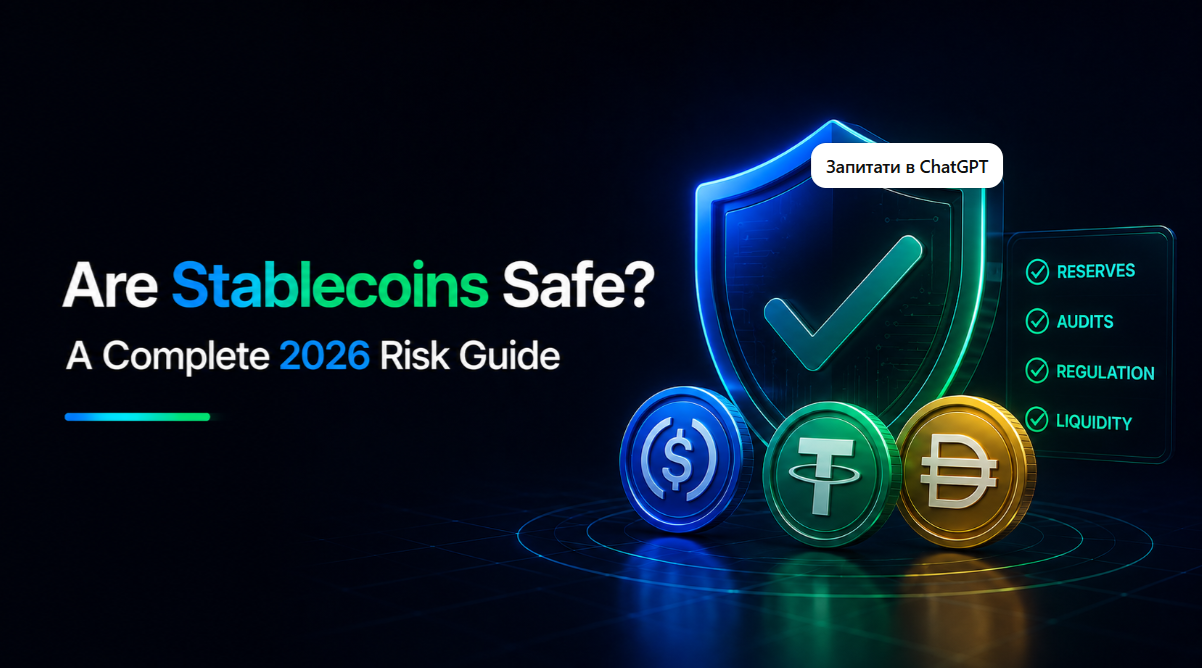
Stablecoins seem safe by design: pegged to $1, backed by reserves, widely used. In practice, safety varies significantly across issuers, and specific failure scenarios have caused real losses. This guide covers the actual risks — depeg events, issuer failures, bank runs, regulatory freezes — with historical examples and the specific rules for owning stablecoins without exposure to preventable losses.
The five stablecoin risk categories
1. Issuer solvency risk
The reserves backing the stablecoin might not exist, be misrepresented, or become inaccessible. For centralized stablecoins, you're trusting the issuer's honesty and operations.
Historical: Tether has faced repeated scrutiny over reserve backing. NYAG settled with them in 2021 over past misrepresentations. CFTC also settled. Reserve composition has evolved but transparency concerns persist for some observers.
2. Bank run / redemption risk
If many holders try to redeem at once and reserves aren't liquid enough to satisfy all demands quickly, the peg can break during the redemption process.
Historical: USDC dropped to $0.87 during the March 2023 SVB collapse because Circle had $3.3B stuck at SVB. Once the FDIC guaranteed the deposits, USDC restored peg within days. This was NOT insolvency — it was a temporary liquidity crisis that showed how bank exposure can cascade.
3. Depeg mechanics
Even with intact reserves, the market price can temporarily diverge from $1 due to trading pressure, especially during broader crypto crises.
Historical: USDT frequently traded at $0.95-0.98 during 2022 crypto crashes even though reserves were fine. Market panic can outpace redemption mechanics.
4. Regulatory action
Governments can freeze stablecoin addresses, force issuers to halt operations, or seize reserves.
Historical: Circle and Tether have frozen thousands of addresses per law enforcement requests. In most cases, legitimate compliance; in some cases, users caught up in false-positive matches.
5. Smart contract risk (for DeFi-native stablecoins)
DAI, USDS, GHO, and other crypto-backed stablecoins depend on smart contracts working correctly. A protocol bug could theoretically drain reserves or break the peg.
Historical: MakerDAO has operated without a catastrophic incident since 2017, but the risk isn't zero.
Categories to avoid entirely
Algorithmic stablecoins without hard reserves
Terra's UST is the paradigm case. Its peg mechanism depended on a market feedback loop between UST and LUNA. When the feedback loop broke in May 2022, UST fell from $1 to essentially $0 in 72 hours, wiping out $40+ billion. LUNA fell from $80 to $0.0001.
Every purely algorithmic stablecoin since then has failed similarly. If a stablecoin's backing is "code that promises to maintain the peg" without underlying assets, treat it as pure gambling.
Stablecoins from anonymous teams
If you can't verify who is behind the stablecoin, you can't verify what backs it or hold anyone accountable if the peg breaks.
Stablecoins on a single small chain
If a stablecoin is only available on one obscure blockchain, its liquidity is fragile. Bridge dependencies add risk. Multi-chain issuance is a safety feature.
Historical depeg events (educational review)
USDC — March 10-13, 2023 ("SVB depeg")
Fell to $0.87 over the weekend after Silicon Valley Bank collapsed with $3.3B of Circle's reserves. FDIC guaranteed all deposits Sunday night; USDC restored peg by Monday morning. No holder lost value; some got scared. Lesson: bank exposure in the reserve creates linked risk.
UST — May 2022 ("Terra collapse")
Fell from $1 to $0.10 in 48 hours, then to fractions of a cent. Algorithmic peg mechanism failed under redemption pressure. $40B+ lost. Lesson: algorithmic stablecoins are a fundamentally different asset class from reserve-backed ones.
USDT — May 2022, November 2022, etc.
Traded at $0.95-0.98 during multiple 2022 crises. Peg restored within days each time. Lesson: even large stablecoins face market-driven depeg risk during broader crypto stress.
DAI — March 2020 ("Black Thursday")
Traded at $1.02-1.10 during a MakerDAO liquidation crisis. Some users lost collateral due to broken liquidation auctions. MakerDAO governance approved reimbursement. Lesson: even overcollateralized stablecoins face stress during extreme market events.
The safe stablecoin ownership rules
For any amount:
- Use only major stablecoins (USDC, USDT, DAI). Avoid experimentation with unknown ones.
- Prefer stablecoins with monthly (not quarterly) attestations.
- Understand the difference between fiat-backed, crypto-backed, and algorithmic.
For >$10,000:
- Diversify across 2-3 stablecoins to hedge issuer-specific risk.
- Suggested split: 50% USDC, 30% DAI, 20% USDT.
- Do not hold in one exchange account — split across custody options.
For yield-earning:
- Use only battle-tested protocols (Aave, DSR, Curve).
- Don't chase yields above sustainable levels (>10% APR requires scrutiny).
- Keep some liquid in your wallet — always able to move fast if issue arises.
For very large holdings (>$100k):
- Consider stablecoin insurance via Nexus Mutual, Unslashed.
- Split across chains (Ethereum + Base + Solana).
- Consult a tax professional — reporting on large holdings has specific requirements.
Stablecoins are not risk-free. They are lower-risk than volatile crypto, and often lower-risk than the fiat currencies of unstable-currency countries. But treating them as pure cash equivalents ignores real failure modes. Understanding the risks is what turns "stablecoins" into a genuinely useful component of a crypto portfolio.
Related: What Are Stablecoins? · USDC vs USDT vs DAI · Best Stablecoins Ranked.