What is a stablecoin?
A stablecoin is a cryptocurrency whose value is designed to stay fixed — almost always pegged to $1 USD, though euro- and other fiat-denominated stablecoins also exist. Unlike Bitcoin or Ethereum, which can swing 10–20% in a single day, a well-functioning stablecoin is supposed to be worth exactly one dollar tomorrow, next week, and next year.
Stablecoins solve the core problem that makes crypto impractical for everyday transactions: volatility. You can pay a freelancer, send money abroad, earn yield in DeFi, or park funds between trades — all without converting back to traditional bank rails. In 2026, the combined stablecoin market cap sits above $200 billion, making it one of the most systemically important layers of the crypto economy.
There are four main engineering approaches to achieving price stability: fiat-backed reserves, crypto collateral, algorithmic mechanisms, and yield-bearing synthetics. Each involves different trust assumptions and risk profiles. This guide walks through all of them.
How the peg works: arbitrage and redemption
Price stability is enforced through arbitrage — not by decree. When a fiat-backed stablecoin like USDC drifts above $1.00, traders buy it on the open market, redeem it with the issuer for exactly $1 in real dollars, and pocket the difference. When it falls below $1.00, traders buy the discount and redeem at par, pushing price back up.
For the arbitrage to work, three things must be true: the issuer must honour redemptions reliably, the reserve must actually contain one dollar for each stablecoin in circulation, and the redemption process must be fast enough to prevent the discount from widening. When any of these breaks — as happened with Terra/UST in 2022 — the peg collapses.
Crypto-collateralised stablecoins like DAI use a different mechanism: smart contracts automatically liquidate under-collateralised vaults when collateral value drops, shrinking supply and defending the peg. No single issuer controls this process — the protocol enforces it on-chain.
Fiat-backed stablecoins: USDT, USDC, GUSD, EURC
Fiat-backed stablecoins are the simplest model: a company holds dollars (or equivalent cash and short-term bonds) in a bank account, and issues tokens 1:1 against those reserves. Redemptions are straightforward — send tokens back, receive dollars.
Tether (USDT) is the largest stablecoin by market cap and trading volume, with over $110 billion in circulation across more than a dozen blockchains. It dominates exchange liquidity and is the default trading pair on most centralised and decentralised exchanges. See the live USDT market page for current data. The persistent concern with Tether is reserve transparency — its attestations have historically been less detailed than competitors, though it has improved disclosure since 2021.
USD Coin (USDC), issued by Circle and co-founded with Coinbase, is the transparency-first alternative. Circle publishes weekly attestations from a Big Four accounting firm and holds reserves exclusively in cash and short-duration US Treasury bills. See the USDC market page. In March 2023, USDC briefly depegged to $0.87 when $3.3 billion of its reserves were briefly stuck in the failed Silicon Valley Bank — and recovered fully within 72 hours once the FDIC backstop was confirmed, demonstrating both the vulnerability and the resilience of fiat-backed models.
Gemini Dollar (GUSD) is issued by Gemini exchange and is the most regulated fiat-backed stablecoin in the US market, operating under a New York State Department of Financial Services (NYDFS) trust licence. Reserves are held in FDIC-insured accounts. Lower liquidity than USDT/USDC, but the strongest regulatory standing of any USD stablecoin.
EURC is Circle's euro-denominated stablecoin, pegged 1:1 to the euro and MiCA-compliant as of 2024. It provides a stablecoin on-ramp for European users without currency conversion, and is gaining traction in euro-denominated DeFi pools.
Key risk for all fiat-backed stablecoins: counterparty risk. You are trusting the issuer to maintain full reserves, honour redemptions, and not be shut down by regulators. The token itself is a liability of the issuer — the opposite of Bitcoin's bearer-asset model.
Crypto-collateralised stablecoins: DAI, crvUSD, GHO
Crypto-collateralised stablecoins replace the bank account with on-chain smart contracts. Users lock up cryptocurrency as collateral — always over-collateralised, meaning you must deposit $150 worth of ETH to mint $100 of stablecoin. If the collateral value falls below the liquidation threshold, the protocol sells it automatically to cover the outstanding stablecoin.
DAI (now called USDS after the Sky rebrand) is the original decentralised stablecoin, created by MakerDAO in 2017. It accepts ETH, WBTC, and other assets as collateral via Collateralised Debt Positions (CDPs). DAI is battle-tested through multiple market crashes and has never lost its peg for more than a few hours. Visit the DAI market page for current supply and price data. One caveat: DAI has increasingly relied on USDC as collateral, introducing some indirect fiat-backed risk.
crvUSD is Curve Finance's native stablecoin, launched in 2023. It uses a novel liquidation algorithm called LLAMMA (Lending-Liquidating AMM Algorithm) that continuously rebalances collateral as prices move, avoiding the harsh cliff-edge liquidations of traditional CDPs. This makes it more capital-efficient under volatile conditions.
GHO is Aave's native stablecoin, also launched in 2023. It is minted against collateral already supplied to the Aave lending protocol, meaning users earn yield on their collateral while simultaneously borrowing GHO. Aave governance sets rates and risk parameters.
The main risk in this category is liquidation cascades: a sharp market drop can simultaneously trigger mass liquidations across many vaults, depressing collateral prices further, which triggers more liquidations. The March 2020 ETH crash caused 4 million DAI of bad debt for MakerDAO — an event that led to the DAI Savings Rate and risk parameter overhauls.
Algorithmic stablecoins: lessons from the UST collapse
Algorithmic stablecoins attempt to maintain the peg without any collateral at all — through algorithmic expansion and contraction of token supply, or through a paired governance token acting as a shock absorber. In theory, this achieves capital efficiency. In practice, every major algorithmic stablecoin has failed catastrophically.
The defining catastrophe is Terra/UST. At its peak in May 2022, TerraUSD (UST) had $18 billion in circulation and was the third-largest stablecoin. The mechanism: UST could always be minted by burning $1 of LUNA, and $1 of LUNA could always be minted by burning 1 UST. This created arbitrage to defend the peg — but only as long as market confidence in LUNA remained high.
When a large wallet began selling UST in May 2022, panic spread. UST dropped slightly below $1, triggering mass redemptions into LUNA. More LUNA supply drove LUNA's price down, making each $1 of UST worth less LUNA to burn — a classic death spiral. Within 72 hours, $40 billion in combined UST and LUNA market cap evaporated. The event wiped out retail investors worldwide and triggered the regulatory scrutiny that produced MiCA in Europe and the GENIUS Act in the US.
The lesson is not that algorithmic stability is impossible in theory — it is that any mechanism requiring persistent market confidence to function is fragile. When confidence breaks, purely algorithmic systems have no collateral floor to limit the downside. Regulatory frameworks now effectively ban uncollateralised algorithmic stablecoins in the EU.
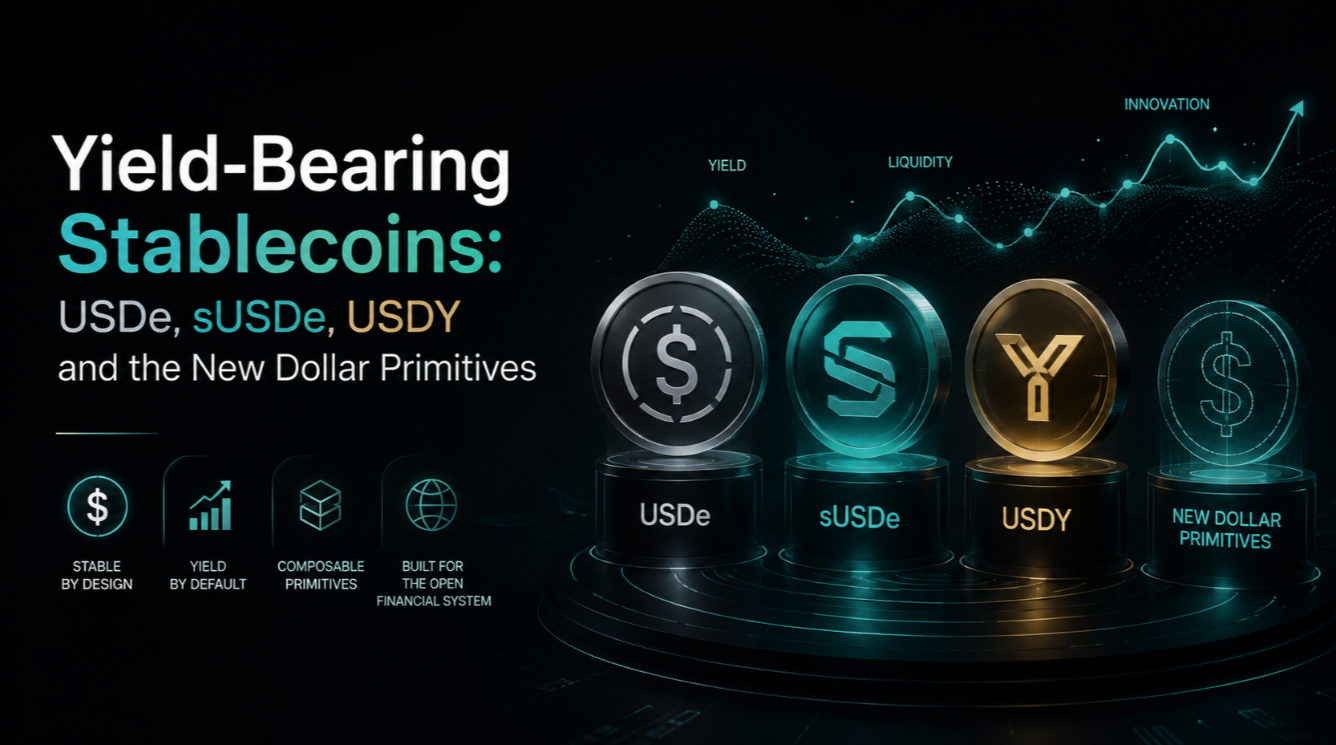
Yield-bearing and synthetic stablecoins: USDe, sUSDe, USDY
The newest category combines price stability with built-in yield — often called "yield-bearing stablecoins" or "synthetic dollars." These products hold collateral that generates returns and pass some or all of that yield to holders.
Ethena's USDe is the most prominent example. It is backed by a delta-neutral position: long staked ETH (earning staking yield) and a short ETH perpetual futures position (earning funding rates when futures trade at a premium, which they do most of the time). The two positions cancel out directional ETH exposure, creating a synthetic dollar. Ethena market page. In bull markets, USDe can yield 15–25% APY; in bear markets, funding rates flip negative and the yield disappears or turns slightly negative.
sUSDe is the staked version of USDe: you lock USDe into Ethena's staking contract and receive all the protocol yield in return. It functions like a yield-bearing savings account denominated in synthetic dollars.
USDY by Ondo Finance is a tokenised Treasury bill product — essentially a money-market fund wrapped in a blockchain token. It holds short-duration US government bonds and passes the yield to holders. It is permissioned (KYC required for direct purchase) but increasingly available via DeFi integrations.
The key risk in this category is that yields are not guaranteed. USDe yield depends on positive ETH funding rates, which reversed during the 2022 bear market. If you are holding sUSDe as a savings substitute, model the scenario where the APY drops to zero or briefly goes negative.
Use cases: trading pairs, remittances, and savings
Stablecoins have three dominant real-world applications in 2026:
- Trading pairs and DeFi liquidity. On centralised exchanges, USDT and USDC are the base pair for almost every trading market. On DEXs (Uniswap, Curve, Balancer), stablecoin liquidity pools are the largest by TVL. Traders move between volatile assets and stablecoins without cashing out to fiat — avoiding bank settlement delays and conversion fees.
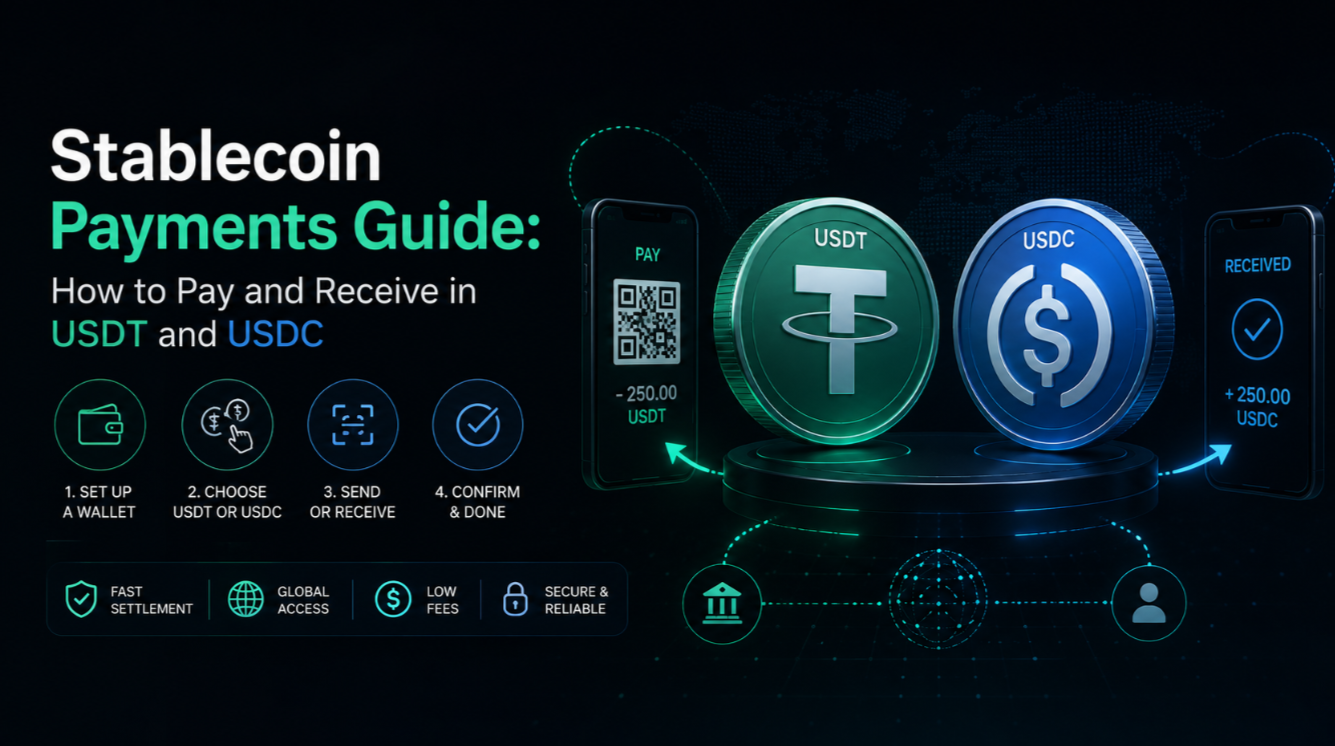
- Cross-border remittances. Sending $200 from the US to the Philippines via USDC on Stellar or USDT on Tron costs less than $0.10 and settles in under a minute. Traditional wire transfers charge 3–7% and take 1–5 business days. Stablecoin remittances are already the dominant use case by transaction count in parts of Latin America, Southeast Asia, and Sub-Saharan Africa.
- Savings and yield. In countries with high inflation (Argentina, Turkey, Nigeria), dollar-denominated stablecoins have become a practical savings mechanism — accessible to anyone with a smartphone, without needing a US bank account. Platforms like Aave and Compound offer 4–8% APY on USDC deposits, competitive with or exceeding US high-yield savings accounts.
For choosing a platform to hold or trade stablecoins, see our exchange ratings — we evaluate custody security, withdrawal limits, and stablecoin support across major platforms.
Reserves and audit transparency: what to check
The most important question to ask about any fiat-backed stablecoin is: what exactly is in the reserve, and how do you know? The honest answer varies dramatically by issuer.
- Attestation vs audit. Most stablecoins publish "attestations" — a snapshot by an accounting firm confirming reserves exceeded liabilities on a specific date. This is not the same as a full audit, which tests whether the accounting systems themselves are reliable. Circle is moving toward monthly audits; Tether still publishes quarterly attestations.
- Reserve composition. Cash and short-term US Treasuries are the safest reserve assets. Corporate bonds, money-market funds, and secured loans (as Tether has historically held) introduce credit risk. Always check the reserve breakdown, not just the total.
- Real-time proof of reserves. Some issuers publish on-chain reserve wallets that can be independently verified. Chainlink's Proof of Reserve oracle standard is being adopted by several issuers to provide automated, continuous verification.
- Redemption mechanics. Who can redeem, how fast, and for what minimum? Circle allows institutional redemptions within 1 business day. Tether requires a $100,000 minimum. Retail users typically rely on exchanges to provide liquidity rather than direct redemption.
MiCA and the GENIUS Act: the new regulatory landscape
Stablecoins are now subject to dedicated regulatory frameworks in major jurisdictions — a direct response to the Terra/UST collapse and concerns about systemic risk.
MiCA (Markets in Crypto-Assets Regulation) — In force across the EU since June 2024, MiCA creates two categories: e-money tokens (EMTs, pegged to a single fiat currency) and asset-referenced tokens (ARTs, pegged to a basket). EMT issuers must hold full reserves in segregated bank accounts, publish white papers, and obtain an e-money licence. Algorithmic stablecoins without full collateral backing are effectively prohibited. USDC and EURC are MiCA-compliant; Tether's USDT is operating under a transitional period while it seeks authorisation.
The GENIUS Act (US) — Passed by the US Senate in 2025, the Guiding and Establishing National Innovation for US Stablecoins Act creates a federal framework for "payment stablecoins." Issuers must maintain 1:1 reserves in cash or short-term Treasuries, submit to monthly audits, and register with either a federal banking regulator or a qualifying state regulator. The act explicitly prohibits unbacked algorithmic stablecoins. It is the first comprehensive federal stablecoin law in the US.
Both frameworks increase compliance costs for issuers but provide clearer operating rules. The practical effect for users: regulated stablecoins operating in the EU and US are now subject to audits, reserve requirements, and redemption guarantees that did not exist before 2024.
How to use stablecoins safely
Stablecoins are safer than volatile crypto assets but are not risk-free. These practices reduce your exposure to the main failure modes:
- Diversify across issuers. Holding USDT, USDC, and DAI simultaneously reduces the impact of any single issuer failing or depegging. No stablecoin should represent 100% of your stable holdings.
- Use reputable, audited platforms. Exchange-held stablecoins carry platform risk on top of issuer risk. For exchange selection, see our Coinbase review for a benchmark of what good compliance and security looks like.
- Understand DeFi smart contract risk. Earning yield on Aave or Curve introduces smart contract vulnerability risk. Use audited protocols and diversify across platforms. Higher yields usually mean higher risk.
- Check the reserve report before moving large sums. Both Circle (USDC) and Tether publish reserve reports. Read the most recent one before depositing significant value.
- Keep redemption paths in mind. In a crisis, you need to be able to exit quickly. Centralised exchanges provide the fastest liquidity; direct issuer redemption is available only to institutions or holders above minimum thresholds.
- Understand tax treatment in your jurisdiction. In many countries, swapping between stablecoins and other crypto is a taxable event even if no profit was made. Consult local tax guidance.
For a vetted list of exchanges where you can safely hold and trade stablecoins, see our Coinbase review and the broader exchange ratings.
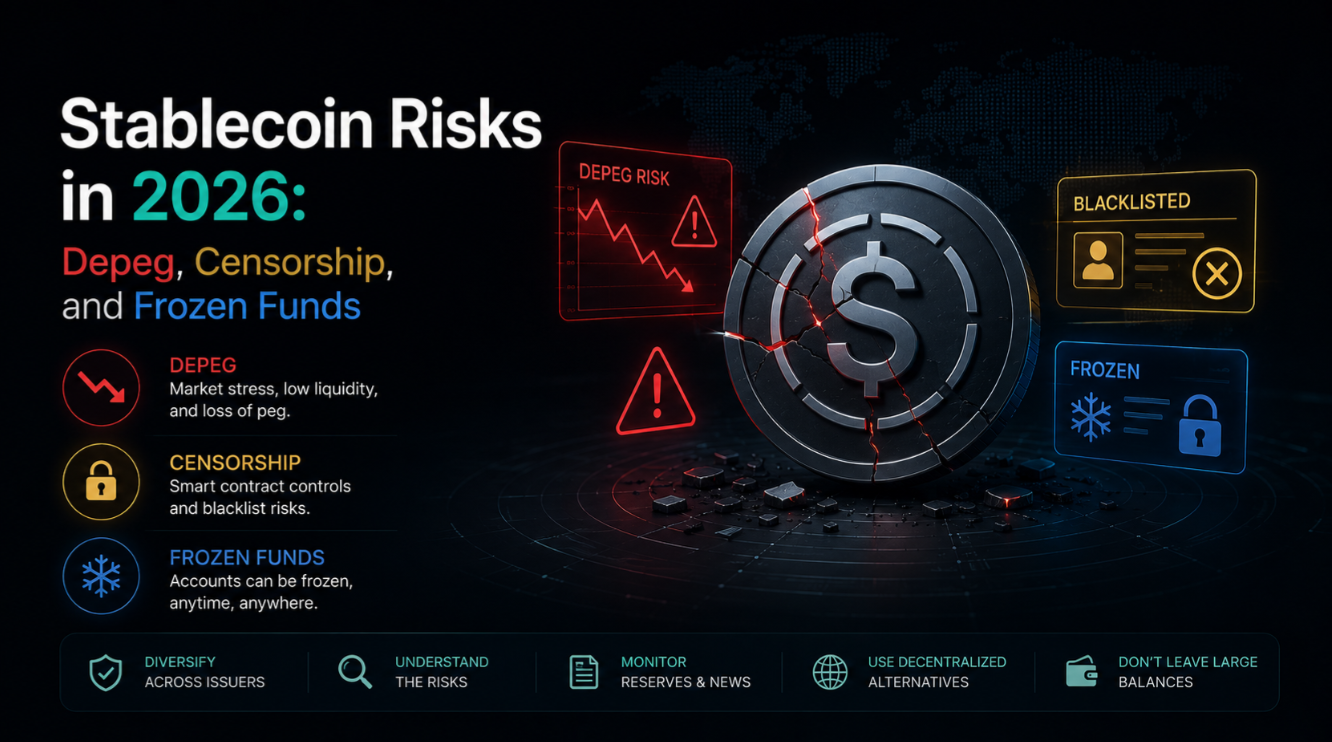
Stablecoin risks and depeg history
Every major stablecoin type has experienced at least one significant depeg event. Understanding the history makes the risk categories concrete:
- USDC (March 2023): Depegged to $0.87 when $3.3 billion of USDC reserves were trapped in Silicon Valley Bank. Recovered fully within 72 hours after FDIC intervention. Demonstrated fiat-backed stablecoins can depeg due to banking system stress, not just crypto-native failures.
- TerraUSD/UST (May 2022): Collapsed from $18 billion in circulation to near zero in under a week. The definitive case study in algorithmic stablecoin failure. $40 billion in combined UST/LUNA market cap destroyed. No recovery.
- DAI (March 2020): "Black Thursday" — ETH price dropped 40% in hours, overwhelming the liquidation system. Network congestion meant some liquidation auctions were won with zero-DAI bids, creating ~$4 million in bad debt. MakerDAO covered the shortfall by minting and auctioning new MKR tokens. The peg held but the event exposed system vulnerabilities that have since been patched.
- USDT historical concerns: Tether has never experienced a formal depeg, but has traded at discounts of 2–5% during periods of extreme market stress (notably late 2018 and mid-2022) due to concerns about reserve adequacy. Each time, the discount closed as reserves were confirmed.
The pattern across all depeg events is that risk materialises fastest when: (1) the underlying mechanism breaks under stress, (2) confidence collapses before fundamentals do, or (3) external infrastructure (banking, oracle feeds, network) fails. Diversification and an understanding of each stablecoin's specific failure modes are the best defences.
This article is for informational purposes only and is not financial advice. Stablecoins carry issuer, smart contract, regulatory, and depeg risk. Always verify reserve reports and platform security before depositing significant value.