
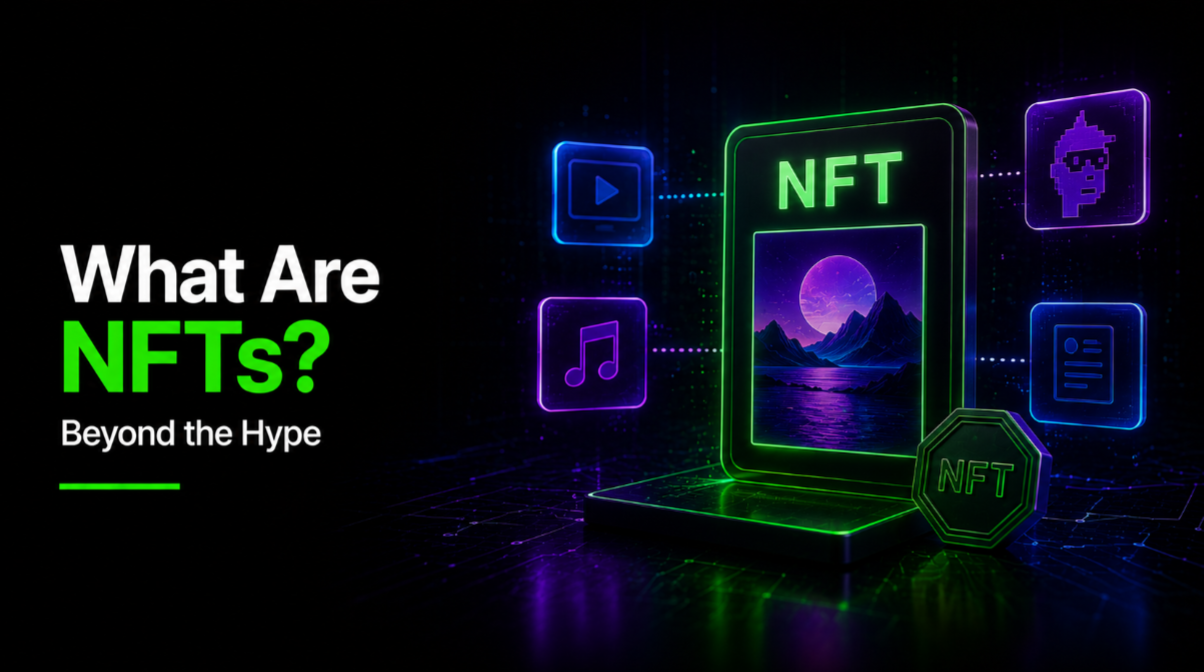
NFTs — non-fungible tokens — went from obscure crypto niche to global mania to widespread disillusionment in the span of about 24 months. The 2021-2022 speculative bubble ended badly for most participants, and the word "NFT" became something of a joke. But the underlying technology continues to be used for real purposes. This guide is an honest 2026 look at what NFTs actually are technically, which use cases genuinely work versus which were marketing, current adoption, and how to evaluate any NFT project.
The one-sentence definition
An NFT is a smart contract record that certifies a specific wallet owns a specific unique digital item.
The word "non-fungible" just means "unique and non-interchangeable." A dollar is fungible — any dollar is worth the same as any other dollar. A specific baseball card is non-fungible — a 1952 Mickey Mantle is not the same as a 1952 Willie Mays even though both are baseball cards. NFTs bring this "unique item" property to digital assets.
How NFTs work technically
The vast majority of NFTs live on Ethereum or Ethereum-compatible chains (Base, Polygon, Arbitrum) as ERC-721 or ERC-1155 tokens. The workflow:
- A creator writes an NFT smart contract that defines a collection (e.g., "Bored Apes").
- When someone "mints" an NFT, the contract creates a new token with a unique ID, records the minter's wallet address as owner, and typically points to some off-chain metadata (image URL, attributes, description).
- The wallet address that owns the token can transfer or sell it. Every transfer is a blockchain transaction.
- The smart contract can enforce rules — e.g., a percentage of every sale goes to the original creator as royalty.
Critical detail: the image or content itself is usually NOT on-chain. The NFT contains a URL or hash pointing to storage that lives on IPFS, Arweave, or a regular HTTP server. If that storage goes offline, the token still exists but points to nothing. This is a real durability issue for many older collections.
For the underlying technology, see What Is a Smart Contract?.
What NFTs are actually good at
1. Digital scarcity + provable ownership
For the first time, a specific digital item can have a specific owner recorded on a public ledger. This enables collectibles, gaming items, and access passes to work in ways they couldn't before.
2. Automatic royalty enforcement (mostly)
Creators can set royalties (say 5%) that trigger on every secondary sale. The revenue accrues to the creator forever, not just on the initial sale. This has been undermined by marketplaces that make royalties optional, but well-designed royalty systems (Blur's BLAST, Warpcast's Zora-native model) still work.
3. Composability with other Web3
An NFT can grant access to Discord servers, unlock content in games, or serve as identity in DeFi. This "programmable ownership" is genuinely new — an NFT is not just a static record but a key that other applications can check.
4. Portability across platforms
A gaming NFT can theoretically move between games. A membership NFT can grant access to multiple communities. In practice, this is much less common than the marketing suggested, but the primitive exists.
What NFTs are NOT good at
1. "Ownership" of what the image represents
Owning a Bored Ape NFT means your wallet holds a token pointing to a specific ape image. It does not mean you own the image legally, control who else can copy the image, or have any real-world rights beyond what the project team explicitly grants. This distinction was often blurred in marketing.
2. Investment returns for the general public
The vast majority of NFT collections lost 90%+ of their peak value between 2021 and 2024, and never recovered. Even in 2026, buying an NFT expecting price appreciation is a very bad statistical bet. The few collections that retained value are highly concentrated and illiquid.
3. Long-term storage durability
If the metadata is hosted on a normal web server that goes down, or on IPFS pinning services that stop paying, the NFT effectively becomes broken. Well-designed projects use on-chain metadata or Arweave for permanent storage; many older projects do not.
4. Legal enforcement
An NFT saying "you own the copyright to this artwork" does not create legal copyright. An NFT saying "you own this piece of real estate" does not create legal ownership. The blockchain records a token; the off-chain claim it supposedly represents needs separate legal enforcement.
Real use cases surviving in 2026
- Gaming items. Games where players truly own their in-game assets and can trade them between players. Working examples include Axie Infinity (with all its ups and downs), Illuvium, Star Atlas.
- Membership and access. Communities that use NFTs as membership passes. Friends With Benefits (FWB), Bored Ape Yacht Club, and many smaller communities operate this way.
- Event tickets. Ticket collections that can't be counterfeited, allow controlled resales, and can double as post-event collectibles.
- Creator monetization. Musicians, writers, and artists who use NFTs to monetize digital work with built-in royalties. Zora, Sound.xyz, and similar platforms serve this.
- Domain names. ENS (Ethereum Name Service) is the largest NFT project by transaction volume in 2026 — each .eth domain is an NFT. Highly practical.
- Digital identity. Soulbound tokens (SBTs) and reputation systems that represent identity or credentials on-chain.
How to evaluate an NFT project (if you're considering buying)
The framework that separates real projects from the ones that will lose all your money:
- Does it have utility? Beyond "the image is cool," what does owning it let you do? Access a community? Play a game? Vote in governance? "Utility = right to sell later at higher price" is not utility.
- Is the team public and credible? Anonymous teams are red flags. Public teams with track records are healthier. LinkedIn profiles, prior projects, real conference speaking history.
- Is the storage durable? On-chain metadata (fully immutable) is best. IPFS with paid pinning is good. Regular web server storage is a serious risk.
- What is the trading volume history? Real projects have consistent volume across market cycles. Projects with a huge spike followed by silence are dead.
- Is the community active? A Discord with 50,000 members but no organic discussion is bought engagement. A smaller community with real conversations is more valuable.
How to buy safely if you decide to
- Use a hardware wallet for anything more than a few hundred dollars. Signing NFT transactions is a common attack vector — see
- Common Crypto Scams
- .
- Buy on established marketplaces (OpenSea, Blur, Magic Eden). Never buy through DMs or Telegram links.
- Verify the collection's contract address on the official website — many phishing scams use fake collection listings.
- Read what you're signing on your hardware wallet. A "purchase" that requests unlimited token approval is a scam.
- Understand: the price of NFTs can go to zero, and often does. Only spend what you'd spend on any other collectible or entertainment.
The honest financial reality
The financial track record of NFTs as an "investment class" is bad. Roughly:
- 95%+ of NFT collections from 2021-2022 lost more than 90% of their peak value.
- Even top-tier collections (Bored Apes, CryptoPunks) trade well below their peaks.
- Illiquidity means you often cannot sell at the listed floor price — bid/ask spreads can be 30-50%.
- The projects that survived tend to be those with real utility, not the ones that were bought purely for status.
The right way to think about NFTs in 2026: they are a technology for provable digital ownership, with some legitimate applications and enormous historical bag-holding. Buy one if you value the underlying utility or the art. Do not buy one expecting to sell it for more. That approach works for physical art collectors — it can work for you.
Continue learning
Related: What Is a Smart Contract? · What Is Ethereum? · Common Crypto Scams · What Is Web3?.