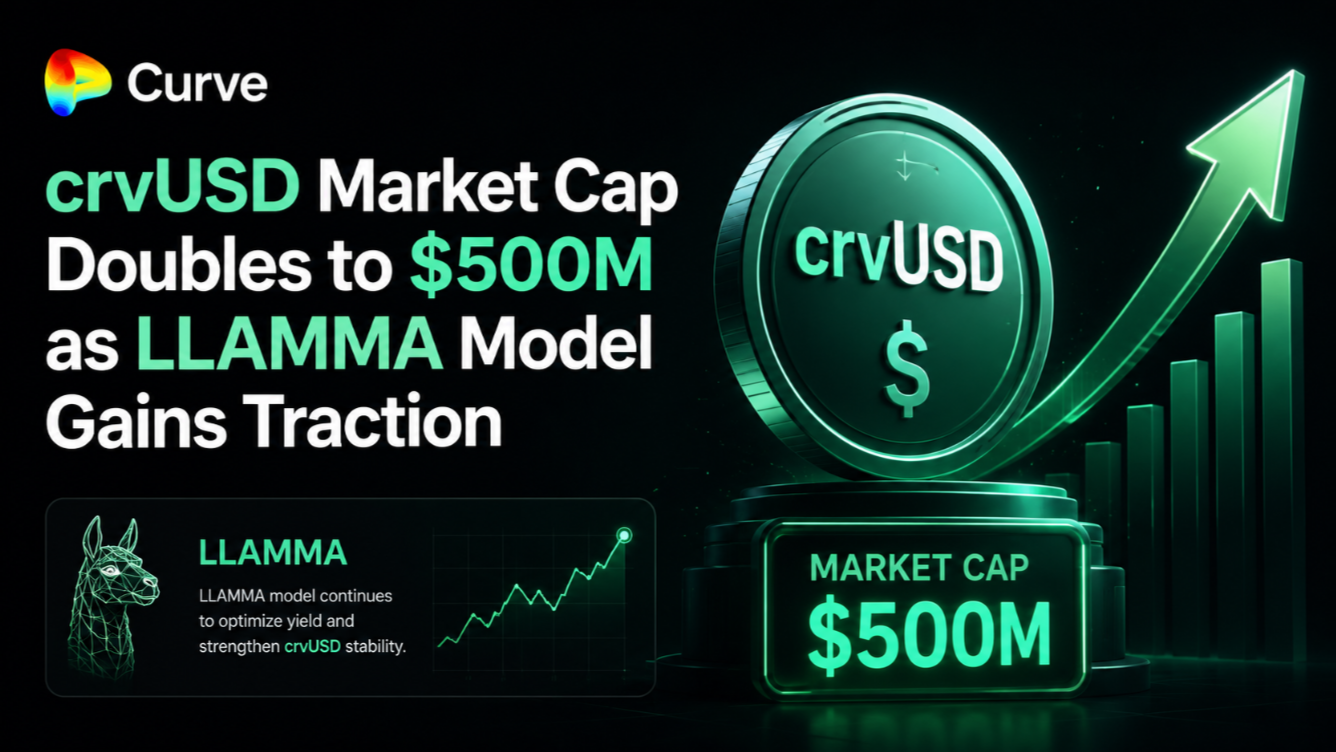
Curve Finance's native stablecoin crvUSD has hit a $500 million market capitalisation milestone, doubling in size within six months and establishing itself as one of the fastest-growing decentralised stablecoin projects in the current cycle. The growth is directly tied to the adoption of Curve's novel Lending-Liquidating AMM Algorithm (LLAMMA), which addresses one of the most painful aspects of DeFi borrowing — abrupt liquidation.
The LLAMMA Mechanism Explained
Traditional lending protocols liquidate collateral in a single transaction when a borrower's health factor falls below a threshold. This creates a cliff-edge risk: a brief price dip can trigger full liquidation even if the borrower would have remained solvent minutes later. LLAMMA takes a fundamentally different approach.
Rather than holding collateral statically, LLAMMA continuously rebalances it into a Curve AMM liquidity position that spans the borrower's liquidation price. As collateral value falls, a growing portion is converted into crvUSD (the borrowed stablecoin). As collateral value recovers, crvUSD is swapped back into the collateral token. The borrower's position is thus "soft liquidated" gradually rather than wiped out in one event.
This model reduces the probability of bad debt formation, lowers stress on collateral token prices during market selloffs, and enables borrowers to weather volatility without total position loss — provided prices eventually recover.
Why Growth Has Accelerated
crvUSD launched in May 2023 and spent its first year as a niche product, primarily used by liquidity providers who were already deeply embedded in the Curve ecosystem. Growth inflected in late 2025 when three catalysts converged: wBTC was added as a collateral type bringing in large BTC-denominated positions; integrations with Aave's GHO were announced, enabling crvUSD to be deposited as collateral; and Curve deployed crvUSD markets on Arbitrum, dramatically lowering gas costs for typical borrow operations.
- wBTC collateral onboarded — added ~$140M in crvUSD supply in Q4 2025
- Arbitrum deployment cut borrow transaction costs from ~$40 to under $0.50
- Curve Savings Rate (scrvUSD) launched with 6–9% APY, absorbing idle supply
- Integration with Yearn and Convex vaults created automated yield strategies on crvUSD
The Curve Savings Rate: Demand-Side Innovation
A key driver of the $500M milestone is the Curve Savings Rate (scrvUSD), analogous to the DAI Savings Rate pioneered by MakerDAO. By depositing crvUSD into the savings contract, users earn protocol revenue generated by borrowing interest. The rate fluctuates between 5% and 12% depending on borrow utilisation, making it competitive with both traditional money markets and centralised stablecoin yields.
The savings rate creates a virtuous cycle: higher demand to hold scrvUSD reduces circulating supply, tightening the peg and encouraging more minting to satisfy demand. In the six months since scrvUSD launched, over 60% of all crvUSD supply has flowed into the savings contract — a remarkably high lock rate that indicates genuine demand rather than speculative inflation.
Competitive Position Against DAI, USDS, and GHO
The decentralised stablecoin market is increasingly competitive. MakerDAO's USDS (the rebranded DAI) holds $7 billion and benefits from deep third-party integrations. Aave's GHO has grown to $500 million in roughly the same period as crvUSD. Frax V3 and Ethena's USDe represent alternative architectures with different risk profiles.
crvUSD's differentiation lies in its collateral-efficiency for volatile assets. LLAMMA allows higher LTV ratios on assets like ETH and wBTC compared to MakerDAO's conservative parameters, appealing to sophisticated borrowers who want to maximise capital efficiency. The trade-off is model complexity — LLAMMA behaviour during extreme volatility remains less battle-tested than Maker's decade-old liquidation engine.
For how Curve compares against other DeFi platforms, see the DeFi ratings overview. The CRV token market page tracks live price and protocol metrics.
CRV Tokenomics and Protocol Revenue
crvUSD growth directly improves CRV tokenomics. Borrowing fees from crvUSD markets flow to the Curve DAO treasury, a portion of which is distributed to veCRV holders via fee sharing. As crvUSD supply grows, so does protocol revenue — creating a demand-side argument for locking CRV into veCRV beyond the gauge-weight voting incentives.
In Q1 2026, crvUSD-sourced revenue accounted for 23% of total Curve protocol fees, up from 6% in Q2 2025. If crvUSD reaches $1 billion in supply — a target analysts now view as achievable by year-end — it could become the single largest fee contributor ahead of stablecoin swap pools.
The $500 million milestone is a signal that LLAMMA's novel approach has survived real market conditions and earned genuine user adoption. Whether crvUSD can challenge USDS at the $5 billion scale will determine whether Curve's stablecoin ambitions move from promising experiment to DeFi mainstay.