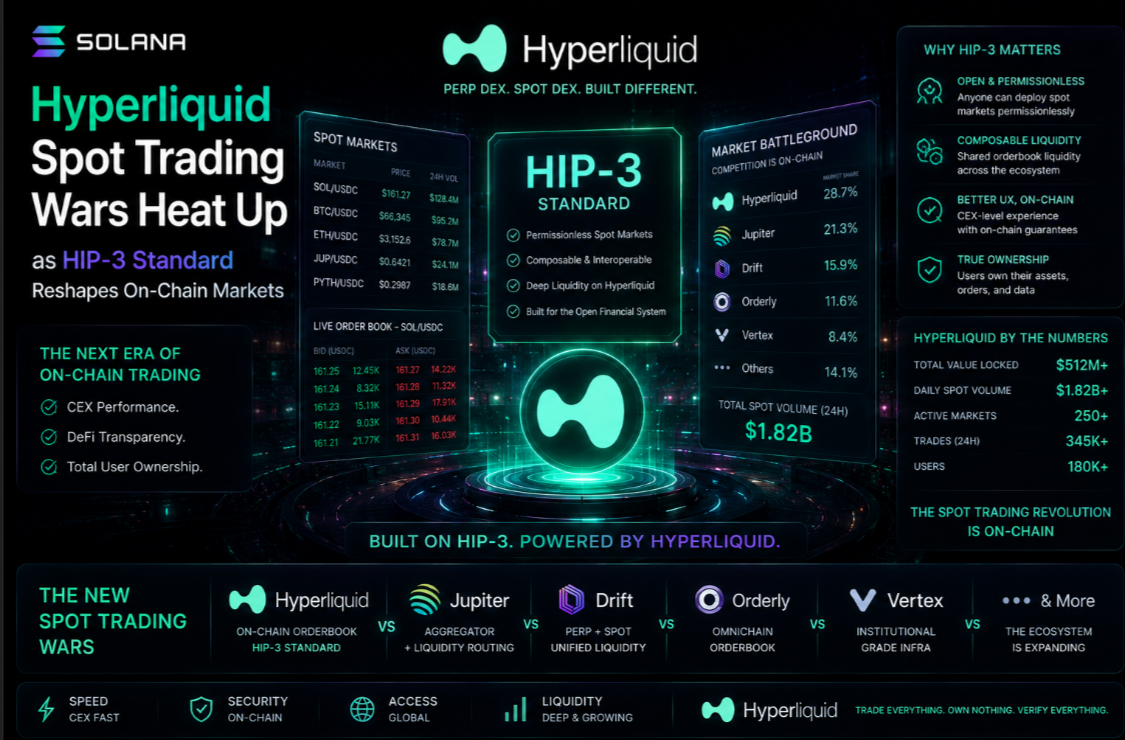
Hyperliquid has emerged as the most discussed on-chain exchange of 2026, and the introduction of the HIP-3 token standard has intensified competition in DeFi spot markets to a degree not seen since the Uniswap V3 launch. With daily spot volume exceeding $2 billion, near-zero latency order matching, and a native L1 built for trading, Hyperliquid is making a credible case that decentralised exchanges can replicate — and in some dimensions surpass — the performance of centralised counterparts.
What Is the HIP-3 Standard?
HIP-3 (Hyperliquid Improvement Proposal 3) defines a new token issuance and market-making standard on the Hyperliquid L1. Unlike ERC-20 tokens deployed on Ethereum or Solana SPL tokens, HIP-3 tokens are natively integrated with Hyperliquid's order book, meaning every HIP-3 token automatically has a spot trading pair, a public order book, and programmatic market-making hooks from the moment of deployment.
This is a structural departure from the AMM model popularised by Uniswap. AMMs set prices algorithmically based on pool ratios; order books match discrete bids and asks. Order books allow tighter spreads, limit orders, and the kind of price discovery that professional traders rely on.
- HIP-3 tokens deploy with an automatic spot book — no bootstrapping liquidity required
- Native on-chain limit orders with sub-100ms finality on the Hyperliquid L1
- Programmatic market-maker hooks allow protocols to incentivise tight spreads
- Dutch-auction primary issuance mechanism replaces fair-launch token launches
- Integrated perps listing means a spot token can have a perpetual future live within hours
The Spot Volume Surge
Prior to HIP-3, Hyperliquid was primarily known as the dominant on-chain perpetuals exchange, regularly posting $5–8 billion in daily perp volume. Spot was a secondary market. Since HIP-3 went live in February 2026, spot daily volume has grown from under $200 million to over $2 billion — a 10x increase in ten weeks.
The growth reflects two dynamics: native Hyperliquid ecosystem tokens (HYPE, PURR, and 40+ HIP-3 assets) generating speculative volume; and arbitrageurs running basis trades between Hyperliquid spot and perpetuals markets. The latter category is professionalising the market and narrowing spreads, making execution quality competitive with Binance spot markets for mid-cap tokens.
How HIP-3 Compares to the AMM Paradigm
The DeFi community has debated order books versus AMMs since 2020. Early on-chain order book attempts — dYdX V2, Serum on Solana — suffered from latency and front-running issues. Hyperliquid's purpose-built L1 with dedicated block space for trading eliminates most of these problems.
Against AMMs, order books offer: price improvement for large trades that would cause slippage in pools; the ability to set limit orders and stop-losses without keeper infrastructure; and transparent price formation that does not depend on arb bots restoring pool ratios. The trade-off is that bootstrapping liquidity for a new token is harder than seeding a Uniswap pool, but HIP-3's automated market-maker hooks partially address this.
Uniswap V4's hooks architecture represents AMMs fighting back — custom hooks can implement TWAP oracle limits, dynamic fees, and even order-book-like mechanics. The convergence of AMMs and order books may define the next generation of on-chain trading infrastructure.
DeFi Implications: Liquidity Migration Risk
For established DeFi protocols, Hyperliquid's spot growth raises liquidity migration risk. Tokens that previously needed deep Uniswap or Curve pools to ensure liquid on-chain markets can now bootstrap native Hyperliquid books. If spot volume migrates, AMM LP fee revenue falls and token liquidity concentrates on a single venue with a different risk profile (centralised sequencer vs. decentralised AMM).
The DeFi ratings category is already tracking liquidity migration as a risk factor for AMM-dependent protocols. Analysts at multiple research firms have flagged that a sustained Hyperliquid spot dominance could compress Uniswap and Curve fee revenue by 15–25% over 18 months.
What Comes After HIP-3
Hyperliquid governance is already discussing HIP-4, which would introduce lending and margin accounts against spot HIP-3 positions, creating a unified spot-perp-lending platform within a single L1. If implemented, this would represent the most vertically integrated on-chain trading venue in DeFi history.
The speed of Hyperliquid's product iteration — from perps-only DEX to spot trading standard in under 18 months — is a warning signal for protocols that move at governance-vote pace. The spot trading wars of 2026 are likely just the opening phase of a broader competition for on-chain market infrastructure dominance.