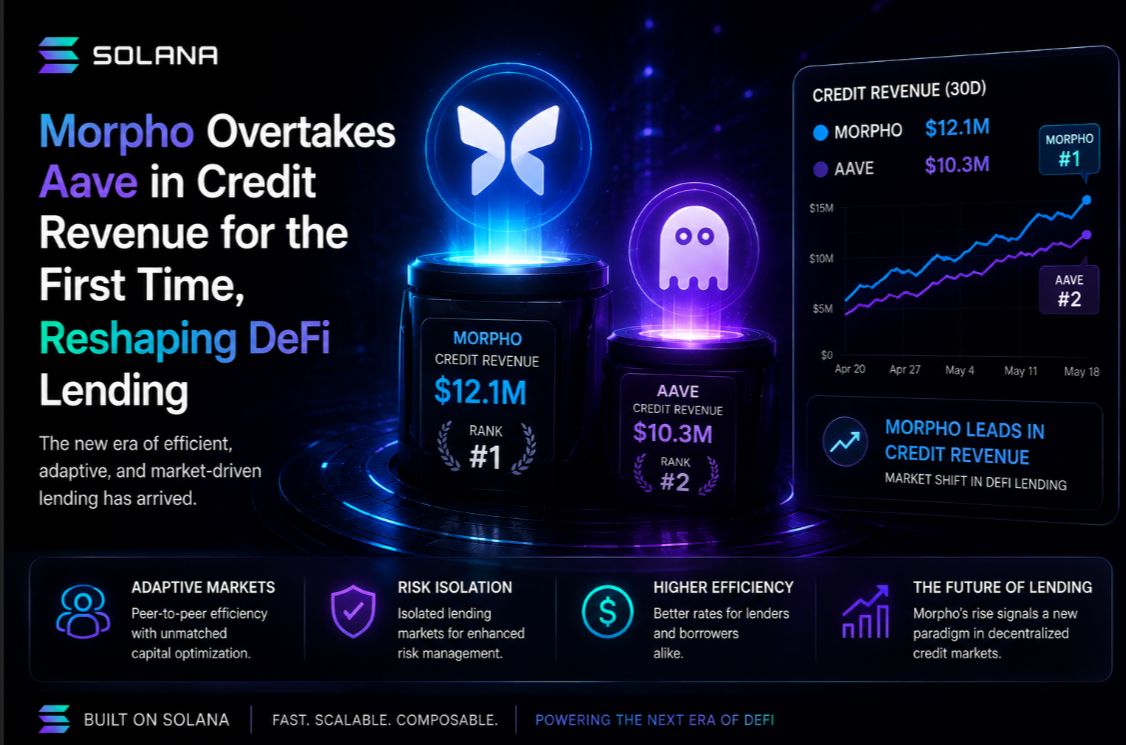
Morpho has overtaken Aave in annualised credit revenue for the first time in DeFi history. The milestone, crossed in April 2026, marks a structural shift in decentralised lending — from monolithic protocol dominance to modular, composable vault infrastructure. It also signals that Aave's decade-long hold on the lending category is no longer unassailable.
The Revenue Milestone in Numbers
On a trailing 30-day annualised basis, Morpho generated $127 million in credit revenue in April 2026 against Aave's $119 million. The gap is narrow — and could reverse — but the directional shift matters enormously for protocol positioning, token valuations, and where institutional allocators deploy borrowing operations.
Credit revenue measures interest income collected by the protocol — distinct from TVL, which measures raw assets deposited. Morpho's superiority in revenue despite lower TVL ($18B versus Aave's $62B) reflects dramatically higher capital utilisation rates. Morpho's average utilisation across vaults runs at 82%, compared to Aave's 53%.
Why Morpho Is More Capital Efficient
Morpho's architecture is fundamentally different from Aave's monolithic pool model. Rather than a shared liquidity pool where all depositors backstop all borrows, Morpho is built on isolated, purpose-built vaults called Morpho Markets and Morpho Blue.
Each vault is configured by a curator — typically a risk manager like Gauntlet or Re7 Capital — who sets collateral types, LTV parameters, oracle sources, and interest rate curves independently. Lenders choose which vaults to deposit into based on their own risk tolerance, rather than accepting a pooled average risk.
- Isolated vaults prevent contagion between collateral types — a bad debt event in one vault does not affect others
- Curators compete for lender deposits by offering optimised risk-return profiles
- Utilisation rates are higher because vaults are size-matched to actual borrow demand
- Interest rates respond more dynamically to per-vault supply and demand
- No governance vote required to add new collateral types — curators create new markets permissionlessly
The Curator Ecosystem: Gauntlet, Re7, and Block Analitica
The emergence of professional vault curators is Morpho's defining institutional feature. Gauntlet, originally a simulation platform for protocol risk management, has deployed its own Morpho vaults with conservative, institution-grade parameters — targeting funds that require auditable risk frameworks. Re7 Capital curates higher-yield vaults targeting sophisticated DeFi users comfortable with greater utilisation risk.
This curator marketplace creates a competitive dynamic that benefits depositors: curators earning fees from vault TVL have a direct financial incentive to optimise both yield and safety. In contrast, Aave's risk parameters are set through a governance process that moves more slowly and represents a pooled average of stakeholder preferences.
For a full competitive breakdown, visit our DeFi lending ratings and the DeFi category overview.
Aave's Response: V4 and the Counter-Narrative
Aave is not conceding the lending category without a fight. V4's hub-and-spoke architecture directly addresses the capital efficiency gap that Morpho exploits. By dynamically routing liquidity between chains and dynamically adjusting rates, Aave V4 aims to push average utilisation above 70% — closing much of the gap with Morpho.
The Aave team also argues that Morpho's fragmented vault model introduces complexity risks that pooled protocols avoid. In a black swan event — a major oracle failure, a correlated collateral crash — Morpho's vault isolation that normally limits contagion could instead create a race-to-liquidate dynamic across multiple small markets, potentially amplifying systemic stress.
AAVE holders point to the protocol's safety module, governance maturity, and eight-year track record of zero bad debt (excluding edge-case exploits) as durable advantages that Morpho has not yet demonstrated at comparable scale.
What This Means for Borrowers and Depositors
For retail borrowers, the competition is unambiguously positive. Morpho's efficiency has pushed Aave to accelerate V4 development and improve rate competitiveness. Average stablecoin borrow rates on Ethereum have compressed from 8–12% in 2024 to 5–8% in 2026 as both protocols compete for borrower market share.
For depositors, Morpho offers more granular risk selection: a conservative Gauntlet USDC vault versus an aggressive emerging-collateral vault versus a Curve-integrated crvUSD vault. Aave offers simplicity — one deposit, diversified exposure. Neither model is universally superior; user preference and risk tolerance determine the right choice.
Token Implications for MORPHO and AAVE
The revenue crossover has direct token implications. Protocol revenue is a fundamental driver of value for governance tokens in DeFi. If Morpho sustains or extends its revenue lead, pressure will mount for MORPHO token holders to activate fee sharing — currently disabled — boosting token yield. For AAVE, V4 launch mitigated near-term sentiment risk, but a sustained Morpho revenue lead would test the narrative that Aave is the inevitable DeFi lending winner.
Market analysts estimate that if Morpho reaches $200M annualised revenue within 12 months — a target achievable at current growth rates — MORPHO token could see significant multiple expansion as fee-sharing mechanics activate. The DeFi lending category is entering its most competitive phase since 2020.