
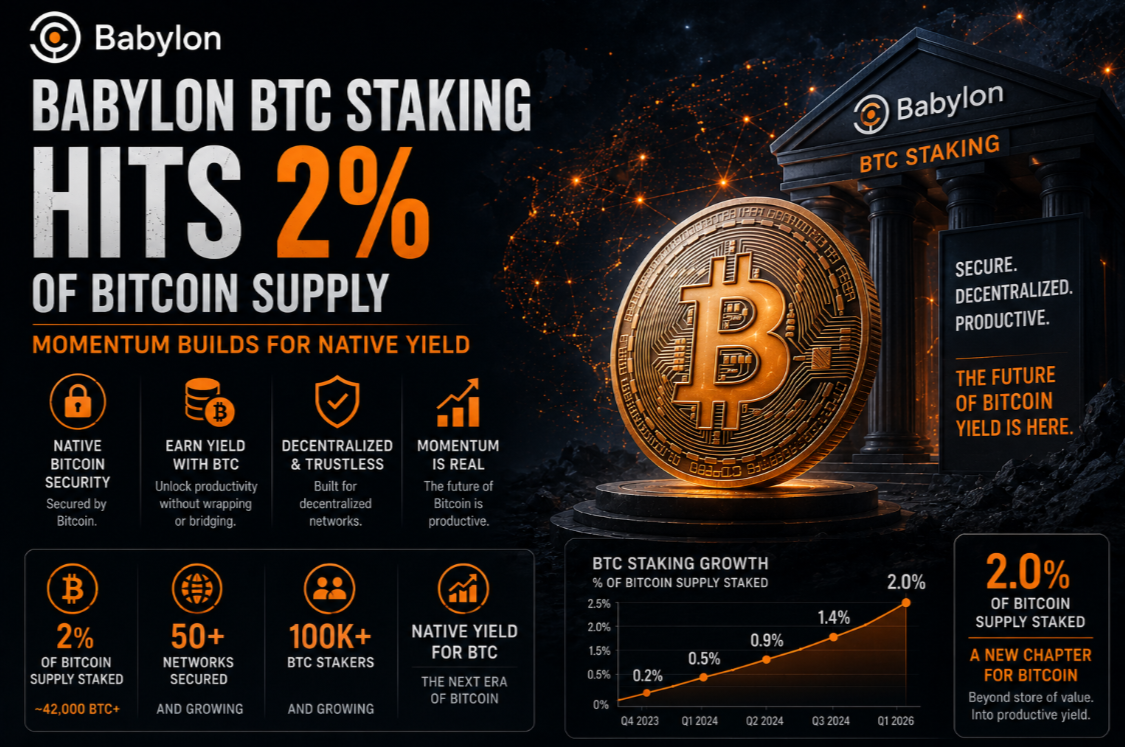
Babylon Protocol crossed 420,000 BTC staked in late April 2026 — approximately 2% of Bitcoin's entire 21 million coin supply — entirely without bridges, wrapped tokens, or secondary chains. Every satoshi secured remains on the Bitcoin mainchain, locked in native UTXO scripts that enforce slashing conditions through Bitcoin's own consensus. The milestone represents the most significant validation yet of the native Bitcoin yield thesis: that BTC holders can earn meaningful returns without compromising Bitcoin's self-custodial properties. For context on Bitcoin's broader DeFi expansion, see the EigenLayer market page and compare staking options at the staking ratings page.
How Babylon's Native Staking Works
The core cryptographic primitive in Babylon is a UTXO locking script that creates a conditional spending path. When a BTC holder stakes, they broadcast a Bitcoin transaction that moves their BTC into a script with two spending conditions: the normal withdrawal path (time-locked, available after the unbonding period), and a slashing path (immediately available to a designated burn address if cryptographic evidence of misbehaviour is submitted).
The slashing evidence is generated off-chain by Babylon's finality gadget protocol. Validators who double-sign on a Babylon-secured PoS chain produce cryptographic signatures that can be extracted and used to construct a valid slashing transaction on the Bitcoin network. Because the slashing transaction is pre-signed and embedded in the staking UTXO at deposit time, no oracle, bridge, or intermediary is needed — Bitcoin's own validation rules enforce the penalty.
This design is genuinely novel. Previous attempts at Bitcoin yield (wrapped BTC on Ethereum, Stacks sBTC, Lightning channel fees) all require some form of off-chain trust or wrapped representation. Babylon achieves slashable, yield-bearing staking using only Bitcoin script opcodes available in the current protocol, without any soft or hard fork.
The Path from 0 to 420,000 BTC
Babylon's first mainnet phase launched in October 2024 with a cap of 1,000 BTC per staking cap round to manage risk during early deployment. The demand in the first round was extraordinary: the cap filled within minutes, with users queuing via gas-like priority bidding on Bitcoin transaction fees. Babylon raised the cap iteratively through Phases 1A, 1B, and 1C, each testing new components of the finality gadget before removing caps entirely for Phase 2 in Q1 2026.
Phase 2's full launch removed staking caps and activated the finality gadget for three initial partner chains: two Cosmos appchains and one EVM-compatible PoS network. The combination of uncapped access and real yield from partner chain tokens drove rapid TVL growth — from approximately 180,000 BTC at Phase 2 launch to 420,000 BTC in under three months.
- Phase 1A cap (Oct 2024): 1,000 BTC — filled in under 4 minutes
- Phase 1B cap (Dec 2024): 10,000 BTC — filled in under 2 hours
- Phase 1C cap (Feb 2025): 50,000 BTC — filled within 3 days
- Phase 2 uncapped launch (Q1 2026): 180,000 → 420,000 BTC in ~90 days
- Current unbonding period: 7 days for most partner chains
The BABY Token and Governance
Babylon's BABY governance token launched alongside Phase 2, distributing a portion of supply to Phase 1 stakers through a retroactive airdrop. BABY serves several functions: governance over Babylon's protocol parameters, staking eligibility criteria for partner chain admission, and a share of protocol fees from finality services. Phase 1 stakers received BABY allocations proportional to their BTC-days staked, rewarding early risk-takers who participated before the finality gadget was fully operational.
The tokenomics attracted scrutiny for the relatively small circulating supply at launch — approximately 12% of total BABY supply — which constrained early price discovery. Investors seeking BABY exposure must weigh the token's governance utility against the long vesting schedule for team and investor allocations. However, the fee-sharing mechanism creates genuine buy pressure: as Babylon secures more PoS chains, protocol fee revenue grows, and BABY stakers receive proportional distributions.
Partner Chain Economics: Who Pays for Bitcoin Security?
The sustainability of Babylon's model depends on PoS chains paying meaningful fees to access Bitcoin-backed security. The economic logic is compelling for new or smaller PoS chains: bootstrapping a native validator set requires significant token issuance (inflationary rewards) and years of trust-building. Renting Bitcoin security through Babylon allows a chain to launch with credible economic security from day one, funded by a fraction of what native validator incentives would cost.
Current Babylon partner chains are paying in native tokens — effectively printing inflation to pay for Bitcoin security. This is sustainable only if the partner chain tokens maintain value and if Babylon BTC stakers accept those tokens as meaningful compensation. The longer-term model likely involves chains paying in stablecoins or established assets, but that requires Babylon to reach sufficient scale and credibility that chains view Bitcoin security as a premium product worth paying market rates for.
The competitive dynamic with EigenLayer is instructive. EigenLayer offers Ethereum-backed shared security for EVM chains; Babylon offers Bitcoin-backed security for any PoS chain. The two serve somewhat different markets (EVM vs. non-EVM) but will increasingly overlap as both ecosystems mature and as multi-chain protocols seek both Bitcoin and Ethereum security guarantees.
Liquid Staking on Top of Babylon
As with every native staking system, a liquid staking layer has emerged on top of Babylon. Protocols like Lombard Finance, pSTAKE, and Solv Protocol issue liquid BTC tokens (LBTC, pBTC, SolvBTC.BBN) representing Babylon-staked positions. These tokens can be used in DeFi while earning Babylon staking rewards — replicating the liquid staking flywheel that characterised early Ethereum staking.
The combined TVL in Babylon liquid staking wrappers has reached approximately $5.2 billion, representing about 58,000 BTC that is simultaneously staked on Babylon and circulating as liquid DeFi collateral. Lombard's LBTC, backed by Coinbase Custody-held Babylon staking positions, has become the most DeFi-integrated option, accepted on Aave, Morpho, and several Pendle yield markets.
For holders seeking access to Babylon staking through a regulated custodian, Coinbase review covers the Lombard LBTC partnership. Broader staking platform comparisons — including Bitcoin, Ethereum, and Solana options — are available at the staking ratings page.