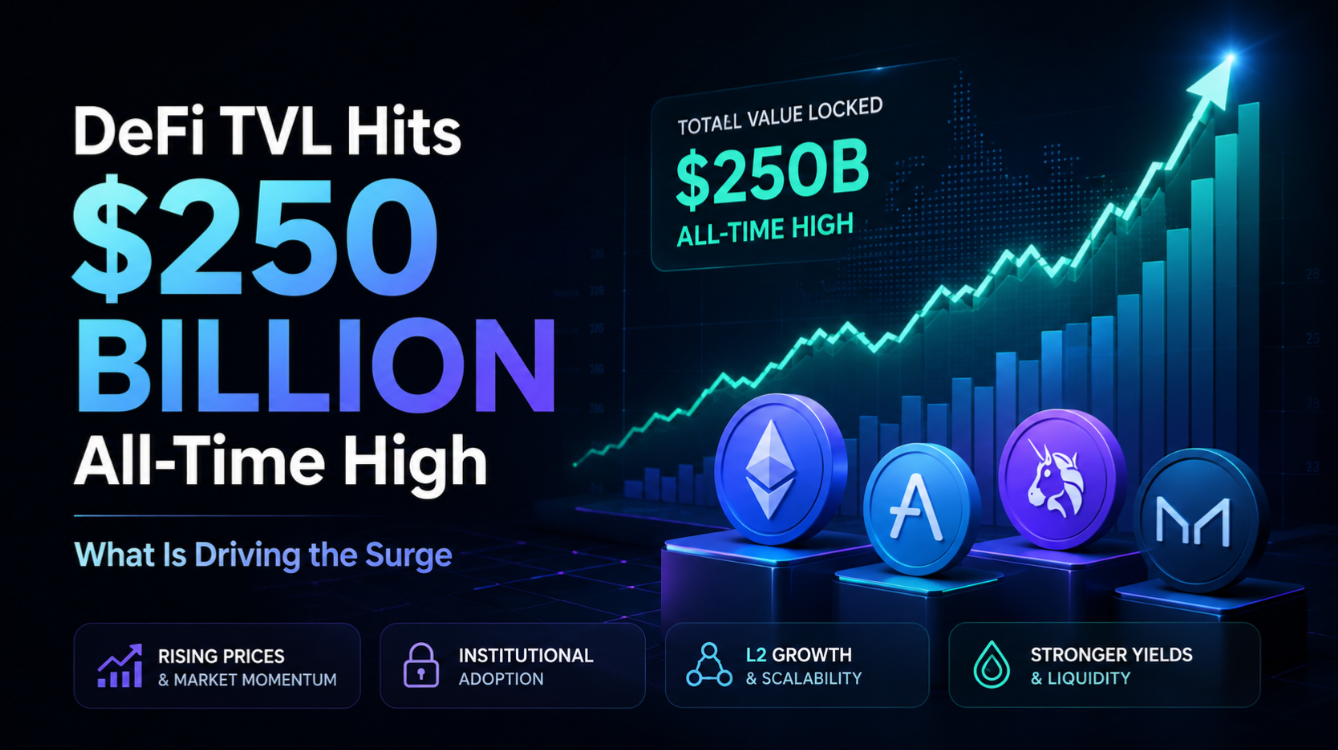
Decentralized finance has crossed $250 billion in total value locked (TVL), surpassing the previous all-time high set in late 2021 and signalling that on-chain capital markets have entered a new era of maturity. The record comes amid an extended period of protocol innovation, improving user experience, and institutional appetite that was absent during the last cycle.
Breaking Down the $250B Number
TVL measures the cumulative value of assets deposited in smart contracts — collateral in lending markets, liquidity in automated market makers, staked tokens in validator sets, and locked assets in bridge contracts. The figure is not a proxy for profit or user count, but it does reflect genuine economic activity on-chain.
The three largest contributors to the current milestone are liquid staking derivatives, which account for roughly $90 billion; lending and borrowing platforms — led by Aave — at around $60 billion; and automated market makers anchored by Uniswap and Curve at $40 billion combined. The remainder is spread across perpetual DEXs, yield aggregators, and real-world asset protocols.
Driver 1 — Liquid Staking Comes of Age
Liquid staking tokens (LSTs) have become the dominant DeFi primitive of this cycle. By converting illiquid staked ETH into yield-bearing tokens that can be used as collateral, borrowed against, or traded, protocols like Lido, Rocket Pool, and EigenLayer have unlocked billions in dormant capital. The re-staking narrative pushed by EigenLayer alone attracted over $15 billion in restaked ETH, creating compounding TVL effects.
Institutional players in particular have embraced LSTs as a compliant way to access staking yields while preserving liquidity for treasury management. Custody solutions from Coinbase and Anchorage now support LST integration, removing the last operational barrier for fund managers.
Driver 2 — Lending Markets Expand Beyond Crypto-Native Collateral
The second major driver is the expansion of collateral types in lending markets. Aave V4 accepts tokenised US Treasuries, ETF shares, and real estate tokens alongside traditional crypto collateral. This widens the addressable market and keeps capital productive even during low-volatility periods when crypto-native yield compresses.
According to on-chain data, the share of non-crypto collateral in major lending protocols grew from under 2% in 2024 to over 11% in Q1 2026. Real-world asset (RWA) protocols like Centrifuge and Goldfinch contributed another $8 billion in TVL as trade-finance and invoice-factoring products gained traction with institutional borrowers.
For a detailed look at lending platforms, see our DeFi lending ratings and the broader DeFi ratings hub.
Driver 3 — DEX Liquidity Deepens With Concentrated Positions
Uniswap V4's hooks architecture and Curve crvUSD's LLAMMA model have both improved capital efficiency in AMMs, allowing LPs to earn more fee revenue with the same notional capital. This has pulled substantial institutional liquidity into DEX pools that previously sat on centralised exchanges.
Concentrated liquidity positions managed by automated range managers now account for more than 40% of Uniswap V3 and V4 liquidity. Professional market-making firms, sensing that MEV extraction opportunities on-chain outperform centralised venue rebates, have migrated significant inventory to DeFi.
Macro Tailwinds and Regulatory Clarity
The broader macro environment has also helped. Interest rate cuts in the US and EU have compressed traditional fixed-income yields, pushing allocators toward on-chain alternatives offering 5–12% APY on stablecoin strategies. At the same time, regulatory frameworks in the EU (MiCA) and tentative guidance in the US have reduced legal uncertainty, emboldening compliance teams to approve DeFi exposure.
A wave of spot ETF approvals and qualified custodian solutions for DeFi tokens has created a bridge between tradfi capital pools and on-chain protocols. Market analysts now project DeFi TVL could reach $400 billion by end-2026 if current growth rates persist.
Risks That Could Reverse the Trend
Not all analysts are bullish. Key risks include:
- Smart contract exploits — 2025 saw $1.2 billion lost to hacks despite improved auditing standards
- Regulatory rollback — a US executive action targeting DeFi front-ends could drain TVL rapidly
- Macro reversal — a risk-off shock could trigger cascading liquidations in over-leveraged lending markets
- Oracle manipulation — price feed attacks remain the most common attack vector in lending protocols
Despite these risks, on-chain insurance protocols and better audit tooling are gradually closing the gap with traditional finance risk management. The $250B milestone reflects a DeFi ecosystem that has substantially de-risked since the chaotic 2022 collapse.