
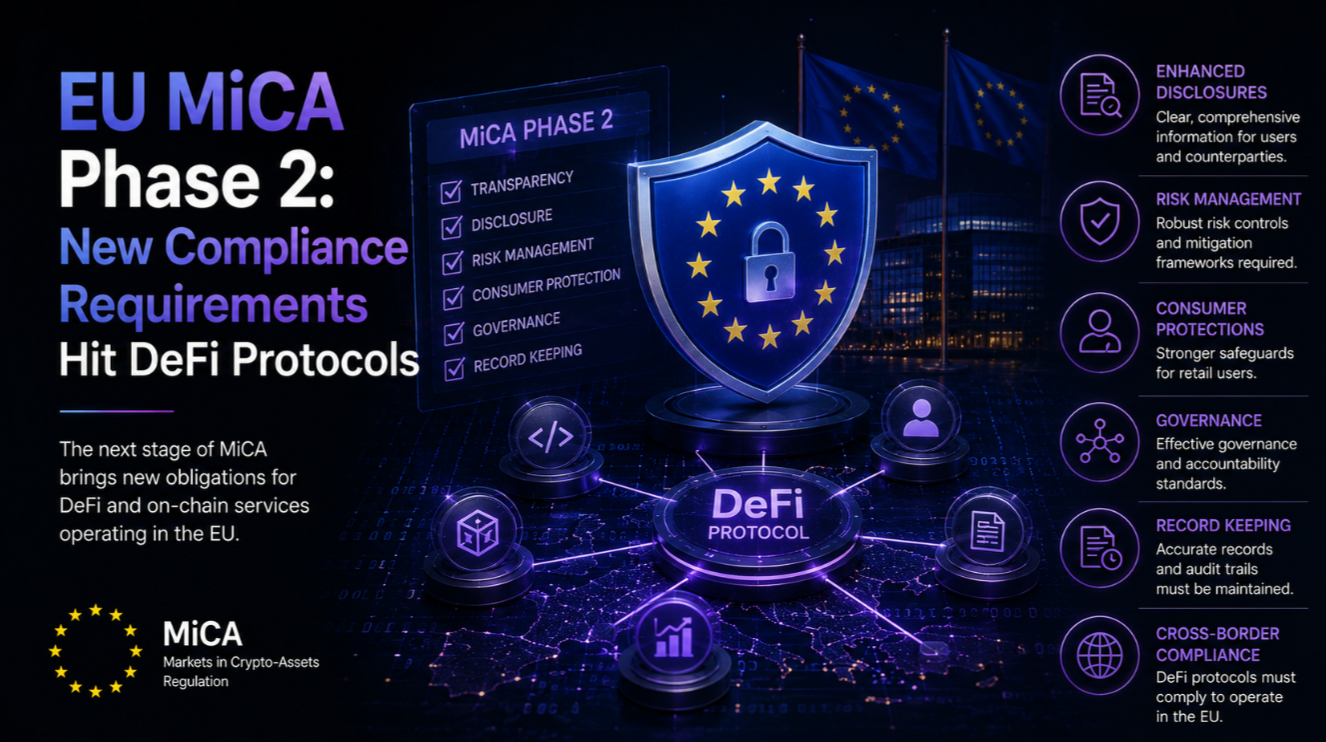
The European Union's Markets in Crypto-Assets regulation entered its second and most ambitious phase in April 2026, extending its reach beyond centralised exchanges and stablecoin issuers to encompass decentralised finance protocols. The European Banking Authority and the European Securities and Markets Authority jointly published the final delegated acts, giving DeFi projects a six-month transition window before enforcement begins.
What MiCA Phase 2 Covers
MiCA Phase 1, which took full effect in December 2024, established licensing and reserve requirements for centralised crypto-asset service providers and electronic money token issuers. Phase 2 fills the gaps regulators identified during the first year: governance transparency in DeFi, cross-border stablecoin flows, and the treatment of protocol revenue as regulated financial activity.
Key pillars of Phase 2 include:
- Decentralised protocol disclosure obligations for protocols with >€5M in monthly EU user fees
- Governance accountability: DAOs with EU-resident token-holders above defined thresholds must appoint a legal representative
- Stablecoin reserve segregation: all e-money token reserves must be held with EU-authorised credit institutions, not used for yield generation
- Smart-contract audit requirements for protocols handling EU retail user funds above €50M TVL
- Incident reporting: critical protocol vulnerabilities must be disclosed to regulators within 72 hours
Stablecoin Operators: Reserve Rules Tighten
The stablecoin provisions in Phase 2 directly affect the two largest dollar-backed assets in the EU market. USD Coin (USDC) operator Circle had already received an e-money institution licence under Phase 1, positioning it well for compliance. Tether (USDT), which had declined to seek EU licensing under Phase 1, now faces a harder choice: obtain a licence within the transition period or restrict EU-resident access to issuance and redemption services.
Under Phase 2, reserve assets backing e-money tokens must be fully segregated from the issuer's operating capital, held in escrow at authorised credit institutions, and audited quarterly by an EBA-registered auditor. Yield generated on reserves belongs to the issuer but must be disclosed in real time via a public dashboard.
DeFi Protocol Obligations: The Hard Part
The treatment of DeFi is where MiCA Phase 2 breaks new regulatory ground globally. The regulation avoids a "front-end equals issuer" model and instead introduces a sliding scale based on economic activity and EU user exposure. Protocols below the €5M monthly fee threshold are exempt. Those above face a tiered framework:
- Tier 1 (€5M–€25M/month): Publish protocol documentation, governance structure, and smart-contract audit results
- Tier 2 (€25M–€100M/month): All Tier 1 obligations plus appoint an EU legal representative and submit to supervisory oversight by ESMA
- Tier 3 (>€100M/month): Full CASP-equivalent licensing, capital adequacy, and consumer protection requirements
Most major DeFi protocols — Uniswap, Aave, Curve — fall into Tier 1 or Tier 2. The legal representative requirement is particularly contentious for projects that emphasise their decentralised and pseudonymous governance, as it implies legal accountability for protocol decisions.
Industry Response and Legal Challenges
The European Crypto Initiative and the DeFi Education Fund have already filed joint observations with ESMA challenging the legal representative requirement as incompatible with the fundamental design of permissionless protocols. A judicial review at the Court of Justice of the EU is considered likely within the transition period.
For businesses operating centralised services, compliance is more straightforward. Licensed exchanges including Coinbase and Binance both hold MiCA CASPs licences from Phase 1 and have published updated compliance statements confirming Phase 2 readiness for their EU-facing products.
What EU Crypto Users Should Know
For retail users, Phase 2 brings stronger protections: mandatory segregation of custodied assets, public audit trails for stablecoin reserves, and an ESMA dispute resolution mechanism for cross-border complaints. The six-month transition window runs until October 2026, after which non-compliant protocols and services risk being blocked at the DNS and payment-processor level by national competent authorities.
The EU's phased approach to crypto regulation remains the most comprehensive in any major jurisdiction. Whether Phase 2 achieves its goal of consumer protection without stifling DeFi innovation will be closely watched by regulators globally, particularly in the US as the CLARITY Act moves through Congress.