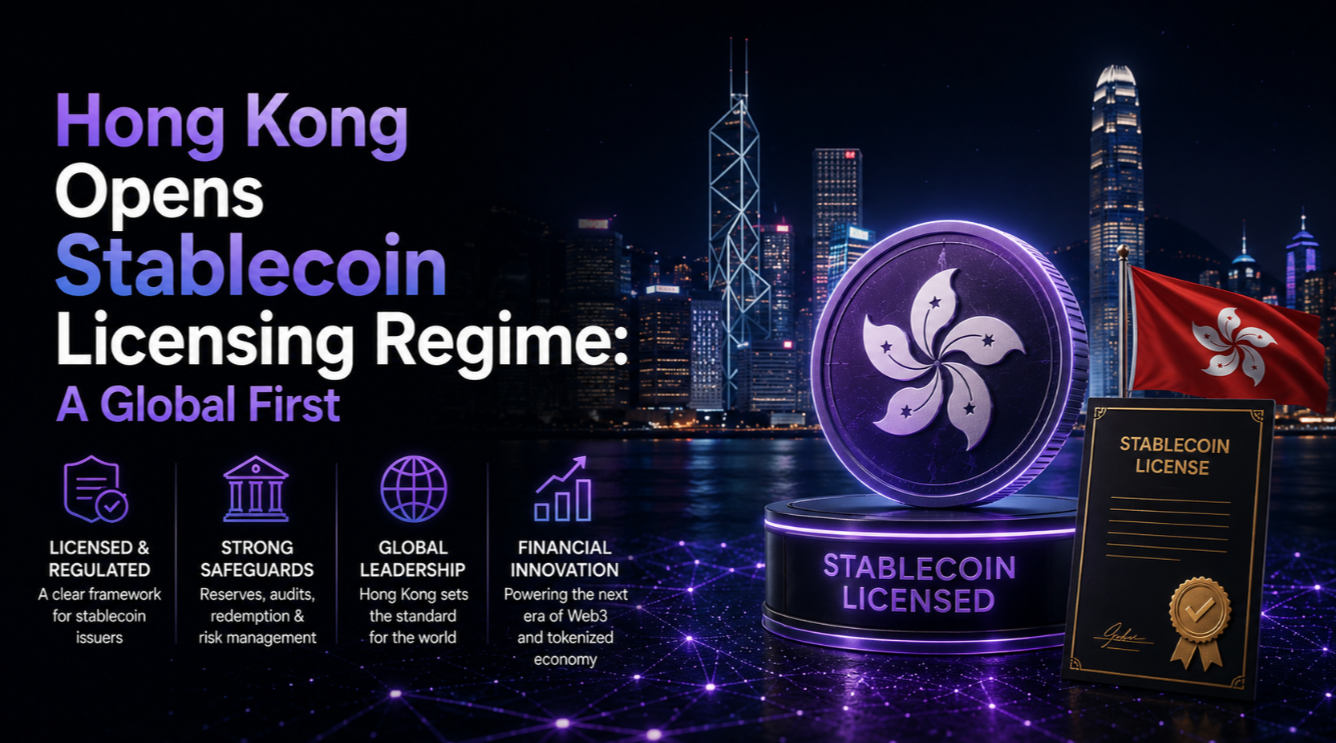
Hong Kong became the first jurisdiction in the world to operate a formal stablecoin issuer licensing regime on 25 April 2026, as the Hong Kong Monetary Authority opened applications under the Stablecoins Ordinance enacted in March. The regime requires all fiat-referenced stablecoin issuers serving Hong Kong residents to hold a licence, maintain segregated reserves, and guarantee one-to-one redemption on demand.
Why Hong Kong Moved First
Hong Kong's decision to regulate stablecoins ahead of any other major financial centre reflects a deliberate strategy to position the city as Asia's digital-asset hub following a series of reforms that began in 2023. The Securities and Futures Commission had already licensed virtual asset trading platforms, and the HKMA had issued guidelines for bank participation in the crypto ecosystem. The stablecoin regime is the final pillar of a comprehensive framework designed to attract institutional capital while maintaining financial stability.
HKMA Chief Executive Eddie Yue described the regime as "a model for responsible innovation" that other central banks could adapt. Singapore, Japan, and the UAE have all indicated they are studying the Hong Kong approach as they finalise their own stablecoin frameworks.
Licence Requirements: What Issuers Must Do
The licensing requirements are demanding and explicitly designed to exclude undercapitalised or operationally inadequate issuers. Key obligations include:
- Minimum paid-up capital of HK$25 million (approximately US$3.2 million)
- Reserve assets equal to 100% of outstanding tokens, held in licensed Hong Kong banks or approved custodians
- Reserve assets limited to HK dollar deposits, HK government bills, and qualifying short-duration sovereign debt
- Monthly reserve attestation by an HKMA-approved auditor published on the issuer's website
- Redemption within one business day of request at par value with no redemption fee exceeding 0.1%
- Real-time reserve monitoring dashboard accessible to the HKMA
- Business continuity plans tested annually and submitted to the regulator
Who Has Applied
The HKMA confirmed it received seven applications in the first 48 hours of the regime opening. Three are from locally incorporated entities backed by traditional financial institutions; two are subsidiaries of existing licensed virtual asset exchanges. The remaining two include a subsidiary of USD Coin (USDC) issuer Circle, which has engaged extensively with the HKMA during the two-year consultation period, and an Asia-focused stablecoin backed by a basket of Asian currencies.
Tether (USDT) has not yet filed a Hong Kong licence application as of the publication date. The firm issued a statement noting it is "evaluating the regime requirements" and expects to make a formal decision by Q3 2026. Given that USDT accounts for the majority of crypto trading volume in Asia, the HKMA has indicated it will engage directly with Tether to discuss a compliance pathway.
Impact on Crypto Exchanges Operating in Hong Kong
Licensed virtual asset trading platforms in Hong Kong — including those operated by affiliates of Binance and Coinbase — must update their stablecoin listing policies within 180 days of the regime opening. Platforms may only list stablecoins issued by HKMA-licensed entities for Hong Kong retail investors. Unlicensed stablecoins may still be available for professional investors through specific carve-outs.
The 180-day transition period was welcomed by exchanges as sufficient time to re-engineer product listings and update compliance documentation. However, several platforms noted the operational complexity of managing different stablecoin inventories for retail and professional investor segments on the same infrastructure.
HKD-Backed Stablecoins: The New Opportunity
Beyond licensing existing dollar stablecoins, the regime creates a legal foundation for Hong Kong dollar-backed stablecoins for the first time. At least two of the initial applicants are pursuing licences for HKD stablecoins, which could facilitate cheaper domestic payments, tokenised trade finance, and interbank settlement on distributed ledgers. The HKMA's own Project mBridge — a multi-CBDC cross-border payment initiative — is explicitly designed to be interoperable with licensed stablecoins under the new regime.
Global Implications
The Hong Kong framework arrives at a critical moment in the global regulatory debate. The US CLARITY Act's stablecoin provisions, the EU's MiCA e-money token rules, and now Hong Kong's dedicated licence represent three different but compatible approaches to the same problem. Each requires reserves, audits, and redemption guarantees — signalling an emerging international consensus on the minimum standards for regulated stablecoins. This convergence is good news for issuers like Circle, which can design a single compliance architecture for multiple jurisdictions, but creates headaches for operators like Tether that have historically avoided formal licensing.