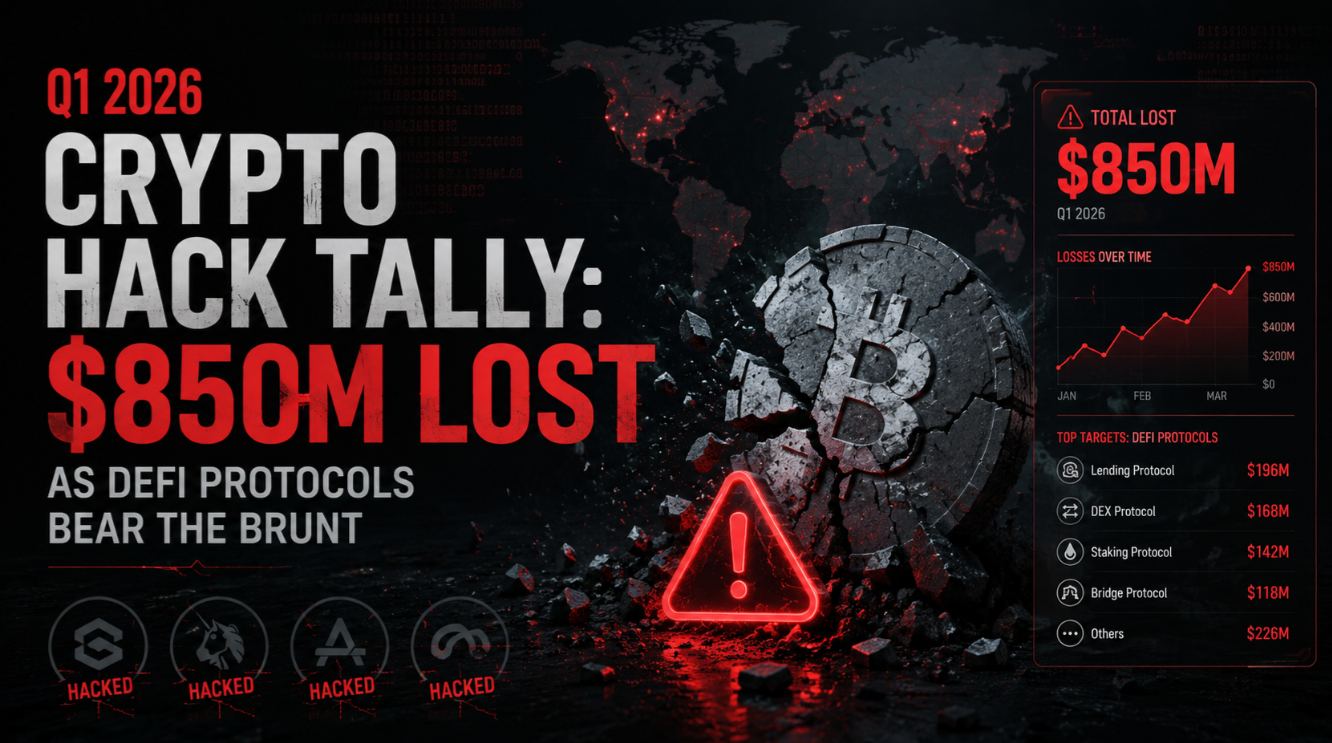
The first quarter of 2026 closed with $850 million in confirmed losses across the broader cryptocurrency ecosystem — the second-highest Q1 figure on record. According to aggregated data from on-chain security firms, decentralised finance protocols bore the heaviest damage, accounting for $610 million or roughly 72% of the total. The numbers underscore a persistent industry failure: despite years of high-profile incidents and an expanding audit ecosystem, attackers continue to find and exploit the same categories of vulnerability. Users seeking to protect their holdings should consult the hardware wallet reviews and the wallet category ratings before committing funds to any protocol.
The Biggest Incidents of Q1 2026
The quarter's largest single loss was a $190 million oracle manipulation attack on a cross-chain lending protocol operating across Ethereum, Arbitrum, and BNB Chain. The attacker used a series of flash loans to distort spot price feeds on a low-liquidity trading pair that the protocol used as its primary collateral oracle, artificially inflating the value of a minority asset and draining the lending pool before liquidations could execute.
The second-largest incident — $145 million — exploited a reentrancy vulnerability introduced in an unaudited vault upgrade to an established automated market maker. The protocol had undergone multiple audits of its core contracts but pushed the upgrade without a formal review, a procedural failure that allowed the attacker to recursively drain funds across 47 vault positions in a single transaction.
A $90 million flash-loan attack on a yield aggregator rounded out the top three. The attacker exploited a pricing discrepancy between the aggregator's internal share accounting and the underlying asset pool during a temporary liquidity imbalance, extracting value without any code exploit — purely through economic manipulation of the protocol's own logic.
- $190M — Cross-chain lending oracle manipulation (Feb 14)
- $145M — AMM vault reentrancy exploit (Jan 28)
- $90M — Yield aggregator flash-loan price attack (Mar 7)
- $68M — Bridge validator key compromise (Jan 11)
- $41M — Governance attack on a DAO treasury (Feb 27)
- $316M — All other incidents combined
Root Cause Breakdown
Categorising the 47 distinct incidents tracked in Q1 2026 by root cause reveals a landscape that has not changed fundamentally in three years. Logic errors in smart contract code remain the top category by loss value. These are not simple bugs — they are subtle interactions between contract modules, often only exposed when an attacker builds a transaction that triggers a code path never reached during normal use or testing.
Oracle manipulation has grown as a share of losses as DeFi protocols expand to support more exotic collateral types with thin on-chain liquidity. When a lending protocol accepts an asset that trades only $2 million per day as collateral, a well-capitalised attacker can temporarily move that market, borrow against inflated collateral, and exit before liquidation bots respond. Time-weighted average price oracles reduce but do not eliminate this risk.
Bridge vulnerabilities contributed $68 million in Q1, down sharply from prior years as the industry moves toward more conservative bridge designs. However, the average bridge hack when it does occur remains catastrophic — the $68 million figure came from a single incident involving a compromised validator key, not a code exploit.
The Audit Problem
Industry observers have noted with frustration that a significant share of Q1 incidents struck protocols that had been audited by reputable firms. Audits are not guarantees — they are time-limited reviews that cannot anticipate every future upgrade, integration, or market condition. The reentrancy attack that cost $145 million targeted code written after the most recent audit. Several oracle manipulation attacks exploited conditions (low liquidity, novel asset pairings) that exist outside the audit's scope.
The emerging best practice is continuous security: formal verification for core invariants, economic modelling of extreme market scenarios, on-chain monitoring with automated circuit breakers, and meaningful bug bounty programs that incentivise researchers to find vulnerabilities before attackers do. The next article in this series covers white-hat bounty programs in detail.
What Individual Investors Can Do
For individual holders, the primary lesson from Q1 2026 remains unchanged: custody decisions matter more than yield optimisation. Funds held in self-custodied hardware wallets are not exposed to smart contract risk. The Ledger hardware wallet review and Trezor hardware wallet review compare the leading devices across security architecture, supported assets, and user experience. For a broader ranking of wallet solutions including software and multi-sig options, the wallets rating page is the starting point.
Investors who participate in DeFi should treat it as a separate risk bucket from their core holdings, limit exposure to recently deployed or unaudited contracts, and monitor their positions for unusual activity. On-chain alert services can notify holders within seconds of suspicious contract interactions — a capability that existed during several Q1 2026 attacks but was not configured by the affected protocols.
For a broader view of the social-engineering threats that accompany technical exploits, see the guide to top crypto scams in 2026.