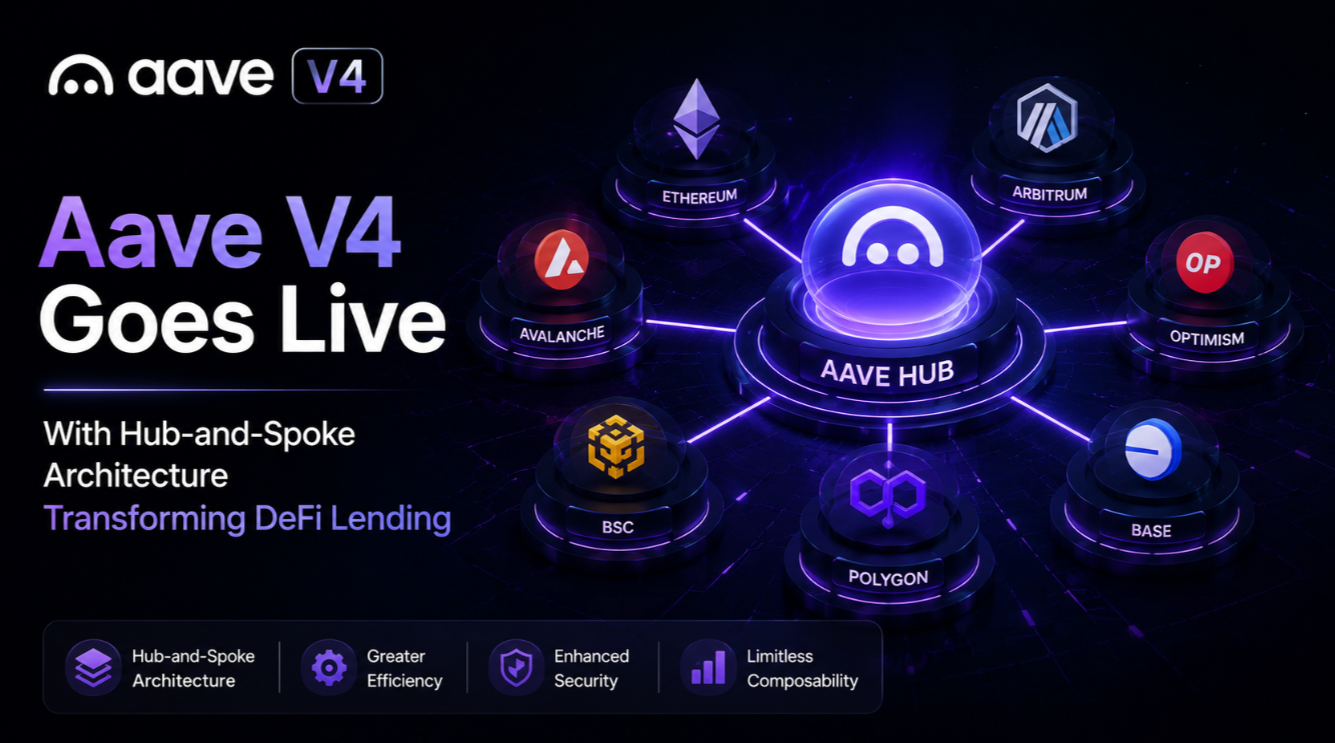
Aave, the largest decentralized lending protocol by total value locked, has deployed its V4 upgrade featuring a fundamentally redesigned hub-and-spoke architecture. The release marks the most significant technical overhaul since Aave V3 launched in 2022 and addresses limitations in cross-chain capital efficiency that have frustrated both users and liquidity providers.
What the Hub-and-Spoke Model Changes
In Aave V3, each chain deployment operated as a siloed lending market. Liquidity on Arbitrum could not backstop borrows on Polygon; rates were set independently and arbitrage opportunities persisted for days. V4's hub-and-spoke model introduces a central liquidity hub on Ethereum that acts as a coordination layer, while spoke deployments on L2s tap into it for liquidity balancing and interest-rate signals.
The practical result is that a $500M USDC pool on Ethereum can backstop borrow demand across Base, Arbitrum, and Optimism simultaneously. When demand on one spoke increases borrowing rates, the hub automatically routes liquidity from underutilised spokes, compressing rate differentials and improving user economics across all chains.
Read our full Aave review for a deeper analysis of the protocol's strengths and how V4 compares to competitors in the DeFi lending ratings.
Dynamic Interest Rate Model
V4 replaces the static slope parameters of previous versions with a dynamic interest rate model that adjusts in real time based on cross-chain utilisation signals. The algorithm accounts for borrow demand, available liquidity depth, oracle variance, and historical volatility of each asset.
Early simulations run by the Aave risk team show that the dynamic model reduces the frequency of utilisation spikes — where borrow rates briefly shoot above 100% APY — by approximately 70%. For retail borrowers holding leveraged positions, this translates to more predictable funding costs and fewer forced liquidations.
- Base borrowing rate now floors at protocol-determined risk-free rate rather than zero
- Volatility-adjusted rate caps prevent outlier borrow spikes during oracle stress events
- Rate smoothing uses a 4-hour exponential moving average to dampen flash loan distortions
- Cross-chain utilisation signal updates every Ethereum block via an optimistic bridge
Native GHO Integration and the Unified Collateral Layer
Aave's native stablecoin GHO has been deeply integrated into V4 as a first-class asset. Borrowers can mint GHO directly against any whitelisted collateral with interest paid in GHO, eliminating the two-transaction flow required in V3. StkAAVE holders continue to receive a discount on GHO borrow rates, now extended to stkBPT positions in the Aave Safety Module.
The unified collateral layer allows a single collateral position to back both a GHO mint and a USDC borrow simultaneously, provided combined loan-to-value stays within risk thresholds. This composability unlocks leveraged yield strategies that previously required multiple protocol hops.
Risk Module Overhaul and Isolation Mode 2.0
V4 introduces a tiered collateral classification system that replaces V3's binary isolation mode. Assets are now assigned one of five risk tiers — Core, Standard, Isolated, Emerging, and Community — each with distinct borrow caps, LTV ceilings, and liquidation incentives.
Core assets (ETH, wBTC, USDC, USDT) can be used cross-collaterally with no cap restrictions. Standard assets can be cross-collateralised up to $500M TVL caps. Isolated and Emerging assets are siloed, limiting contagion risk from long-tail token additions. This granularity allows Aave to safely onboard more collateral types — including RWA tokens and LSTs — without exposing core liquidity to tail-risk assets.
Market Reaction and Competitive Implications
Within 72 hours of the V4 mainnet launch, Aave's TVL grew by $3.4 billion as existing users migrated positions and new capital entered through the updated front-end. AAVE token gained 18% in the same window as markets priced in improved fee generation and expanded GHO utility.
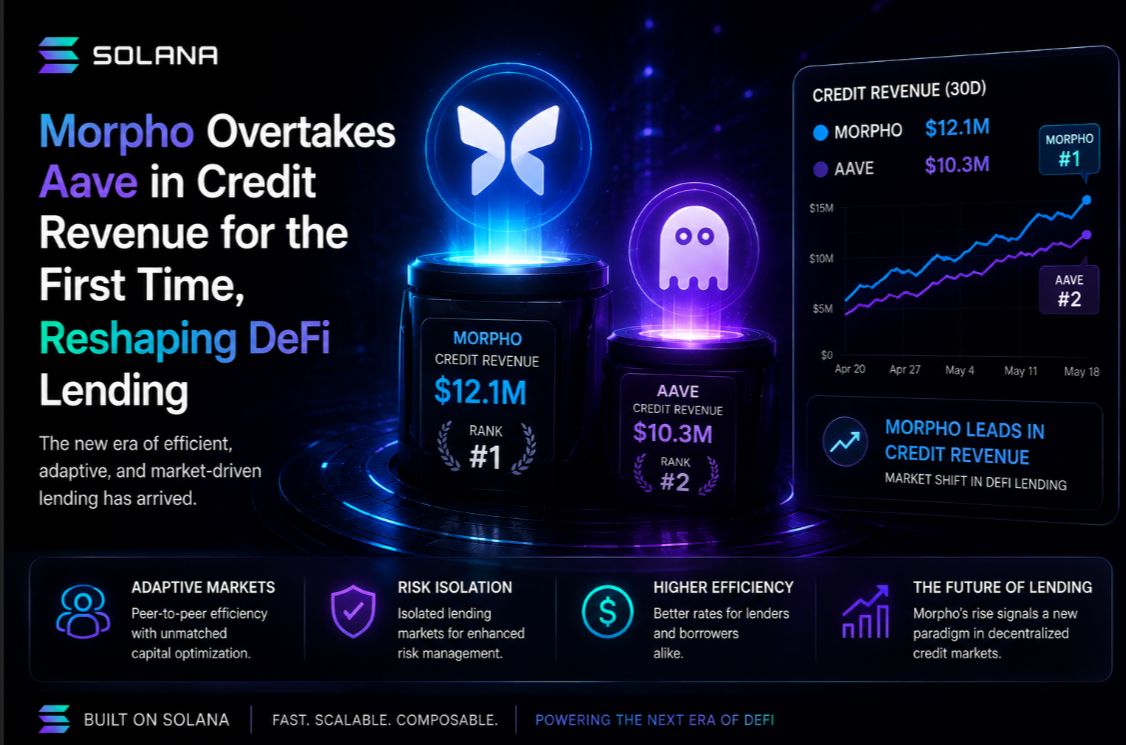
The upgrade directly challenges Morpho, Euler V2, and Compound V3 for institutional lending mandates. Morpho has positioned itself as a modular alternative to Aave, while Euler V2 targets power users with customisable vaults. For a comparison, see the DeFi ratings overview.
For long-term AAVE holders, V4 is significant because it expands GHO supply potential — and GHO interest payments are a direct revenue stream to the Aave DAO treasury, improving protocol sustainability independent of token price.
What Comes Next for Aave V4
The Aave governance forum has already approved a roadmap that extends V4 capabilities. Near-term upgrades include cross-chain liquidation (allowing liquidators on one chain to close positions on another), a native credit delegation marketplace, and a permissioned institutional pool with KYC-gated access for funds needing regulatory compliance.
Longer term, the team has flagged intent to build a native yield layer that automatically compounds idle collateral into Curve or Uniswap V4 liquidity, turning Aave from a passive lending book into an active yield-optimising engine.