
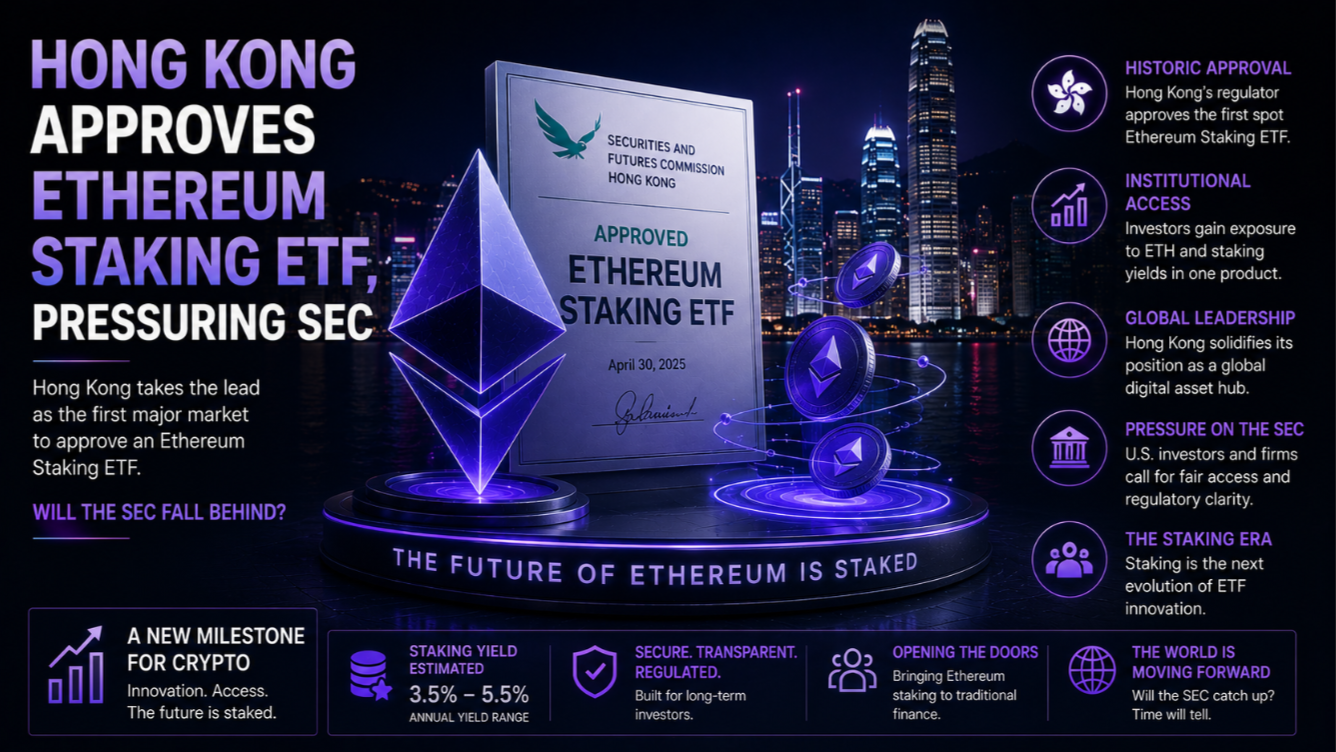
Hong Kong's Securities and Futures Commission (SFC) has approved the first spot ethereum staking ETF, a landmark regulatory decision that enables institutional investors to access ethereum staking yields through a regulated, listed product. The approval represents a significant shift in how financial regulators treat cryptocurrency staking infrastructure and adds pressure on the US Securities and Exchange Commission to approve similar products domestically.
Hong Kong SFC Approval: Historic Regulatory Milestone
On April 23, 2026, Hong Kong's SFC officially approved the VanEck Ethereum Staking ETF for listing and trading on Hong Kong exchanges. This marks the first jurisdiction globally to explicitly authorize a spot ethereum staking ETF with direct yield distribution to retail and institutional investors. The approval follows months of regulatory dialogue between the SFC and ethereum staking infrastructure providers, signaling growing institutional confidence in delegated staking models.
The approval process validated three core mechanisms: (1) ethereum held in trust by regulated custodians, (2) automated delegation to validator nodes via reputable staking operators, and (3) yield distribution directly to ETF shareholders. The SFC's framework treats staking yields as income distributions rather than speculative derivatives, enabling incorporation into traditional asset allocation models.
This regulatory clarity distinguishes Hong Kong from most other jurisdictions. The EU, Switzerland, and Singapore maintain ambiguous rules around staking yield products. The US SEC has repeatedly rejected ethereum staking ETF applications on the grounds that staking constitutes unregistered securities offerings. Hong Kong's approval directly contradicts this interpretation and provides a competitive advantage for Asia-focused institutional allocators.
ETF Mechanics: How the Staking Infrastructure Works
The VanEck Ethereum Staking ETF operates via a specialized trust structure. Ethereum deposited by investors is held in cold storage by Fidelity Digital Assets (the registered custodian), then delegated to independent validator nodes run by Lido Finance, the dominant ethereum liquid staking protocol. Lido maintains a decentralized operator set of 30+ node operators, reducing single-point-of-failure risks.
Key infrastructure details:
- ETF holders receive stETH (staked ethereum) tokens representing their underlying ethereum + accrued rewards
- Daily staking rewards (3-4% APR) are automatically distributed to shareholders as dividend payments
- Ethereum never leaves the trust structure; validator keys are non-custodial and held exclusively by node operators
- Withdrawal and redemption occurs via the Lido protocol with 1-2 day settlement periods
- ETF NAV (net asset value) automatically reflects current eth price + accumulated staking rewards
The trust structure eliminates counterparty risk inherent in direct staking participation. Investors receive passive exposure without managing validators, signing transactions, or worrying about technical failures. This accessibility is crucial for institutional adoption, as most fund managers lack in-house ethereum staking expertise.
Yield Mechanics: 3-4% Annual Returns Built Into the Product
The ETF currently yields 3.2% APR, derived from ethereum consensus-layer staking rewards. These rewards are generated continuously as ethereum validators propose and attest to new blocks. Unlike price appreciation (which is volatile and speculative), staking yields are predictable and algorithmically determined by the Ethereum protocol.
Yield composition:
- Base validator rewards: ~2.8% annually (protocol-set, depends on total eth staked)
- MEV (maximal extractable value) rewards: ~0.4% annually (from transaction ordering optimization)
- Protocol inflation: Currently 0%, but Ethereum treasury may fund future upgrades via issuance
- Net costs: Lido operator fees (~5% of rewards) and ETF management fees (~0.15% per annum)
This yield structure appeals to institutional fixed-income portfolios seeking stable returns uncorrelated to bitcoin or equities. For pension funds, endowments, and insurance companies, 3.2% risk-adjusted returns with minimal operational overhead represent an attractive allocation. The yield is also higher than most corporate bonds and government debt in developed markets, creating demand from yield-hungry asset allocators.
The ETF distributes staking rewards quarterly, with option for automatic dividend reinvestment. This structure enables integration into sophisticated tax-planning strategies and allows institutional holders to optimize cash flow timing.
Regulatory Pressure on the US SEC for Ethereum Staking ETFs
Hong Kong's approval immediately intensifies pressure on the US SEC to reconsider its stance on ethereum staking products. The SEC has rejected multiple ethereum staking ETF applications from major issuers including Fidelity, BlackRock, and Grayscale, citing concerns that ethereum staking constitutes an unregistered securities offering.
However, Hong Kong's regulatory framework undermines this interpretation. If the SFC (a peer agency to the SEC) determined that ethereum staking is compatible with regulated product offerings, the SEC's position becomes increasingly untenable. Industry observers expect one of three outcomes:
- SEC approval of US ethereum staking ETFs within 12 months, following Hong Kong's precedent
- SEC maintains rejection stance, driving institutional allocators to hong Kong and Singapore products, ceding market share to Asia
- SEC approves ethereum staking ETFs with specific guardrails (e.g., requirement to use only regulated custodians like Fidelity)
The geopolitical dimension is significant. Hong Kong's fintech-friendly regulatory approach positions the region as a preferred hub for digital asset infrastructure. If the US SEC continues to block ethereum staking products while Asia approves them, capital flows will accelerate toward Asia-listed ETFs, reducing US regulatory authority over the ethereum ecosystem.
Asia Institutional Flows: Unlocking Capital From Eastern Institutions
Hong Kong approval unlocks capital from an entirely new institutional cohort: large Asian pension funds, insurance companies, and asset managers that operate under strict regulatory compliance frameworks. These institutions were previously barred from ethereum exposure because staking products fell outside regulatory guardrails.
Key beneficiaries:
- Korean institutional investors (currently barred from many crypto products under local law) can access ethereum via Hong Kong ETF routing
- Japanese insurance and pension funds gain approved exposure to ethereum yields
- Singapore's sovereign wealth funds and endowments can incorporate ethereum into global allocation mandates
- Chinese institutional money can access ethereum via offshore Hong Kong structures (with regulatory approval)
Analysts estimate potential institutional inflows from Asia alone could exceed $10-20 billion within 12 months, assuming other jurisdictions follow Hong Kong's regulatory framework. This scale of capital would fundamentally shift ethereum's holder base from retail speculation to institutional allocation, supporting a more mature market structure and reducing price volatility.
What This Means for Ethereum Price and Market Structure
The Hong Kong staking ETF has three potential impacts on ethereum price and adoption:
1. Institutional Demand Stimulus: Approval of regulated, yield-bearing ethereum products removes friction for institutional allocators. Institutions seeking 3% yields in a 2% interest-rate environment will view ethereum staking as an alternative allocation. This could support a gradual price floor around current levels while adding consistent buy-side demand.
2. Staking Pressure and Supply Dynamics: As more ethereum is deposited into staking via ETFs, the total ethereum supply locked in validators increases. Currently ~32% of ethereum is staked; Hong Kong ETF flows could push this to 40%+ over 12 months. Higher staking ratios reduce liquid supply available for trading, potentially supporting price appreciation through supply constraint.
3. Regulatory Clarity Supports Long-Term Adoption: Perhaps most importantly, Hong Kong's approval signals that ethereum is transitioning from speculative asset to regulated financial infrastructure. This narrative shift attracts institutional capital, enables ETF-based exposure, and supports a broader "ethereum as institutional asset class" thesis. Price appreciation may follow regulatory clarity rather than precede it.
Near-term price impact is likely modest (+3-7% over weeks), but medium-term implications (over 12-24 months) could be substantial if other jurisdictions follow Hong Kong's lead and US SEC eventually approves domestic ethereum staking ETFs. A global wave of staking ETF approvals could redirect $50-100 billion in capital toward ethereum, supporting a multi-year structural bull market independent of macro conditions.
For long-term ethereum holders, regulatory approval of staking products represents validation of the asset class itself. Institutions don't hold volatile speculative bets for dividend yields; they hold them as strategic allocations. This shift in investor base—from speculators to yield-seeking institutions—is structurally bullish for ethereum's price resilience and adoption trajectory.
Looking Forward: Global Staking ETF Adoption Timeline
Hong Kong's approval is likely the first of many. Expected regulatory timeline:
- 2026 Q3-Q4: Singapore, Switzerland, and EU likely approve ethereum staking ETFs following Hong Kong precedent
- 2026 Q4 - 2027 Q1: US SEC faces mounting pressure; Fidelity or BlackRock ethereum staking ETF approval expected
- 2027-2028: Global institutional capital begins substantial ethereum reallocation; ethereum staking reaches 50%+ of circulating supply
- 2028+: Ethereum transitions to "institutional yield infrastructure" narrative, supporting higher sustainable valuations based on cash-flow economics rather than speculation
For more information on ethereum's technical roadmap and staking infrastructure, see the ethereum market page and ethereum price forecast.