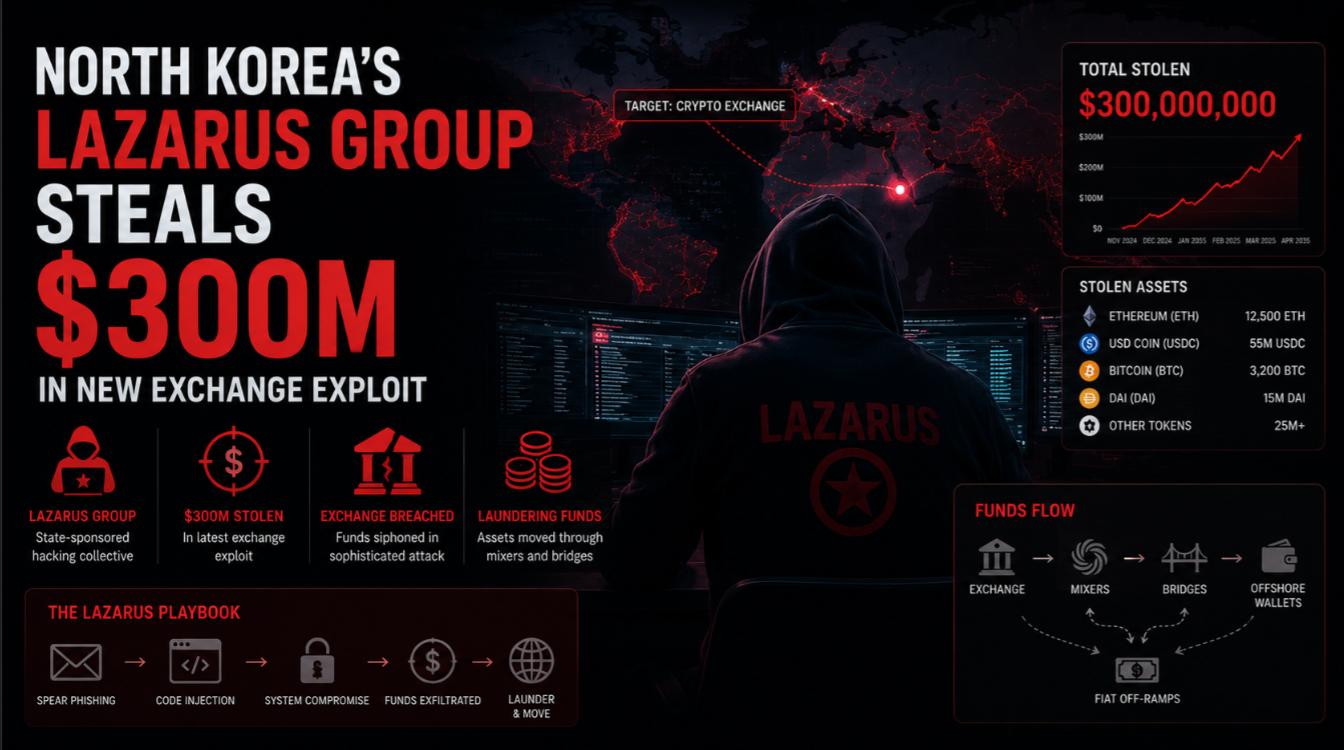
North Korea's Lazarus Group executed what blockchain forensic analysts are calling the most sophisticated state-sponsored crypto theft of 2026: a $300 million extraction from a mid-tier centralised exchange carried out over a six-week period through a combination of supply-chain compromise and targeted social engineering. The operation, pieced together by on-chain analysts and disclosed in a joint advisory from the US Cybersecurity and Infrastructure Security Agency (CISA) and blockchain analytics firm Chainalysis, illustrates the growing gap between the technical sophistication of state-sponsored attackers and the security postures of most crypto businesses.
How the Attack Unfolded: A Six-Week Operation
The attack did not begin at the exchange. According to the CISA advisory, Lazarus operatives first compromised a small software development firm that produced a popular open-source library used by dozens of exchange engineering teams for cryptographic key derivation. The compromise was silent: attackers inserted a delayed-activation payload that logged memory contents in specific circumstances — namely, when the library was called in the context of hot wallet signing operations.
Over four weeks, the payload silently exfiltrated partial key material and internal process data from the exchange's development environment. Lazarus analysts combined this with data from a separate social-engineering campaign: a fake recruiter profile on a professional networking site offered an exchange senior engineer a lucrative job, sending a malicious PDF as part of the interview process. The PDF exploited a zero-day in a widely used PDF rendering library, granting shell access to the engineer's workstation.
With internal network access and partial key intelligence, the attackers mapped the exchange's signing infrastructure over two additional weeks before executing the withdrawal — a multi-transaction sequence that drained $300 million in Bitcoin, Ethereum, and stablecoins to 47 attacker-controlled addresses within a four-minute window.
Blockchain Forensics: Following the Money
Within 90 minutes of the theft, on-chain analysts had flagged the attacker addresses. The subsequent laundering operation followed the Lazarus playbook with minor variations. Funds were initially fragmented across hundreds of wallets using automated scripts, then routed through two privacy-enhancing protocols before being bridged to alternative chains where tracing is more difficult.
Unlike earlier Lazarus operations that relied heavily on Tornado Cash (now sanctioned), this campaign used a combination of centralised mixers operating in non-KYC jurisdictions and cross-chain atomic swaps. Approximately $47 million has been frozen to date at regulated exchanges that received flagged addresses via Chainalysis alerts; the remaining $253 million is being actively traced.
- $47M frozen at regulated exchanges following Chainalysis alerts
- $83M traced through cross-chain bridges to non-EVM chains
- $71M moved through privacy mixers, current status unknown
- $99M unaccounted for, likely in long-duration cold storage
The Geopolitical Stakes
Lazarus Group cryptocurrency operations are not incidental. US Treasury, UN, and South Korean intelligence assessments consistently attribute 40-50% of North Korea's weapons of mass destruction development budget to cryptocurrency theft proceeds. The $300 million stolen in this single operation would, at those ratios, represent meaningful programme funding — a strategic asset, not merely an economic crime.
This reality creates a category of threat that most corporate security frameworks are not designed to handle. Nation-state attackers operate with intelligence agency resources, unlimited time horizons, and no risk of prosecution within their own jurisdiction. The social-engineering vector — a fake recruiter targeting an individual employee — is impervious to technical controls and requires ongoing human security awareness training to mitigate.
The policy response is evolving. The US Treasury's OFAC has expanded its designation of Lazarus-linked addresses, creating legal liability for any regulated entity that processes transactions from these wallets. Several exchange jurisdictions now mandate real-time screening of withdrawal addresses against OFAC and equivalent national lists.
What Exchanges Must Do Differently
The attack exposed three systemic weaknesses common across the mid-tier exchange category. First, over-reliance on software-based key management: the exchange's hot wallet signing keys were ultimately accessible from network-connected machines, enabling remote extraction. Hardware security modules (HSMs) with air-gap signing workflows would have broken the attack chain at this stage.
Second, insufficient software supply-chain vetting: the compromised library had not been audited, its dependencies were not pinned to verified hashes, and no tooling monitored for unexpected network calls from development dependencies. Third, inadequate personnel security: the social-engineering vector succeeded because security training did not specifically cover the fake recruiter threat pattern that has featured in multiple previous Lazarus operations.
Investors evaluating exchanges should look for explicit disclosure of cold wallet architecture, proof-of-reserves attestations, and third-party penetration testing. The wallet security ratings and hardware wallet options offer starting points for reducing personal exposure. For a comprehensive guide to threats beyond exchange hacks, see top crypto scams 2026.