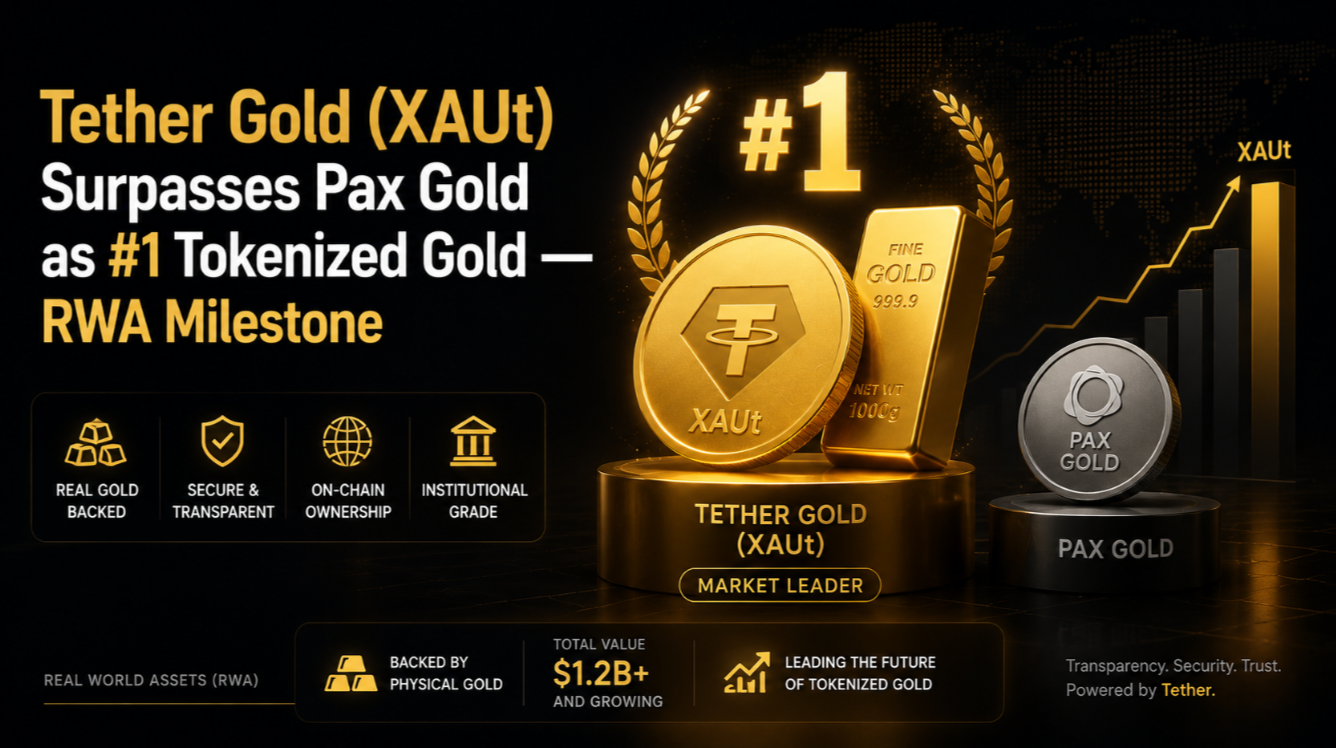
Tether Gold (XAUt) crossed a symbolic milestone in April 2026, overtaking Pax Gold (PAXG) to become the world's largest tokenized gold product by market capitalisation. With XAUt representing over $850 million in gold-backed value versus PAXG's $720 million, the ranking shift reflects Tether's distribution dominance across global crypto exchanges and the accelerating institutional and retail demand for on-chain precious metals exposure. The context of this growth sits squarely within the broader RWA tokenization wave — see Centrifuge market data for a complementary view on tokenized real-world assets.
The Tokenized Gold Market: Current State
Before analysing the XAUt/PAXG competitive dynamics, it is worth contextualising what tokenized gold actually is within the broader precious metals market. Physical gold market cap exceeds $13 trillion; gold ETF AUM is approximately $250 billion. Tokenized gold at $1.6 billion combined represents a rounding error — but it is growing at roughly 85% year-on-year from a base of under $900 million in April 2025.
The growth is driven by two distinct user segments. First, crypto-native investors who want gold exposure without leaving the on-chain ecosystem — they hold XAUt or PAXG as a hedge against crypto volatility, moving capital between BTC/ETH and tokenized gold based on risk-on/risk-off signals. Second, investors in currency-volatile emerging markets who want a dollar-stable, gold-denominated store of value that they can hold in a self-custody wallet beyond the reach of capital controls or bank failures.
How Tether Gold Surpassed Pax Gold
PAXG has historically been regarded as the higher-quality tokenized gold product due to Paxos's robust US regulatory status. Paxos is chartered as a New York Trust Company, subject to NYDFS oversight, and its gold reserves are audited by one of the major accounting firms. For institutional buyers, PAXG's regulatory pedigree was a deciding factor.
XAUt's rise to #1 was not driven by institutional preference but by distribution leverage. Tether has commercial relationships with virtually every major crypto exchange globally — Binance, OKX, Bybit, Kraken, Bitfinex — and has used these channels to aggressively promote XAUt to retail and semi-professional traders. When gold rallied to new nominal all-time highs above $3,200/oz in early 2026, the increased demand for gold exposure flowed through whichever product was most accessible — and XAUt's distribution footprint proved decisive.
- XAUt market cap (April 2026): ~$852 million
- PAXG market cap (April 2026): ~$718 million
- Combined tokenized gold market: ~$1.58 billion
- Year-over-year growth rate: ~85%
- Physical gold price (April 2026): ~$3,280/oz
- XAUt exchanges listed: 47 | PAXG exchanges listed: 31
Swiss Vault Infrastructure: How Physical Gold Backing Works
XAUt's gold is held in Brinks and Malca-Amit vaults in Switzerland, a jurisdiction chosen for its strong property rights, neutrality, and gold refining infrastructure. Each gold bar is a Good Delivery bar meeting the LBMA (London Bullion Market Association) standard: 400 troy ounces, minimum 99.5% purity, and stamped with a unique serial number.
When Tether issues new XAUt tokens, it must first purchase and allocate physical gold to a specific bar (or fractional allocation of a bar) in the vault. The token contract maintains a registry linking each token to specific bar allocations, allowing holders to verify that their tokens represent real, specific, audited gold. Theoretical delivery requests (tokens redeemed for physical gold pickup) are supported with a minimum threshold of one bar.
For investors who want to understand how gold tokenization intersects with broader on-chain credit and yield strategies, Maple Finance's institutional vaults have begun accepting XAUt as eligible collateral for gold-backed lending positions.
DeFi Integration and Yield Opportunities
One of the underappreciated dimensions of tokenized gold is its DeFi composability. Unlike physical gold (which sits inert in a vault) or a gold ETF (which generates no yield), XAUt and PAXG can be deployed in DeFi protocols to earn additional yield on top of gold's price appreciation.
Curve Finance's XAUt/PAXG liquidity pool allows holders to earn trading fee income (currently ~4-6% APY) by providing liquidity between the two tokenized gold products. Aave accepts PAXG as collateral for stablecoin borrowing, allowing gold holders to borrow USDC against their position for spending without selling gold. These yield enhancement strategies are unavailable to holders of traditional gold ETFs or physical bars.
The composability creates a new financial primitive: gold-backed, yield-bearing collateral that is simultaneously a macro hedge, a credit instrument input, and a 24/7 tradeable token. This combination does not exist in traditional finance and represents a genuine capability unlocked by tokenization.
Outlook: Is $10B Tokenized Gold Achievable?
Gold analysts project that tokenized gold could reach $10 billion in combined market cap by 2028 if: (1) gold prices remain elevated, (2) DeFi integration deepens, and (3) at least one major wealth management platform adds tokenized gold to its product offering for retail customers. All three conditions appear plausible. For token-level price dynamics, the Ondo Finance price forecast provides a framework for how the market values RWA protocol tokens as TVL scales.
The competitive question for the next phase is whether a third entrant — perhaps a central bank-backed tokenized gold product or a gold miner tokenizing production — disrupts the XAUt/PAXG duopoly. Several central banks with large gold reserves have expressed interest in tokenized gold as a mechanism for collateralising digital currency reserves, which could dwarf the current private-sector tokenized gold market if implemented.