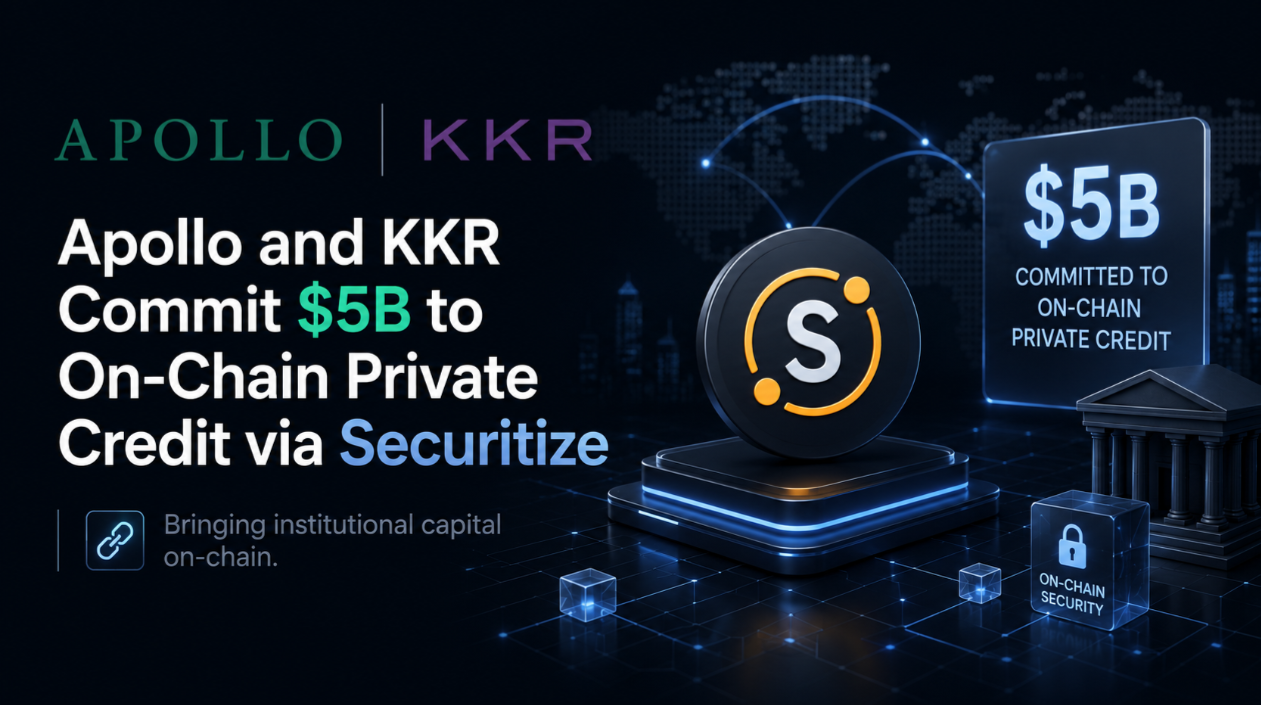
Apollo Global Management and KKR & Co. announced a combined $5 billion commitment to tokenize private credit assets through Securitize — the largest coordinated institutional RWA tokenization announcement in the sector's history. The deal validates years of infrastructure development by tokenization platforms and signals that the institutional asset management industry views blockchain-based distribution as a strategic imperative rather than a peripheral experiment. For context on the DeFi credit infrastructure these assets will interact with, see the Maple Finance review.
The Scale of the Commitment
To appreciate the magnitude of the Apollo/KKR commitment, consider the current state of the RWA market. Total on-chain RWA value (excluding stablecoins) was approximately $14 billion in April 2026. A $5 billion tokenization programme from two firms represents a ~35% step-change in the market's total size — and it is committed capital, not an aspiration.
The $5 billion covers three vehicle types: direct lending funds (loans to mid-market companies), asset-backed finance (securitised pools of consumer and commercial loans), and infrastructure debt (project finance for data centres, renewable energy, and transport). Each vehicle has different liquidity profiles and yield characteristics, and each will be tokenized as a separate instrument class on the Ethereum blockchain via Securitize's platform.
- Apollo commitment: $2.8 billion across direct lending and ABS vehicles
- KKR commitment: $2.2 billion across direct lending and infrastructure debt
- Blockchain: Ethereum (primary), with Avalanche Evergreen subnet for compliance
- Tokenization platform: Securitize (SEC-registered transfer agent)
- Target go-live: Q3 2026 (phased rollout)
- Minimum investment per token: $10,000 (subject to accreditation requirements)
Why Now? The Institutional Calculus
Both firms have publicly cited the same set of factors driving their decision. Distribution reach is primary: tokenization allows Apollo and KKR to offer their credit products to wealth management platforms, regional bank high-net-worth networks, and international allocators who lack the operational infrastructure to invest in traditional private fund vehicles. The tokenised token can be delivered to an investor's wallet through a wealth-tech API in the same workflow as a Treasury ETF purchase.
Operational efficiency is secondary but significant. Traditional private credit fund administration requires monthly NAV calculations, paper-based investor reporting, manual interest payments, and cumbersome transfer processes for secondary liquidity. Smart contract-based administration automates yield distributions, reduces back-office costs by an estimated 30-40%, and creates auditable on-chain records that simplify regulatory reporting.
The presence of Centrifuge's protocol-level infrastructure for structuring asset-backed pools was cited by KKR's head of digital assets as a key technical input — Centrifuge's battle-tested pool architecture informed elements of how KKR's ABS vehicles will be structured on-chain.
DeFi Integration: The Second-Order Story
The first-order story is institutional distribution. The second-order story — arguably more transformative — is DeFi composability. When $5 billion in Apollo/KKR credit tokens exist on Ethereum, they become potential inputs to the entire DeFi ecosystem: collateral for stablecoin minting, base assets for yield-bearing structured products, inputs to automated portfolio management protocols.
Maple Finance is already in discussions with both asset managers about accepting their tokens as collateral in Maple's institutional lending pools. If approved, this would allow DeFi protocols to borrow against high-grade private credit collateral — a fundamental upgrade to the quality of on-chain collateral backing crypto lending markets. Full details on Maple's institutional underwriting framework are available in the Maple Finance review.
The regulatory constraint is the access whitelist. Securitize's compliance architecture means only KYB-approved smart contract addresses can hold these tokens — limiting integration to regulated DeFi protocols with proper institutional compliance frameworks. This is intentional, but it means the composability story will unfold gradually as more DeFi protocols complete institutional compliance onboarding.
What This Means for Retail Investors
The $10,000 minimum investment — dramatically lower than the $1-10 million minimums of traditional Apollo and KKR fund vehicles — opens a meaningful access window for high-net-worth individuals and sophisticated retail investors. For the first time, a private individual investor with a $50,000 investment portfolio can allocate a meaningful percentage to institutional-quality private credit that was previously available only to pension funds and endowments.
This democratisation of access carries responsibility. Private credit is genuinely illiquid — the tokenized secondary market provides some liquidity improvement, but investors should not expect to sell tokenized private credit positions in seconds the way they would sell a stablecoin. The 30-90 day settlement periods and NAV-based pricing require investors to understand they are buying a fundamentally different instrument from liquid tokens.
For investors evaluating on-chain private credit exposure, the Ondo Finance price forecast provides a useful benchmark for understanding how token markets price exposure to similar yield-generating RWA infrastructure.
The Road to $100B On-Chain Private Credit
Industry analysts estimate the total addressable market for tokenized private credit at $500 billion or more, given that the global private credit market exceeds $1.5 trillion. The Apollo/KKR commitment suggests that even 10-20% penetration of that market could translate to $150-300 billion in on-chain private credit assets over the next decade.
Reaching that scale requires regulatory harmonisation, deeper secondary market liquidity, and broader institutional adoption of blockchain-based settlement. The Apollo/KKR move accelerates all three: it brings regulatory credibility, creates the largest on-chain private credit pool to date (improving secondary market depth), and signals to other major asset managers that the reputational risk of blockchain-based distribution is now lower than the competitive risk of sitting out.