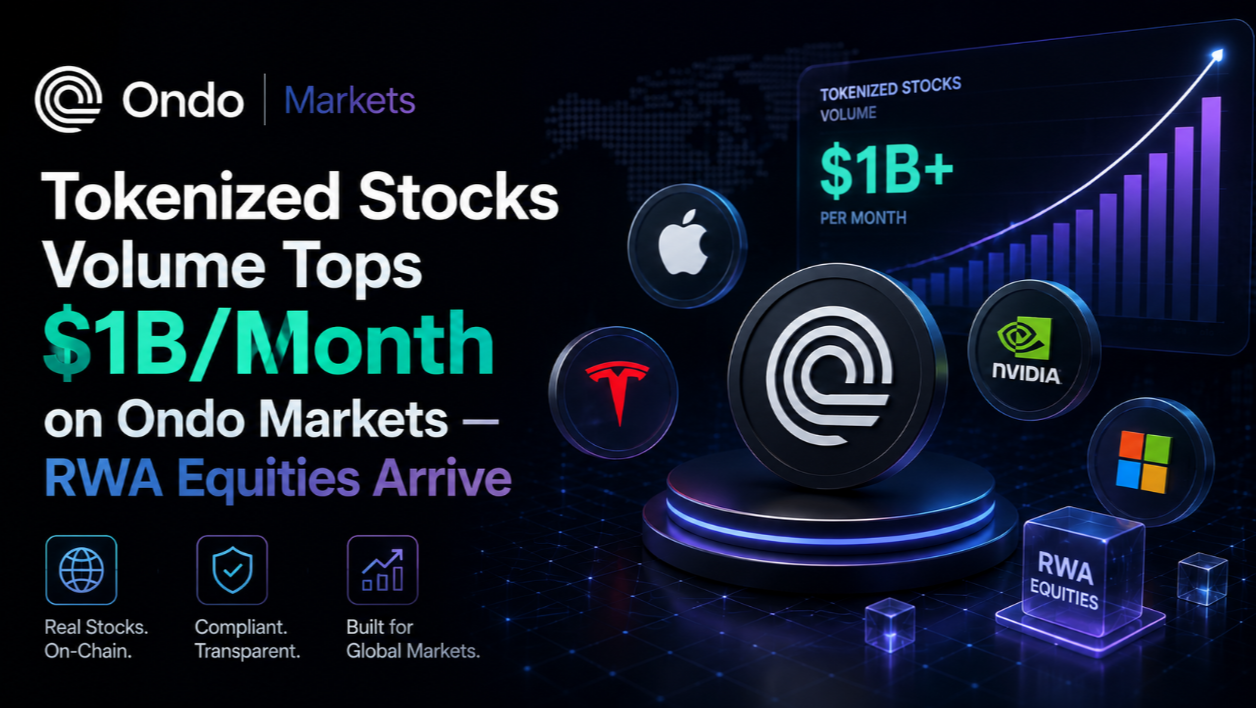
Ondo Markets crossed a landmark threshold in March 2026: the platform processed over $1 billion in monthly tokenized stock trading volume, cementing on-chain equities as a credible asset class rather than a technical experiment. The milestone comes two years after Ondo's initial stock tokenization launch and reflects growing demand from non-US investors seeking direct exposure to US equity markets through DeFi infrastructure. Follow the full market story at Ondo Finance market data.
The Problem Tokenized Stocks Solve
For investors in the United States, buying Apple or Nvidia stock is trivially easy — a few taps in any of a dozen consumer brokerage apps. For an investor in Nigeria, Argentina, Indonesia, or Ukraine, the same purchase requires navigating foreign account applications, currency conversion friction, SWIFT transfer costs, and weeks-long onboarding processes that many brokerages actively discourage for smaller accounts.
Tokenized stocks solve this access problem at the infrastructure level. A Kenyan investor with a crypto wallet and a Ondo-verified identity can buy $50 of tokenized NVDA, receive it in their wallet within seconds, and hold it alongside stablecoin savings — no US brokerage account required. The token represents genuine economic ownership: price appreciation flows through 1:1, and dividends are distributed to token holders automatically.
This access narrative explains why $1 billion in monthly volume emerged without significant US retail participation. Ondo's user base is overwhelmingly non-US: approximately 72% of active wallets are associated with IP addresses outside North America, with Latin America, Southeast Asia, and sub-Saharan Africa representing the largest cohorts.
What's Actually Trading: xStocks Product Suite
Ondo's tokenized equity product line, branded xStocks, currently covers 45 individual equities and 12 ETFs. The most actively traded are:
- xNVDA (tokenized Nvidia) — ~$180M monthly volume, driven by AI narrative
- xSPY (tokenized S&P 500 ETF) — ~$140M monthly volume, broad exposure demand
- xAAPL (tokenized Apple) — ~$95M monthly volume
- xMSFT (tokenized Microsoft) — ~$78M monthly volume
- xQQQ (tokenized Nasdaq-100 ETF) — ~$65M monthly volume
The concentration in mega-cap tech stocks mirrors global retail investor preferences rather than sophisticated portfolio construction — investors want the brands they know. Ondo plans to expand into non-US equities (Nikkei, DAX components) in H2 2026, which could significantly broaden the addressable market in Asian and European investor communities.
DeFi Composability: The Killer Feature for Institutional Adoption
The $1 billion volume figure becomes more significant when you account for what's happening beyond simple buy-and-hold. Tokenized stocks are composable: they can be deposited into lending protocols as collateral, combined with stablecoins in automated portfolio rebalancing strategies, or wrapped into structured products that traditional finance cannot easily replicate.
Maple Finance has begun accepting select xStocks as collateral for institutional credit lines, allowing token holders to borrow stablecoins against their equity positions without liquidating. See the full Maple Finance review for details on their underwriting criteria and rates.
This collateralisation use case is particularly powerful for investors in high-inflation economies. An Argentinian investor who holds tokenised US equities can now borrow USDC against that equity exposure to cover local operating expenses — effectively accessing dollar liquidity backed by dollar-denominated assets without ever touching the traditional banking system. This is a genuine financial innovation with no equivalent in legacy finance.
Regulatory Landscape: How Ondo Navigates Securities Law
Tokenized stocks are unambiguously securities under US law, and Ondo's compliance approach reflects this. The company operates through a registered transfer agent, partners with SEC-registered broker-dealers for custody, and applies a strict jurisdiction-based access control list that blocks US retail investors (who must go through standard brokerage channels) while allowing accredited international investors.
The EU's MiCA framework explicitly classifies tokenized securities as a separate category from crypto-assets, requiring authorization from national competent authorities. Ondo has pursued regulatory approval in multiple European jurisdictions, obtaining authorisation from the BaFin-regulated partner in Germany in late 2025. This paves the way for compliant European institutional adoption in 2026.
For investors researching the broader tokenization sector, Centrifuge represents the private credit equivalent of what Ondo is building for equities — tokenized real-world debt assets on-chain.
What $1B Monthly Volume Signals for the RWA Sector
Volume milestones in emerging markets tend to compound: once an asset class proves liquidity, institutional market-makers enter to tighten spreads, which attracts more volume, which justifies deeper infrastructure investment. Tokenized stocks appear to be entering this virtuous cycle.
The next threshold that market participants are watching is $10 billion monthly volume — the point at which tokenized stocks become liquid enough for institutional index products. At that scale, a passive global equities fund delivered entirely on-chain becomes operationally viable. See the Ondo Finance price forecast for how analysts are modelling the protocol's token value accrual from this growth trajectory.