
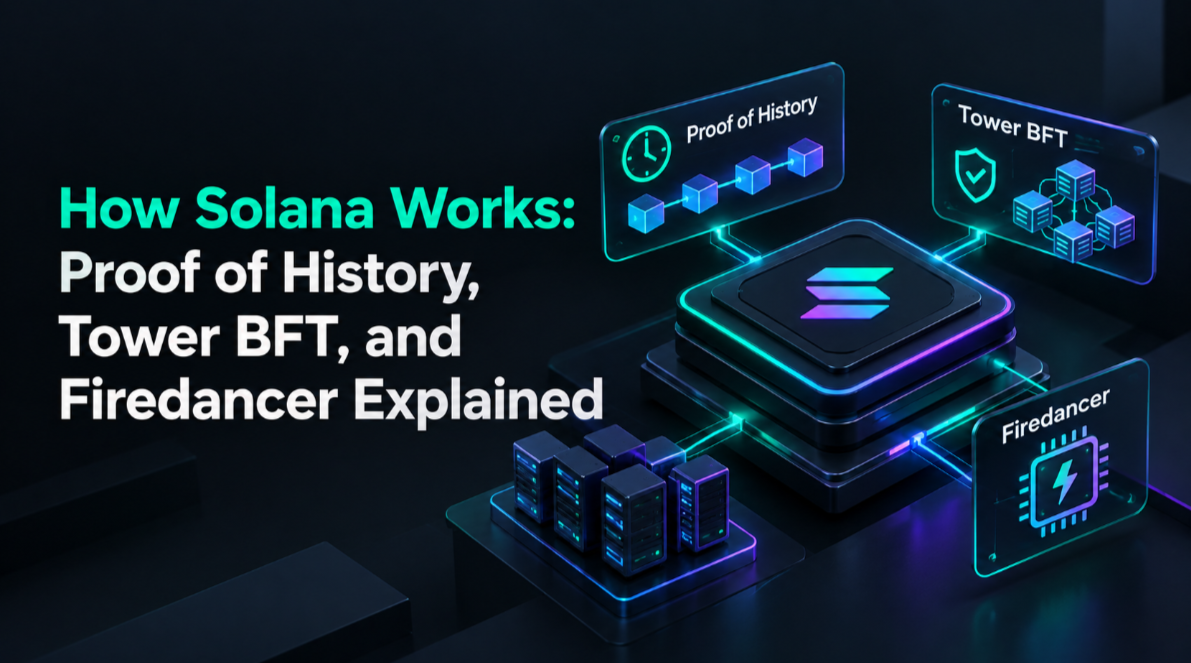
The core problem Solana was built to solve
Every blockchain faces a trilemma: it can optimise for two of three properties — security, scalability, and decentralisation — but not all three simultaneously. Ethereum chose security and decentralisation, achieving this through a relatively slow 12-second block time and single-threaded execution. Solana's founders, led by Anatoly Yakovenko, designed a system to maximise throughput while maintaining reasonable security, built around a novel cryptographic clock called Proof of History.
The result is a blockchain that processes 65,000+ transactions per second in current conditions, with 400-millisecond block times and fees below $0.001. Understanding how this works under the hood is useful for anyone evaluating Solana as an infrastructure investment or building on the chain. For current price data visit the Solana market page.
Proof of History: a cryptographic clock
The most original element of Solana's architecture is Proof of History (PoH). Traditional blockchains establish time through consensus — validators agree on block order by communicating with each other, which takes time and limits throughput. PoH replaces inter-validator time agreement with a verifiable, trustless clock.
PoH is a sequential hash chain: the output of one SHA256 computation becomes the input of the next, repeated billions of times. Each iteration is a clock tick. Because SHA256 is a one-way function that requires real CPU time, anyone can verify that a given number of hash iterations required a minimum amount of real-world time to produce. Events (transactions, votes) are hashed into this chain at specific tick positions, timestamping them without any inter-node communication.
Think of it like a record of time passing: "I hashed 1,000,000 times, and these transactions were observed between tick 600,000 and 700,000." Every validator can independently verify the ordering and timing of events because the computation itself is the proof. This removes the round-trip communication that bottlenecks other consensus mechanisms.
Tower BFT: Solana's consensus mechanism
PoH provides ordering. Finality and safety come from Tower BFT — Solana's Proof of Stake consensus built on top of the PoH clock. Tower BFT is a variant of Practical Byzantine Fault Tolerance (PBFT) adapted to leverage PoH's global clock.
Validators vote on the PoH hash they believe represents the latest valid state. Each vote carries a "lockout" — a minimum number of slots the validator must keep voting for the same fork before switching. Lockouts grow exponentially with each consecutive confirmatory vote: after 1 vote, lockout = 2 slots; after 2 votes, lockout = 4 slots; after 32 votes, lockout is effectively permanent. This makes double-voting economically irrational — the longer you've committed to one fork, the more you risk if you try to switch.
A transaction reaches "optimistic confirmation" (roughly equivalent to 6 Ethereum confirmations) in 2–3 seconds. Full "root" finality — the point where a block cannot be reverted without burning at least one-third of all staked SOL — is reached in about 31 slots (~13 seconds).
Gulf Stream: mempool-less transaction forwarding
Most blockchains have a mempool — a waiting room where unconfirmed transactions sit until a validator picks them up. Solana uses Gulf Stream to eliminate the mempool entirely. Because the next leader (the validator who will produce the next block) is known in advance from the PoH schedule, clients and validators forward transactions directly to the upcoming leaders rather than broadcasting to the entire network.
This pre-caches transactions at the leader before their slot arrives, allowing leaders to begin processing even before their turn officially starts. Gulf Stream reduces confirmation latency and eliminates the memory overhead of maintaining a large mempool, which was a bottleneck for high-throughput scenarios.
Turbine: block propagation via data shredding
Propagating large blocks to thousands of validators quickly is a serious engineering challenge. Solana solves it with Turbine, a block propagation protocol inspired by BitTorrent. Blocks are broken into small packets called "shreds" (typically 1,280 bytes). The leader sends shreds to a random set of validators, who each forward them to their own neighbourhood of peers.
This tree-like propagation means that as the validator set grows, block propagation time grows only logarithmically rather than linearly. A 128MB block can propagate to 10,000 validators faster than a simpler broadcast protocol could manage. Turbine is why Solana can maintain high throughput even with a large validator set.
Sealevel: parallel transaction execution
Most blockchain virtual machines (including the EVM) execute transactions sequentially — one at a time, in order. Solana's Sealevel runtime executes non-overlapping transactions in parallel, exploiting modern multi-core CPUs.
Each transaction on Solana must declare upfront all the accounts it will read from and write to. This declaration allows Sealevel to identify which transactions are independent (they don't touch the same accounts) and execute them simultaneously across CPU cores. Transactions that do share accounts are executed sequentially in the declared order. In practice, this means a Solana validator can process hundreds of thousands of transactions per second limited by hardware rather than protocol design.
Pipelining and the Transaction Processing Unit
Solana validators organise transaction processing into a pipeline with four specialised stages: Fetch (receive packets from the network), Verify (signature verification via GPU acceleration), Banking (execute transactions against account state), and Write (commit results to disk). Each stage runs in parallel on separate hardware units.
This is analogous to an assembly line: while stage 3 is executing one batch of transactions, stage 2 is verifying the next batch, and stage 1 is already fetching the batch after that. The pipeline keeps all hardware resources busy simultaneously rather than waiting for each batch to fully complete before starting the next.
Firedancer: the validator client revolution
For most of its existence, Solana had a single validator client — the reference implementation in Rust from Solana Labs. Client monoculture is a major risk: a bug in the single client can halt the entire network, which is exactly what happened in Solana's outages of 2021–2022.
Firedancer is a completely independent validator client written from scratch in C and C++ by Jump Crypto. It was designed with performance as the primary objective — benchmarks show Firedancer capable of processing over 1 million transactions per second in controlled environments. Beyond performance, Firedancer provides the client diversity that makes the network more resilient: a bug that crashes Solana Labs' client would not affect Firedancer-running validators, and the network would continue.
Firedancer's Frankendancer variant (combining Firedancer's networking layer with Solana Labs' execution layer) went live on mainnet in 2024. Full Firedancer mainnet deployment proceeded through 2025. By 2026, a significant portion of Solana validators run Firedancer or Frankendancer, substantially improving network resilience.
Solana's account model vs Ethereum's smart contract model
Ethereum stores both code and state inside smart contracts. Solana uses a different model: code (programs) is stored in executable accounts, while state is stored in separate data accounts owned by those programs. Programs are stateless — they read and write external accounts passed in at call time.
This separation enables Sealevel's parallel execution (accounts are the unit of conflict detection) and allows programs to be upgraded by their owner (until they are marked immutable). The trade-off is that Solana program development requires more careful account management and is architecturally unfamiliar to developers coming from Ethereum's EVM model.
Network performance in 2026: real numbers
- Average block time: 400ms (0.4 seconds)
- Theoretical peak TPS: 65,000+ (Firedancer target: 1M+)
- Average transaction fee: $0.00025
- Validator count: ~1,900 active validators globally
- Nakamoto coefficient (decentralisation measure): ~32 (improving year-on-year)
- Network uptime since January 2023: >99.9%
For a longer-term perspective on Solana network development and price trajectory see the SOL price forecast.
What Firedancer means for Solana's future
Firedancer is not just a performance upgrade — it is the foundation for Solana becoming a genuinely decentralised, high-throughput settlement layer. With two independent clients, the network can survive bugs in either. With 1M+ TPS potential, Solana can serve as the settlement layer for real-world payment networks, DePIN micropayments, and financial applications that require internet-scale throughput.
The combination of PoH as a global clock, Tower BFT as Byzantine-fault-tolerant consensus, Sealevel for parallel execution, and Firedancer for client diversity represents one of the most sophisticated blockchain engineering efforts in the industry.
This article is for educational purposes only. Not financial advice. Crypto carries significant risk of loss. Always conduct your own research.